
Myo-inositol is a powdered ingredient often used in food supplements. If you want to put it into empty capsules, the most important question is not simply “Which size holds 500 mg?” but “How much volume does my particular powder occupy?” This CAPSI guide explains capsule sizes 000–4, estimated fill weights, HPMC versus gelatin, home filling, measuring bulk density and common mistakes. All capacity figures are illustrative, not laboratory measurements of myo-inositol.
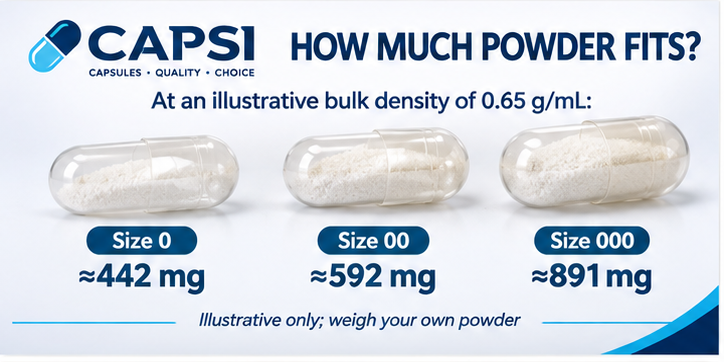
Quick answer: At an assumed bulk density of 0.65 g/mL, a size 00 capsule (0.91 mL nominal volume) holds approximately 592 mg and size 000 (1.37 mL) approximately 891 mg. Size 0 holds about 442 mg. Actual fill weights can differ considerably; weigh and test your own powder.
What is myo-inositol?
Myo-inositol is one of the naturally occurring forms of inositol, a carbohydrate-like compound present in the human body and in foods. It is available as a white crystalline powder and is sold as a supplement ingredient, including in capsule and powder formats. It is sometimes labelled simply “inositol”, although other forms of inositol exist.
This article focuses on capsule selection and powder handling, not whether myo-inositol is appropriate for a particular health condition. Research into myo-inositol and metabolic or reproductive health is ongoing; evidence varies by outcome and population. Do not interpret a capsule-size example as a recommended dose. If you take medication, are pregnant, or are managing a medical condition, discuss supplement use with a qualified clinician.
Myo-inositol powder: what matters when filling capsules?
- Bulk density: the mass of loose powder per unit volume, usually expressed in g/mL. This determines the starting estimate for capsule capacity.
- Particle size and flow: fine or clumpy powder can bridge over filling holes, settle unevenly or require repeated levelling.
- Moisture: keep powder, shells and equipment dry and follow the ingredient supplier’s storage guidance.
- Fill technique: tapping or tamping can change the mass that fits, but excessive compaction may prevent proper closing.
- Accuracy: a capsule looking full does not prove that it contains the intended mass.
Myo-inositol capsule size chart: sizes 000 to 4
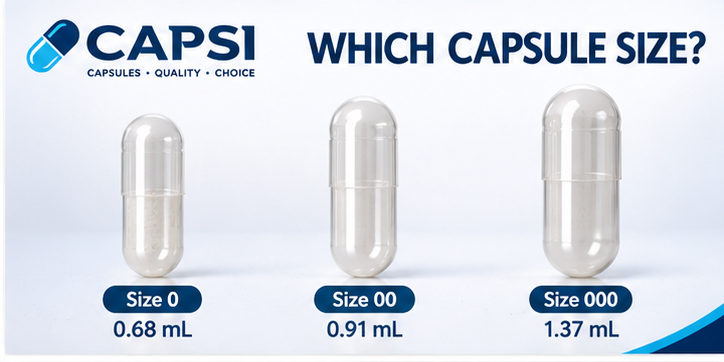
The table below uses CAPSI nominal capsule volumes and three hypothetical loose-powder bulk densities: 0.50, 0.65 and 0.80 g/mL. These are calculation scenarios, not a tested density range for any specific myo-inositol product.
| Capsule size | Nominal volume | 0.50 g/mL | 0.65 g/mL | 0.80 g/mL |
|---|---|---|---|---|
| 000 | 1.37 mL | 685 mg | 891 mg | 1,096 mg |
| 00 | 0.91 mL | 455 mg | 592 mg | 728 mg |
| 0 | 0.68 mL | 340 mg | 442 mg | 544 mg |
| 1 | 0.50 mL | 250 mg | 325 mg | 400 mg |
| 2 | 0.37 mL | 185 mg | 241 mg | 296 mg |
| 3 | 0.30 mL | 150 mg | 195 mg | 240 mg |
| 4 | 0.21 mL | 105 mg | 137 mg | 168 mg |
Formula: estimated powder mass (mg) = capsule volume (mL) × bulk density (g/mL) × 1,000. Real usable volume and final fill mass depend on shell tolerances, powder behaviour and filling technique. The numbers above should never replace a measured trial fill.
Which capsule size is best for 500 mg of myo-inositol?
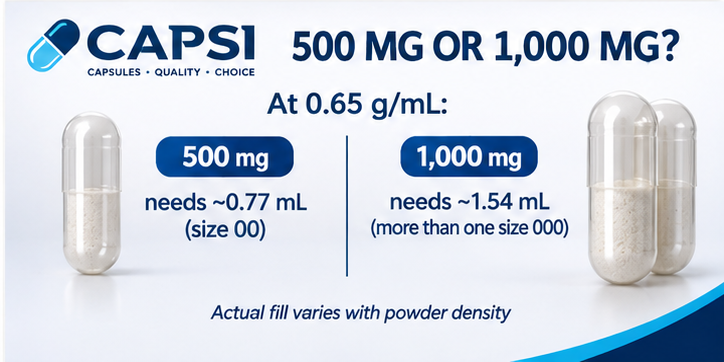
For a 500 mg target, the required volume depends on the measured density. At 0.50 g/mL, it is approximately 1.00 mL, which is larger than size 00 and within the nominal volume of size 000. At 0.65 g/mL, it is approximately 0.77 mL, which fits nominal size 00 but not size 0. At 0.80 g/mL, it is approximately 0.63 mL, which fits nominal size 0. These are geometric comparisons, not guarantees that a real fill will succeed.
Can a 1,000 mg serving fit in one capsule?
At 0.50 g/mL, 1,000 mg occupies about 2.00 mL; at 0.65 g/mL, about 1.54 mL; and at 0.80 g/mL, about 1.25 mL. Only the last scenario is within size 000’s nominal 1.37 mL volume. At 0.65 g/mL, even size 000 is too small for a single 1,000 mg fill, so more than one capsule would be needed. This is a packaging calculation, not a suggested daily intake.
How to measure your myo-inositol powder’s bulk density
If the supplier provides a reliable loose bulk-density specification for your exact ingredient batch, use that as a starting point. Otherwise, a small measured-volume trial can give a rough estimate:
- Use a clean, dry graduated vessel with sufficient precision for the sample size.
- Weigh the empty vessel, add a known volume of loosely poured powder without deliberate compression, then weigh again.
- Subtract the vessel mass to obtain the powder mass in grams.
- Divide mass (g) by occupied volume (mL) to estimate loose bulk density (g/mL). Repeat several times.
- Calculate a theoretical capsule fill, then check it by filling and weighing several real capsules.
Example: 13 g of loosely poured powder occupying 20 mL gives 13 ÷ 20 = 0.65 g/mL. This example is hypothetical and does not establish myo-inositol’s actual density. A kitchen measuring spoon is generally too imprecise for reliable small-volume density measurements.
HPMC vegetarian capsules or gelatin capsules?
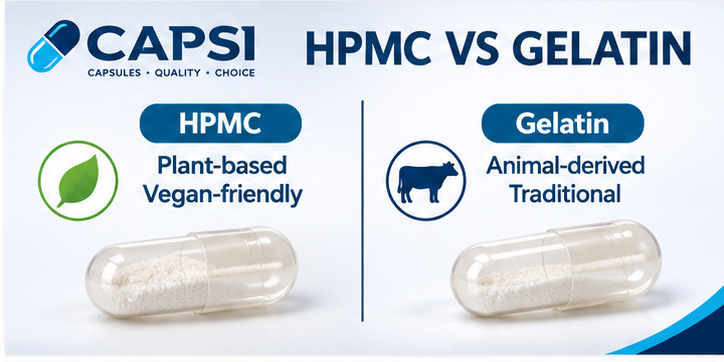
Both CAPSI HPMC and gelatin hard capsule shells can be used with many dry powders, provided the ingredient and shell are compatible and stored appropriately. The choice is usually driven by dietary preference, shell specifications, handling and intended market.
| Feature | HPMC capsules | Gelatin capsules |
|---|---|---|
| Source | Plant-derived cellulose polymer | Animal-derived gelatin |
| Dietary suitability | Generally suitable for vegetarian and vegan preferences; check complete product specification | Not vegetarian or vegan |
| Appearance | Available in clear shell options | Available in clear shell options |
| Fill weight | Depends mainly on capsule volume and powder properties | Depends mainly on capsule volume and powder properties |
| Handling | Follow manufacturer humidity and storage guidance | Follow manufacturer humidity and storage guidance |
Neither shell material automatically allows a higher myo-inositol dose in the same nominal capsule size. For a like-for-like comparison, use the same size and confirm the individual product’s technical specifications.
How to fill myo-inositol capsules at home
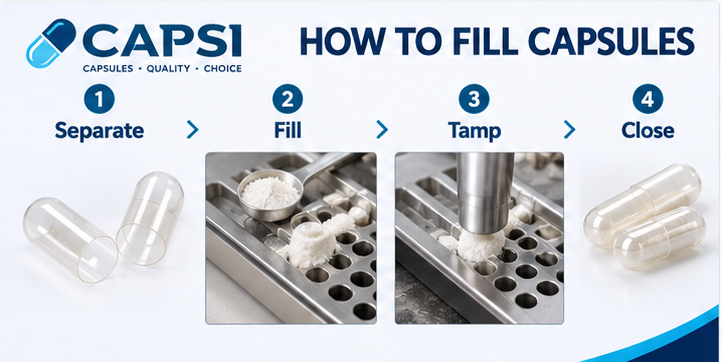
- Prepare: clean and dry the work surface, filling tray, utensils and hands. Check capsule size compatibility with the tray.
- Separate: gently remove the capsule caps and position the bodies upright in the tray.
- Fill: add powder evenly across the bodies, then level using the filling tool.
- Tamp only if appropriate: if the device supports it, use gentle, consistent pressure and add more powder as needed. Avoid forcing capsules shut.
- Close: replace the caps and check that each capsule is fully engaged and undamaged.
- Check: weigh a sample of filled capsules and subtract the average empty-shell mass to estimate net fill. Inspect for large variations.
How to check fill weight and consistency
For a practical quality check, weigh a number of empty shells of the same size and batch to estimate their average mass. Fill a test group using the same technique, weigh each filled capsule, and subtract the empty-shell estimate. A sufficiently precise calibrated scale is essential; ordinary kitchen scales generally cannot measure individual capsule fills accurately. For commercial manufacture, use validated equipment, sampling plans and applicable quality standards rather than this basic home method.
Common capsule-filling problems and solutions
| Problem | Likely cause | What to check |
|---|---|---|
| Capsule will not close | Overfilled body, powder on rim or misaligned cap | Remove excess powder, clean rim and align cap |
| Different weights between capsules | Uneven powder distribution or variable tamping | Use consistent levelling, weigh samples and reassess process |
| Powder spills or clumps | Poor flow, static or moisture exposure | Keep equipment dry; inspect ingredient and handling conditions |
| Target mass does not fit | Actual powder density lower than assumed | Measure density and consider a larger capsule or multiple capsules |
| Shells soften or become brittle | Unsuitable storage conditions | Follow the shell supplier’s temperature and humidity guidance |
Storage, labelling and safety
Store empty shells and filled capsules in suitable closed packaging, away from moisture, heat and direct sunlight, following the shell and ingredient suppliers’ specifications. Label filled capsules clearly with the ingredient, batch and relevant preparation information. For products offered for sale, UK food-supplement, labelling, safety and claims rules may apply; home-filling advice is not a substitute for a compliant commercial manufacturing process.
Frequently asked questions
Does size 0 hold 500 mg of myo-inositol?
Only if the actual powder and filling process achieve a high enough density. Size 0 is 0.68 mL nominally, so 500 mg requires approximately 0.74 g/mL. At the illustrative 0.65 g/mL scenario, size 0 holds about 442 mg.
Is size 00 a good starting point?
Size 00 is a useful trial size for many powder-filling projects because it has a nominal capacity of 0.91 mL. At 0.65 g/mL it corresponds to approximately 592 mg, but your measured result may differ.
Can size 000 hold 1,000 mg?
Possibly, but not for every powder. A 1,000 mg fill requires at least about 0.73 g/mL in size 000’s nominal 1.37 mL volume. At 0.65 g/mL, the estimated capacity is only about 891 mg.
Do vegetarian capsules hold less than gelatin capsules?
Not necessarily. Capacity is primarily a function of the individual capsule’s internal volume and the powder’s density. Compare actual shell specifications and conduct trial fills.
Can I use a capsule filling machine?
Yes, provided the machine or tray is designed for the chosen capsule size. Confirm the size before purchasing or setting up the equipment, and check filled weights rather than relying only on appearance.
Is 500 mg or 1,000 mg the right amount to take?
These quantities are used here solely to illustrate capsule volume. Appropriate supplement use depends on individual circumstances and professional advice; this guide does not recommend a dose.
CAPSI capsule tools and further reading
Use the CAPSI Capsule Size Calculator to compare estimated capacities, and consult the CAPSI Creatine Guide for another example of why powder density matters when selecting capsules.
Editorial note: All mg capacities in this article are theoretical calculations using stated hypothetical bulk densities. CAPSI has not presented them as measured fill-weight specifications for myo-inositol. Always verify the exact powder, capsule shell and filling method before use.