
Hydration Powder Capsule Sizes
Hydration powders have become increasingly popular among athletes, gym-goers, runners, hikers, and everyday consumers looking to maintain proper electrolyte balance. While most hydration products are designed to be mixed with water, many people prefer encapsulating hydration powders for convenience, portability, or to avoid strong flavours.
If you’re wondering what capsule size works best for hydration powder, this guide explains everything you need to know—including capsule capacities, how many capsules you’ll need, filling tips, and whether hydration powders are suitable for encapsulation.
What Is Hydration Powder?
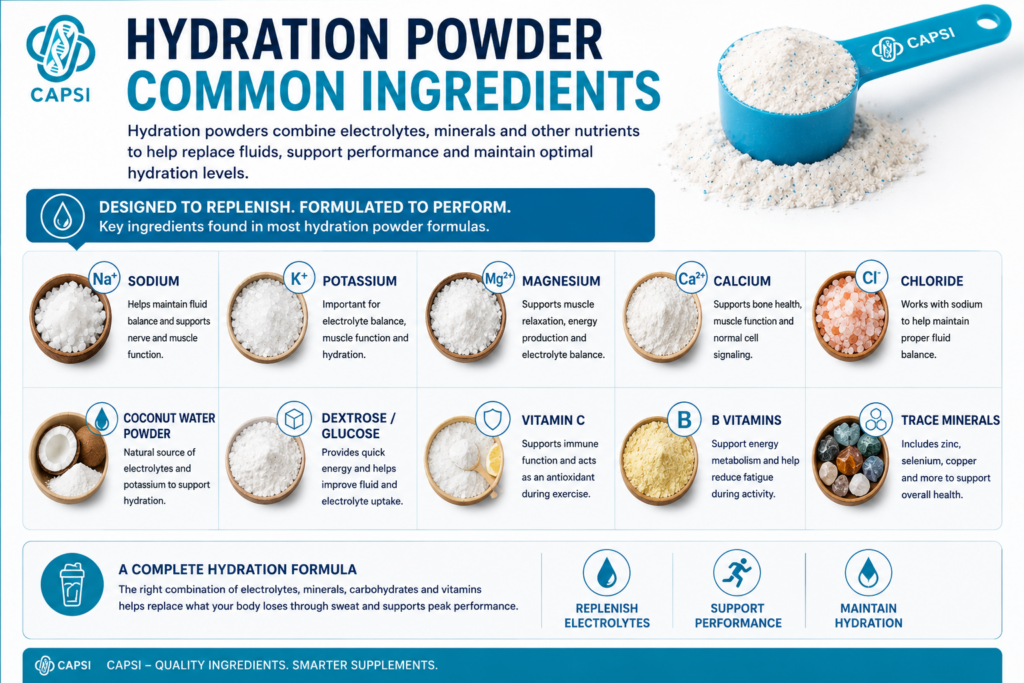
Hydration powder is a supplement blend formulated to help replace electrolytes and support fluid balance in the body. These products are particularly useful after exercise, during hot weather, or whenever fluid losses increase.
Common ingredients found in hydration powders include:
- Sodium chloride
- Potassium citrate
- Magnesium citrate
- Calcium salts
- Coconut water powder
- Dextrose or glucose
- Vitamin C
- B vitamins
- Trace minerals
- Amino acids
- Taurine
Hydration formulas can vary significantly between products. Some focus purely on electrolytes, while others contain carbohydrates, vitamins, or performance-enhancing ingredients.
Can Hydration Powder Be Put Into Capsules?
Yes, hydration powder can be placed into capsules, although there are some important considerations.
Unlike concentrated supplements that require only a few hundred milligrams, hydration formulas often have serving sizes of several grams. This means multiple capsules are usually required to equal a single serving.
Capsules are particularly useful for:
- Travelling
- Hiking and outdoor activities
- Taking electrolytes without flavoured drinks
- Custom supplement formulations
- Portable on-the-go use
However, remember that capsules provide electrolytes—not water itself. Adequate fluid intake remains essential for hydration.
Why Do People Encapsulate Hydration Powder?
There are several reasons why consumers choose capsules over drink mixes.
1. Improved Convenience
Capsules are easy to transport and require no mixing. They can be stored in small containers or travel organisers.
2. Avoid Strong Flavours
Many electrolyte products have salty or artificial flavours that some users dislike.
3. Precise Dosing
Encapsulation allows users to create custom hydration blends with exact ingredient ratios.
4. Reduced Sugar Intake
Some hydration drinks contain sweeteners or sugars. Capsules allow users to avoid these additives if desired.
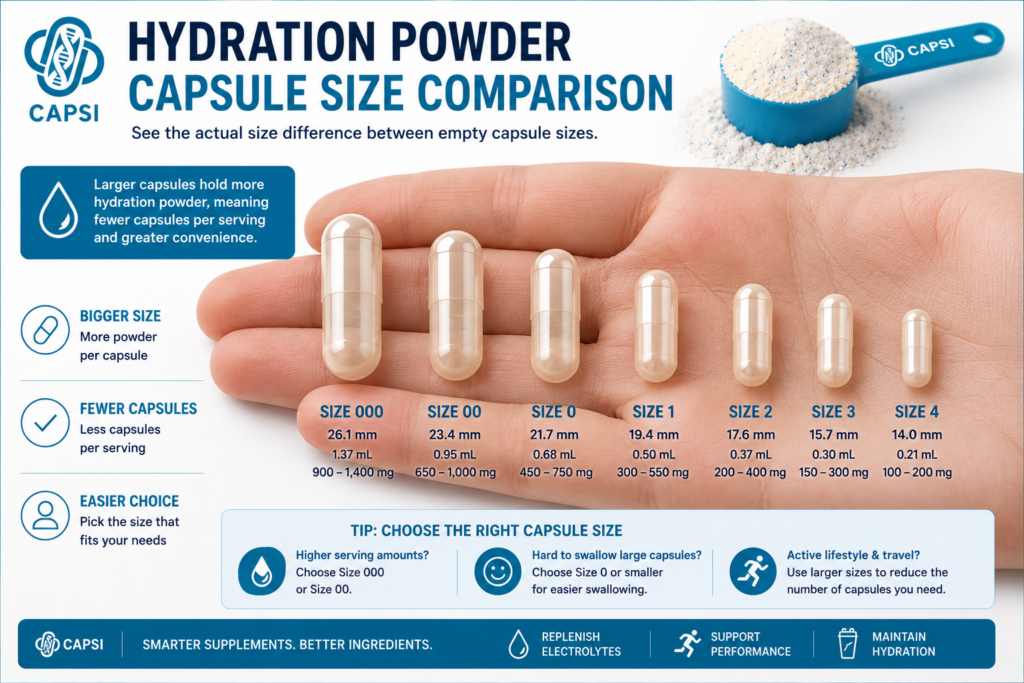
Best Capsule Sizes for Hydration Powder
The best capsule size depends on the density of your specific hydration formula.
Hydration powders containing mineral salts are often relatively dense, while ingredients like coconut water powder and carbohydrates are fluffier.
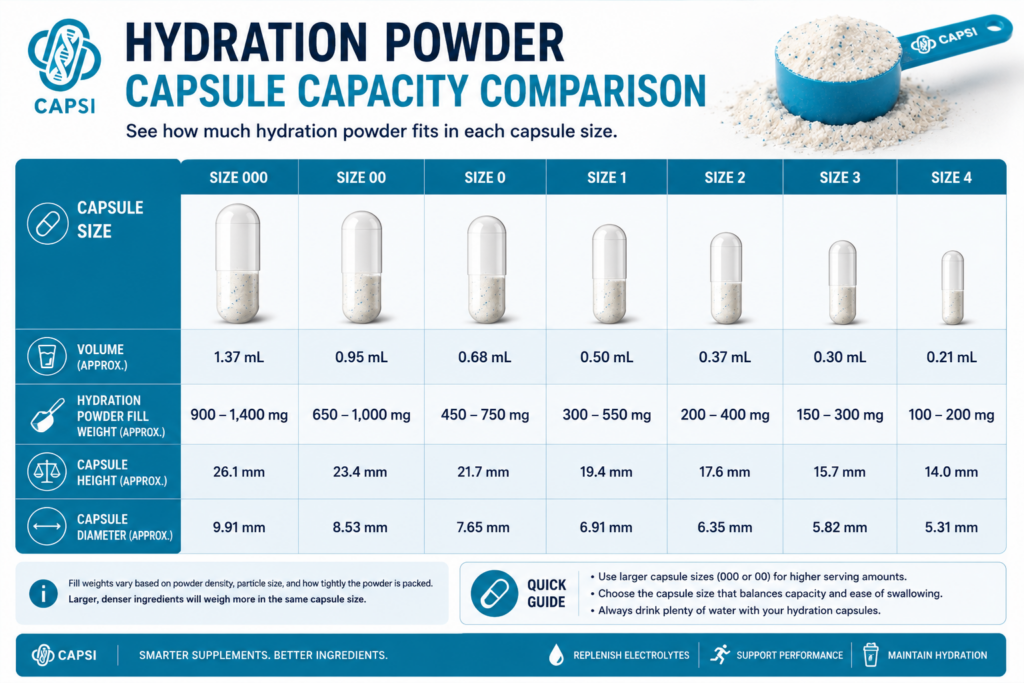
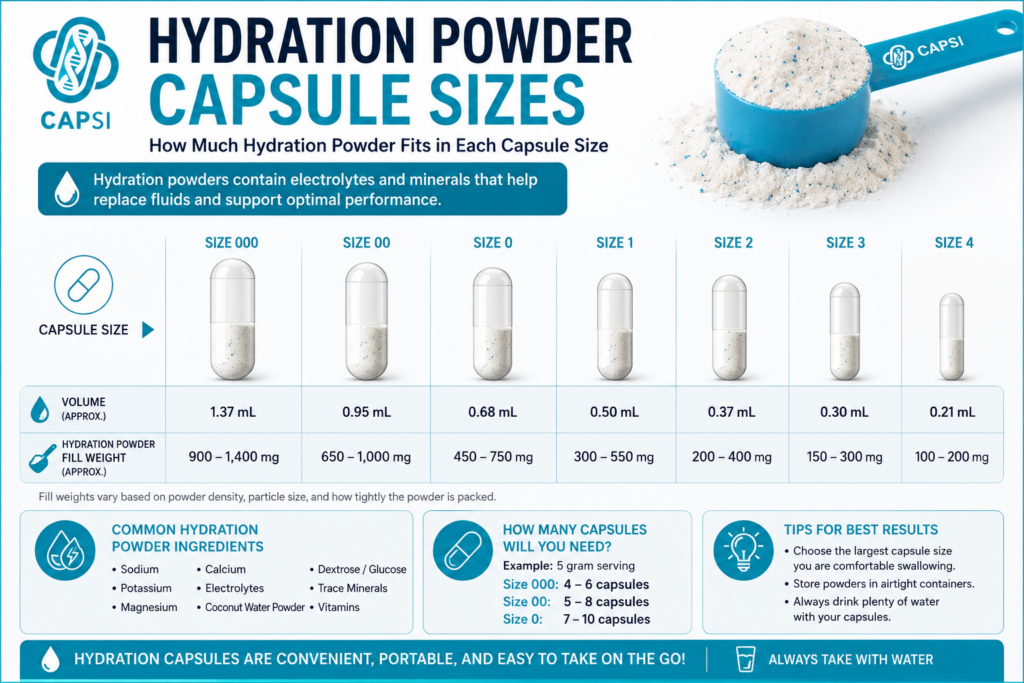
Capsule Size Capacity Table
| Capsule Size | Volume | Approximate Fill Weight |
|---|---|---|
| Size 000 | 1.37 mL | 900–1,400 mg |
| Size 00 | 0.95 mL | 650–1,000 mg |
| Size 0 | 0.68 mL | 450–750 mg |
| Size 1 | 0.50 mL | 300–550 mg |
| Size 2 | 0.37 mL | 200–400 mg |
| Size 3 | 0.30 mL | 150–300 mg |
| Size 4 | 0.21 mL | 100–200 mg |
Actual fill weights vary depending on powder density and compression.
Which Capsule Size Is Best?
Size 000 Capsules
Size 000 capsules are the largest commonly available capsule size and are ideal for high-dose hydration formulas.
Advantages:
- Maximum capacity
- Fewer capsules per serving
- Suitable for large electrolyte doses
Disadvantages:
- Larger size may be harder to swallow for some users
Size 00 Capsules
Size 00 is the most popular capsule size worldwide.
Advantages:
- Good balance of capacity and swallowability
- Widely available
- Compatible with most capsule filling machines
Size 0 Capsules
Size 0 capsules work well for concentrated mineral formulations or smaller electrolyte doses.
How Many Capsules Will You Need?
Hydration formulas often have large serving sizes.
Example: 2-Gram Serving
| Capsule Size | Capsules Needed |
|---|---|
| 000 | 2–3 |
| 00 | 2–4 |
| 0 | 3–5 |
Example: 5-Gram Serving
| Capsule Size | Capsules Needed |
|---|---|
| 000 | 4–6 |
| 00 | 5–8 |
| 0 | 7–10 |
Example: 10-Gram Serving
| Capsule Size | Capsules Needed |
|---|---|
| 000 | 8–12 |
| 00 | 10–15 |
| 0 | 14–20 |
Because hydration supplements can require multiple grams per serving, many users choose size 000 capsules to reduce capsule count.
Factors Affecting Capsule Capacity
Powder Density
Dense ingredients occupy less space and allow higher fill weights.
Examples of dense ingredients:
- Sodium chloride
- Potassium citrate
- Magnesium citrate
Lower-density ingredients include:
- Coconut water powder
- Dextrose
- Fruit powders
Particle Size
Finely milled powders pack more efficiently into capsules than coarse powders.
Moisture Absorption
Electrolyte powders are often hygroscopic, meaning they absorb moisture from the air.
This can:
- Cause clumping
- Reduce flowability
- Affect fill consistency
Store powders in airtight containers with desiccants where appropriate.
Compression During Filling
Manual capsule fillers can lightly tamp powders to increase fill weight.
Approximate Ingredient Weights by Capsule Size
Sodium Chloride
| Capsule Size | Approximate Weight |
|---|---|
| 000 | 1,000–1,400 mg |
| 00 | 800–1,000 mg |
| 0 | 600–750 mg |
Potassium Citrate
| Capsule Size | Approximate Weight |
|---|---|
| 000 | 900–1,300 mg |
| 00 | 700–900 mg |
| 0 | 500–700 mg |
Magnesium Citrate
| Capsule Size | Approximate Weight |
|---|---|
| 000 | 700–1,100 mg |
| 00 | 500–800 mg |
| 0 | 400–600 mg |
Coconut Water Powder
| Capsule Size | Approximate Weight |
|---|---|
| 000 | 600–1,000 mg |
| 00 | 400–700 mg |
| 0 | 300–500 mg |
Hydration Powder Formulations Suitable for Capsules
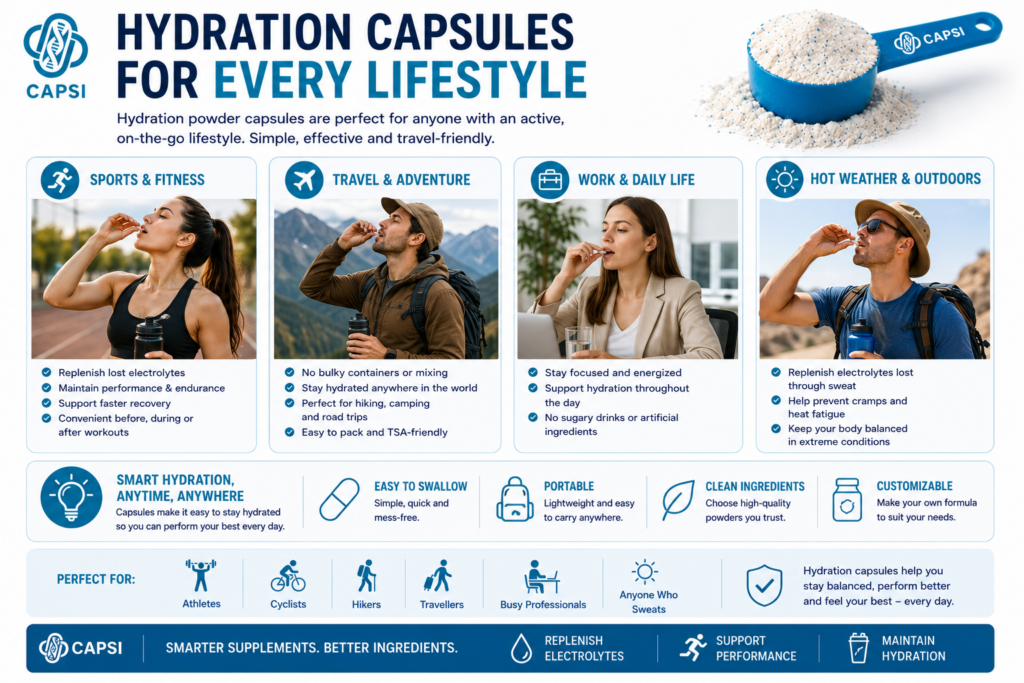
Hydration capsules are especially useful for:
- Running events
- Cycling
- Hiking
- Travel
- Fasting
- Ketogenic diets
- Electrolyte supplementation
Athletes often carry electrolyte capsules during endurance events where mixing drinks may be inconvenient.
Gelatin vs Vegetarian Capsules
Hydration powders can be encapsulated in either gelatin or HPMC capsules.
Gelatin Capsules
Benefits:
- Lower cost
- Fast dissolution
- Easy filling
HPMC Capsules
Benefits:
- Suitable for vegans
- Plant-based
- Better stability under varying humidity conditions
Both capsule types work well with electrolyte blends.
How to Fill Hydration Powder Capsules
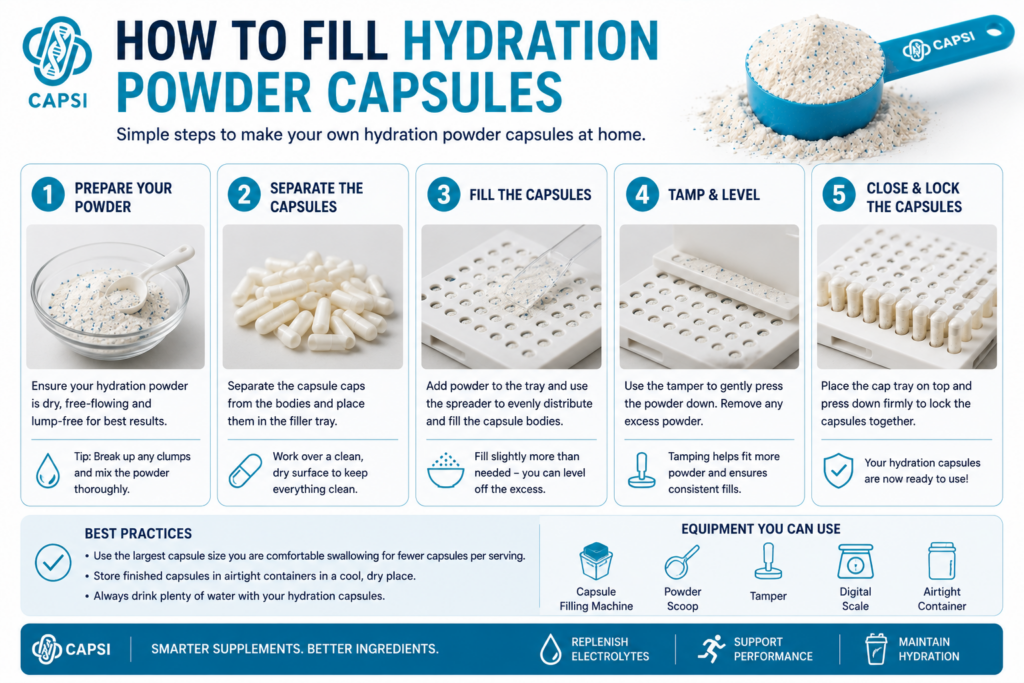
Step 1: Choose Your Capsule Size
For most users:
- Size 000 = maximum capacity
- Size 00 = best all-round choice
Step 2: Prepare Powder
Ensure powder is:
- Dry
- Free-flowing
- Lump-free
Step 3: Use a Capsule Filling Machine
Capsule fillers increase speed and consistency.
Step 4: Weigh Finished Capsules
Check capsule weights using a digital scale to ensure accuracy.
Step 5: Store Correctly
Keep capsules in:
- Airtight containers
- Cool, dry environments
- Away from direct sunlight
Are Hydration Capsules Effective?
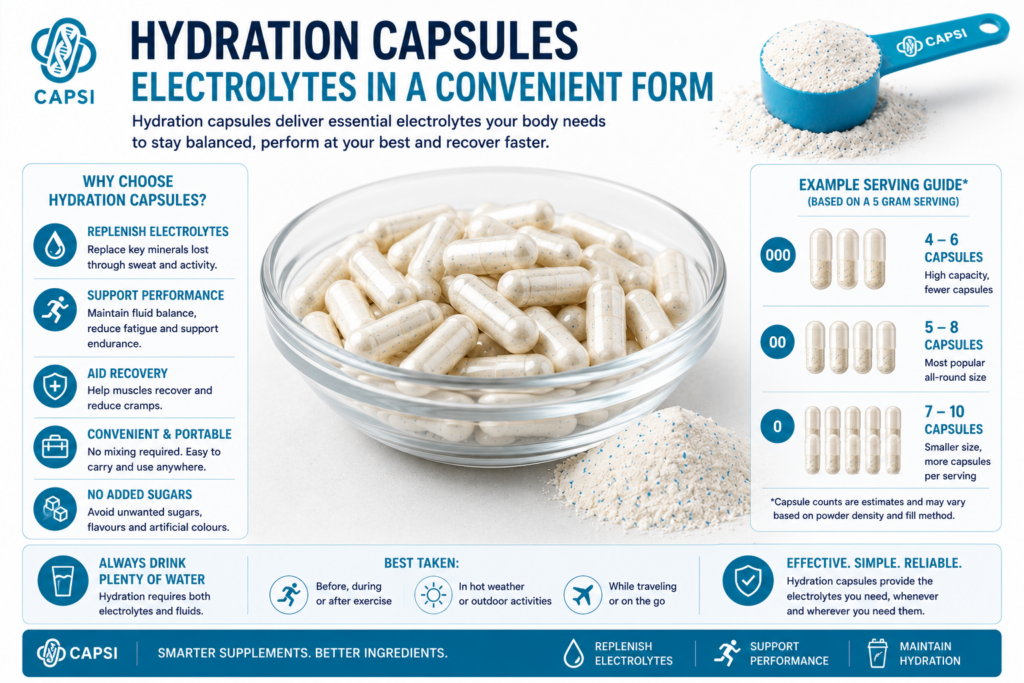
Yes. Capsules deliver electrolytes effectively and are widely used by athletes.
However, hydration requires both:
- Electrolytes
- Adequate fluid intake
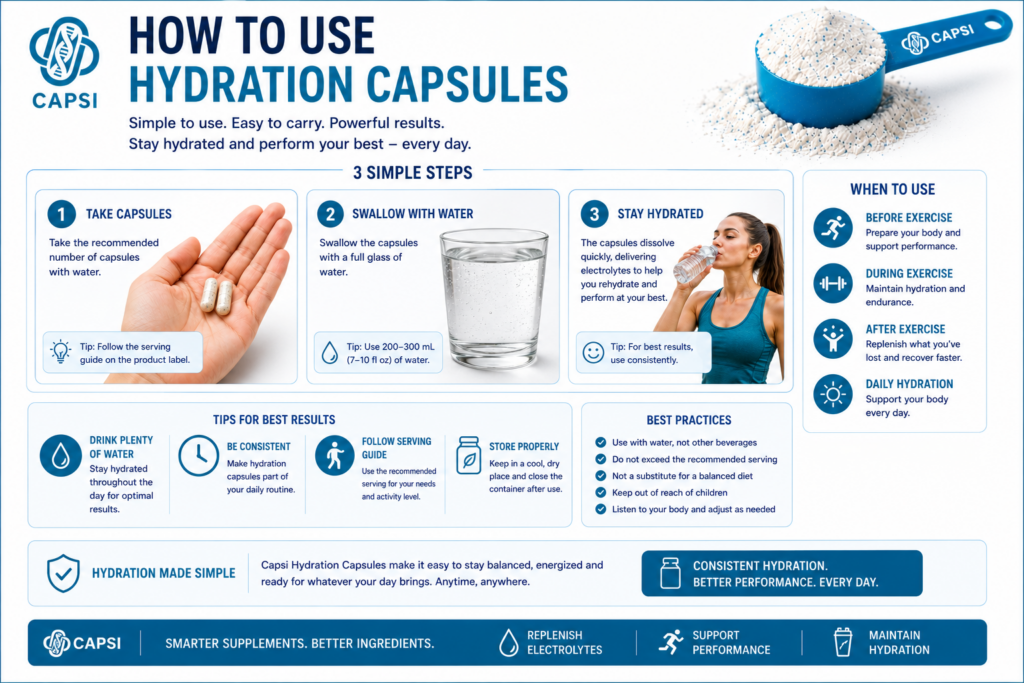
Hydration capsules should always be consumed with water.
Advantages of Hydration Capsules
- Portable
- No mixing required
- Easy travel use
- Precise dosing
- No artificial flavours
- Reduced sugar intake
Potential Drawbacks
- Multiple capsules may be required
- Slower than drinking electrolyte beverages
- Water must still be consumed separately
Recommended Capsule Size for Hydration Powder
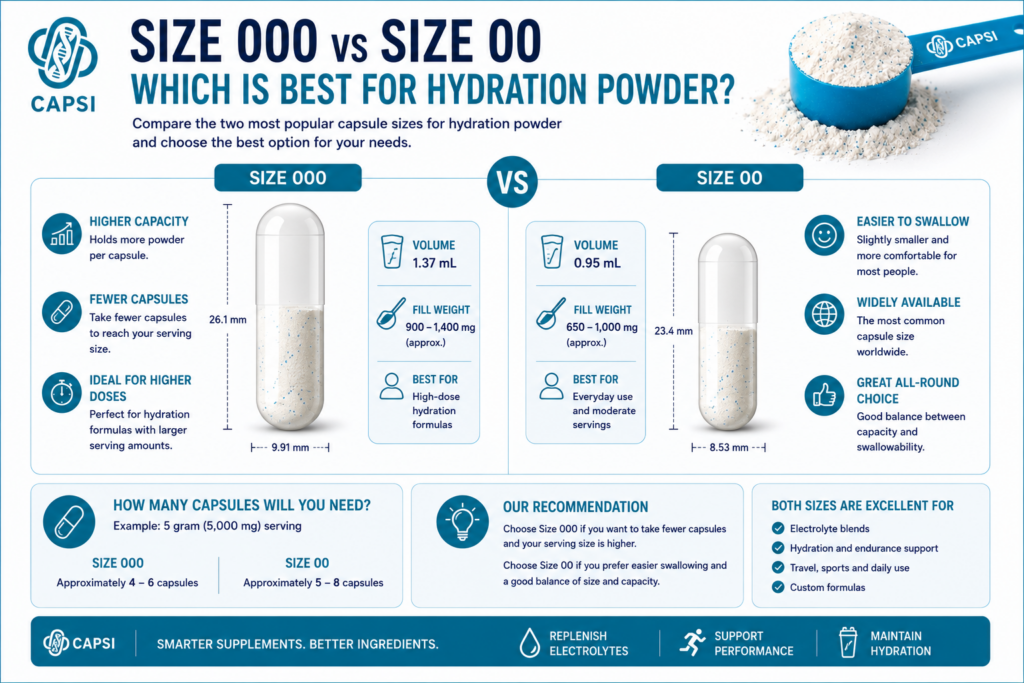
For most hydration formulas:
Best Choice: Size 000 Capsules
- Highest capacity
- Fewer capsules needed
Alternative: Size 00 Capsules
- Easier to swallow
- Most popular option
Frequently Asked Questions
What capsule size is best for hydration powder?
Size 000 is generally best because hydration formulas often require larger doses.
How much hydration powder fits in a size 00 capsule?
Typically between 650–1,000 mg depending on density.
Can electrolyte powder be encapsulated?
Yes. Many athletes use electrolyte capsules for convenience and portability.
Are hydration capsules as effective as drinks?
They provide electrolytes effectively but should always be taken with water.
Can hydration powders absorb moisture?
Yes. Many electrolyte ingredients are hygroscopic and should be stored carefully.
Which capsule material is best?
Both gelatin and HPMC capsules perform well for hydration ingredients.
Final Thoughts
Hydration powders can be successfully encapsulated using empty capsules, making them a convenient alternative to drink mixes. Because hydration formulas often contain several grams of ingredients, larger capsule sizes such as 000 and 00 are typically recommended.
For most users, size 000 capsules offer the best balance between capacity and practicality, while size 00 capsules remain the most popular all-round choice.
Whether you’re creating custom electrolyte blends, preparing for endurance events, or looking for a flavour-free alternative, choosing the correct capsule size can make encapsulation easier and more effective.