
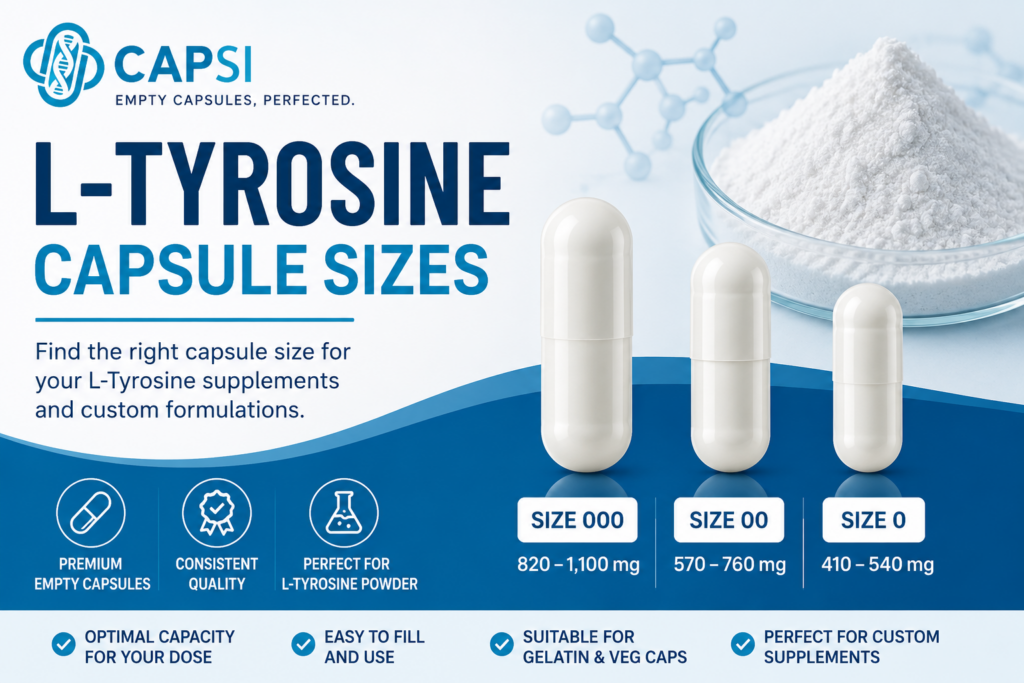
L-Tyrosine is one of the most popular amino acids used in sports nutrition, nootropic supplements, and wellness formulas. Whether you’re making your own capsules at home or developing a commercial supplement, choosing the correct capsule size is essential for achieving accurate dosing and an optimal user experience.
Because L-Tyrosine powder has a moderate bulk density, the amount that fits into an empty capsule can vary significantly depending on the capsule size and how densely the powder is packed. In this guide, we’ll explain how much L-Tyrosine fits into each capsule size, which capsule size is best for common doses, and how to fill capsules efficiently.
What Is L-Tyrosine?
L-Tyrosine is a naturally occurring amino acid that the body uses to produce several important compounds, including:
- Dopamine
- Norepinephrine
- Epinephrine (adrenaline)
- Thyroid hormones
- Melanin
Although the body can synthesize L-Tyrosine from phenylalanine, supplementation has become increasingly popular among athletes, students, shift workers, and individuals seeking cognitive support.
L-Tyrosine supplements are commonly used in:
- Pre-workout formulas
- Nootropic stacks
- Cognitive support supplements
- Stress management products
- Energy formulas
- Amino acid blends
Due to its versatility, L-Tyrosine is frequently encapsulated into gelatin or vegetarian capsules for convenient dosing.
Why Capsule Size Matters for L-Tyrosine
Selecting the correct capsule size is important because it directly affects:
- The number of capsules required per serving
- Ease of swallowing
- Manufacturing efficiency
- Packaging requirements
- Customer satisfaction
Using a capsule that is too small may require multiple capsules per serving, while using a capsule that is too large may make swallowing difficult for some users.
Finding the right balance is therefore crucial.
Understanding L-Tyrosine Powder Density
The amount of powder that fits into a capsule depends on its bulk density. Bulk density refers to how much a powder weighs relative to the space it occupies.
L-Tyrosine powder typically has a bulk density of approximately:
0.60–0.80 g/mL
However, the exact density can vary depending on:
- Manufacturer
- Milling process
- Moisture content
- Particle size
- Powder flow characteristics
Because of these variations, capsule fill weights should always be viewed as estimates rather than exact values.
Standard Empty Capsule Sizes
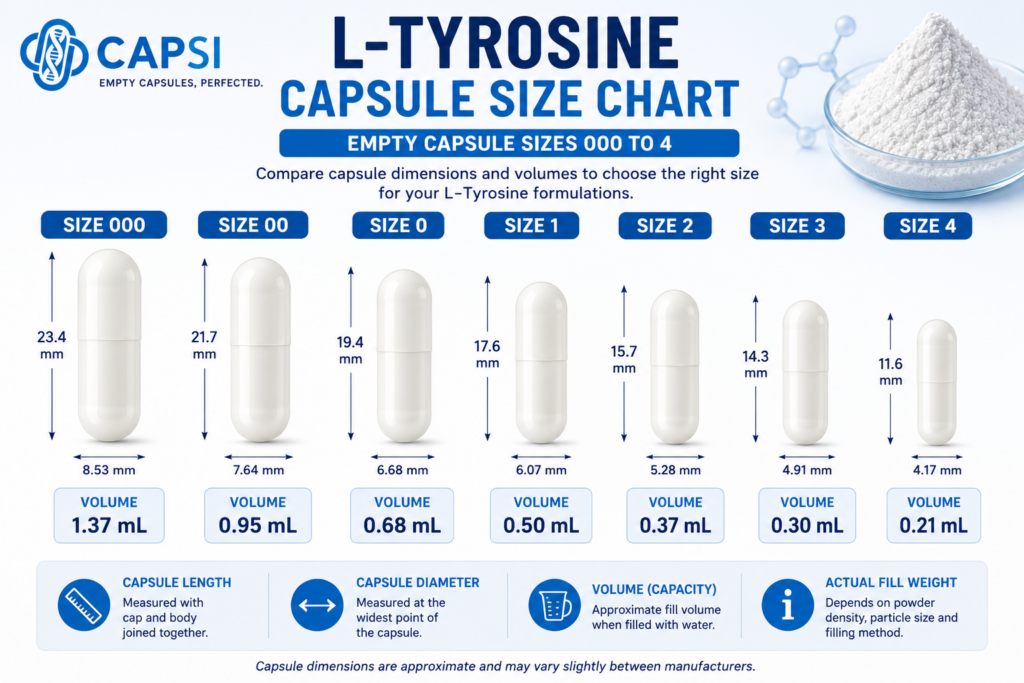
The most common capsule sizes used for nutritional supplements are:
| Capsule Size | Volume (mL) |
|---|---|
| 000 | 1.37 mL |
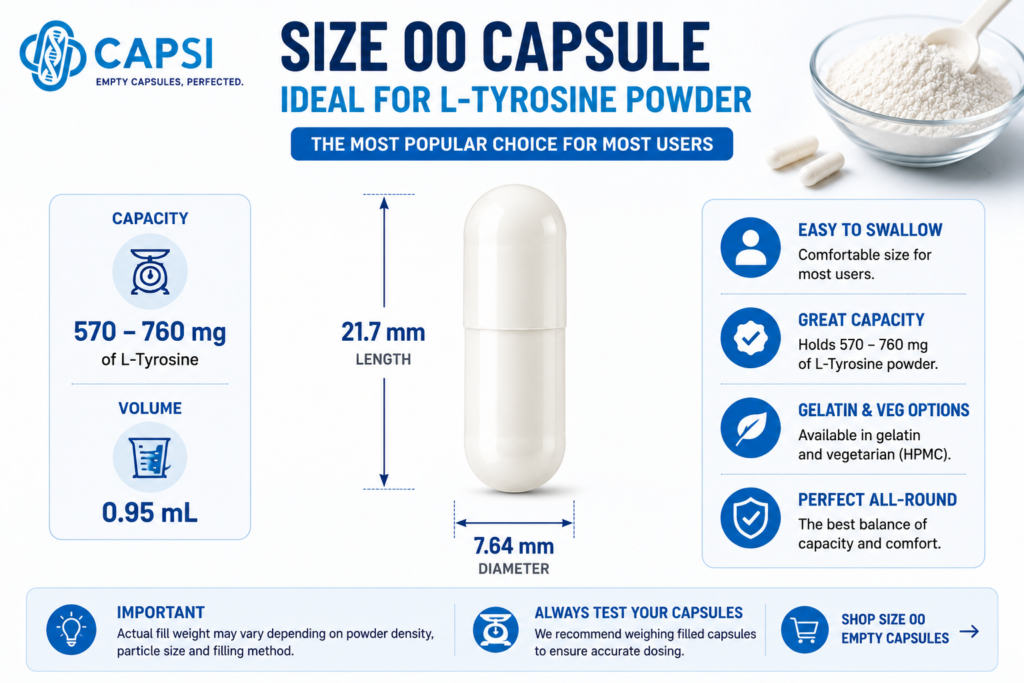
| 00 | 0.95 mL |
| 0 | 0.68 mL |
| 1 | 0.50 mL |
| 2 | 0.37 mL |
| 3 | 0.30 mL |
| 4 | 0.21 mL |
Larger capsule numbers actually indicate smaller capsules. For example, size 000 is the largest commonly used capsule, while size 4 is much smaller.
L-Tyrosine Capsule Size Chart
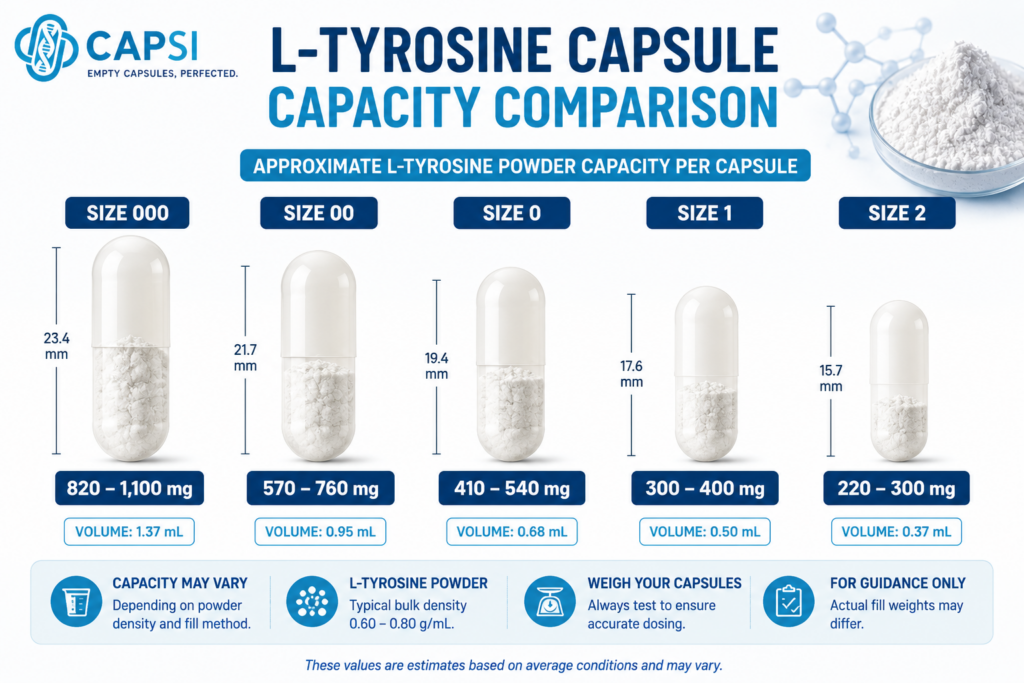
The following estimates assume average powder density and standard filling methods.
| Capsule Size | Approximate L-Tyrosine Fill Weight |
|---|---|
| Size 000 | 820–1,100 mg |
| Size 00 | 570–760 mg |
| Size 0 | 410–540 mg |
| Size 1 | 300–400 mg |
| Size 2 | 220–300 mg |
| Size 3 | 180–240 mg |
| Size 4 | 125–170 mg |
Actual fill weights may differ depending on your specific powder and equipment.
Which Capsule Size Is Best for L-Tyrosine?
Size 000 Capsules
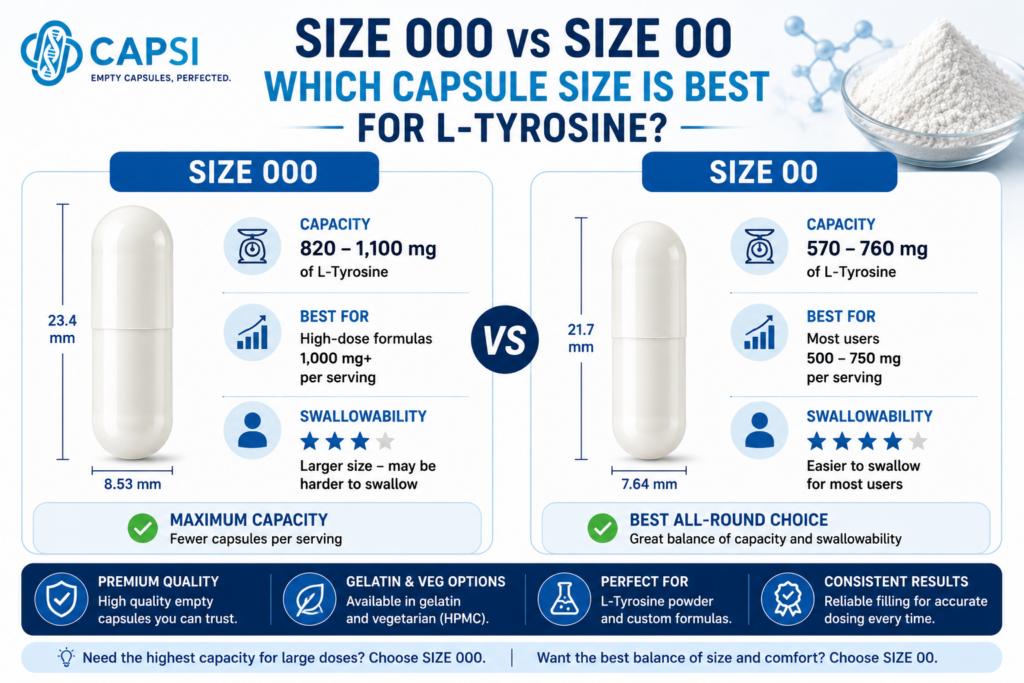
Size 000 capsules are the largest standard capsule available and are ideal for high-dose L-Tyrosine supplementation.
Typical capacity:
- Approximately 820–1,100 mg of L-Tyrosine
Advantages:
- Can accommodate large servings
- Reduces the number of capsules required
- Suitable for advanced formulations
Disadvantages:
- Larger size may be harder to swallow for some individuals
Size 00 Capsules
Size 00 capsules are often considered the industry standard for dietary supplements.
Typical capacity:
- Approximately 570–760 mg
Advantages:
- Excellent balance between size and capacity
- Comfortable for most users to swallow
- Compatible with most capsule filling machines
For many L-Tyrosine products, size 00 capsules provide the best overall solution.
Size 0 Capsules
Size 0 capsules are smaller and easier to swallow.
Typical capacity:
- Approximately 410–540 mg
Advantages:
- More consumer-friendly
- Good for lower-dose formulations
- Suitable for combination products
Disadvantages:
- Multiple capsules may be needed for larger servings
Smaller Capsule Sizes
Capsule sizes 1, 2, 3, and 4 are generally used when:
- Lower doses are desired
- Multiple ingredients are combined
- Small capsules are preferred
However, these smaller sizes are less efficient for high-dose amino acids like L-Tyrosine.
Common L-Tyrosine Dosages
L-Tyrosine supplementation varies depending on the intended use.
Typical daily dosages include:
| Purpose | Typical Dose |
|---|---|
| General supplementation | 500–1,000 mg |
| Cognitive support | 500–2,000 mg |
| Pre-workout use | 500–2,000 mg |
| High-dose protocols | 2,000 mg+ |
Always follow product instructions or seek professional guidance before taking supplements.
How Many Capsules Are Needed Per Serving?
500 mg Serving
| Capsule Size | Capsules Needed |
|---|---|
| 000 | 1 |
| 00 | 1 |
| 0 | 1 |
| 1 | 2 |
| 2 | 2–3 |
1,000 mg Serving
| Capsule Size | Capsules Needed |
|---|---|
| 000 | 1 |
| 00 | 2 |
| 0 | 2–3 |
| 1 | 3 |
| 2 | 4 |
2,000 mg Serving
| Capsule Size | Capsules Needed |
|---|---|
| 000 | 2 |
| 00 | 3–4 |
| 0 | 4–5 |
| 1 | 5–7 |
L-Tyrosine in Pre-Workout Formulas
L-Tyrosine is frequently included in pre-workout supplements alongside ingredients such as:
- Caffeine
- Beta-Alanine
- Citrulline Malate
- Taurine
- L-Theanine
Because pre-workout formulas often contain several active ingredients, capsule size selection becomes even more important. Large formulations frequently use size 000 capsules to maximize ingredient capacity.
Can L-Tyrosine Be Mixed with Other Ingredients?
Yes. L-Tyrosine is commonly combined with other ingredients in custom formulations.
Popular combinations include:
- L-Tyrosine + L-Theanine
- L-Tyrosine + Caffeine
- L-Tyrosine + Alpha-GPC
- L-Tyrosine + Rhodiola Rosea
- L-Tyrosine + B Vitamins
When combining ingredients, total powder volume should be calculated to ensure it fits within the selected capsule size.
Gelatin vs Vegetarian Capsules for L-Tyrosine
L-Tyrosine powder is suitable for both capsule materials.
Gelatin Capsules
Benefits include:
- Lower cost
- Excellent machinability
- Fast dissolution
- Widely available
Gelatin capsules remain a popular choice for supplement manufacturers.
HPMC Vegetarian Capsules
Benefits include:
- Plant-based composition
- Suitable for vegan and vegetarian users
- Lower moisture content
- Excellent stability
HPMC capsules are increasingly popular in the dietary supplement industry.
How to Fill L-Tyrosine Capsules
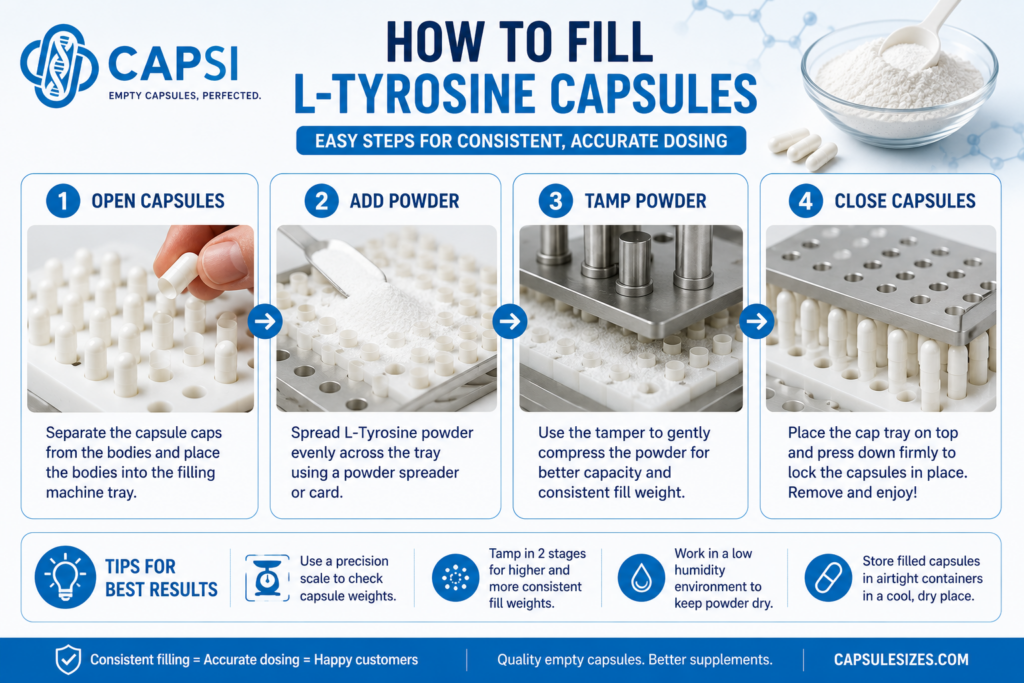
Producing high-quality capsules requires consistent filling methods.
Equipment Needed
- Empty capsules
- Capsule filling machine
- Precision scale
- Powder scraper
- Storage containers
Filling Process
- Separate capsule bodies and caps.
- Place bodies into the filling machine.
- Spread L-Tyrosine powder evenly.
- Tamp powder to improve fill weight.
- Repeat if necessary.
- Attach capsule caps securely.
- Weigh sample capsules for quality control.
Factors Affecting Capsule Fill Weight
Several factors influence how much L-Tyrosine fits inside a capsule:
Particle Size
Finer powders generally pack more densely.
Moisture Content
High moisture may alter flow properties and density.
Filling Pressure
Mechanical filling systems often achieve higher fill weights than manual filling.
Capsule Material
Although differences are usually small, gelatin and HPMC capsules may vary slightly in usable volume.
Storage Recommendations
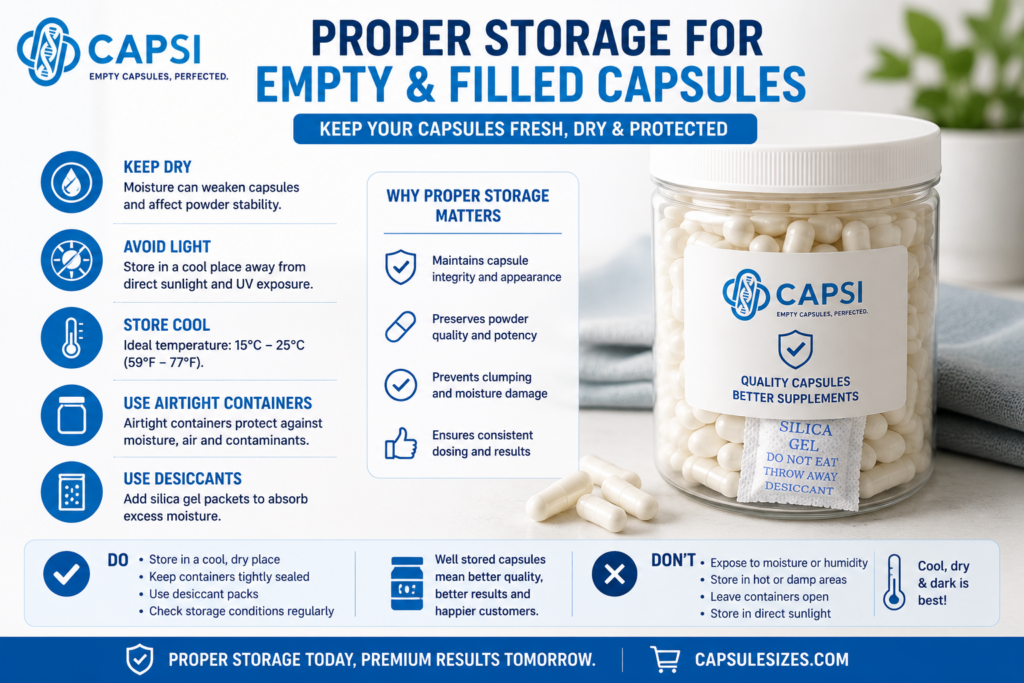
To maintain capsule quality:
- Store in a cool, dry place.
- Keep away from direct sunlight.
- Use airtight containers.
- Consider adding desiccants for long-term storage.
- Avoid excessive humidity.
Proper storage helps preserve both capsule integrity and powder stability.
Why Size 00 Capsules Are Often the Best Choice
For many users, size 00 capsules offer the best balance because they:
- Hold substantial amounts of L-Tyrosine
- Are widely available
- Work with most filling machines
- Are easier to swallow than size 000 capsules
However, if your target dose exceeds 750 mg per capsule, size 000 may be the better option.
Summary: Best Capsule Sizes for L-Tyrosine
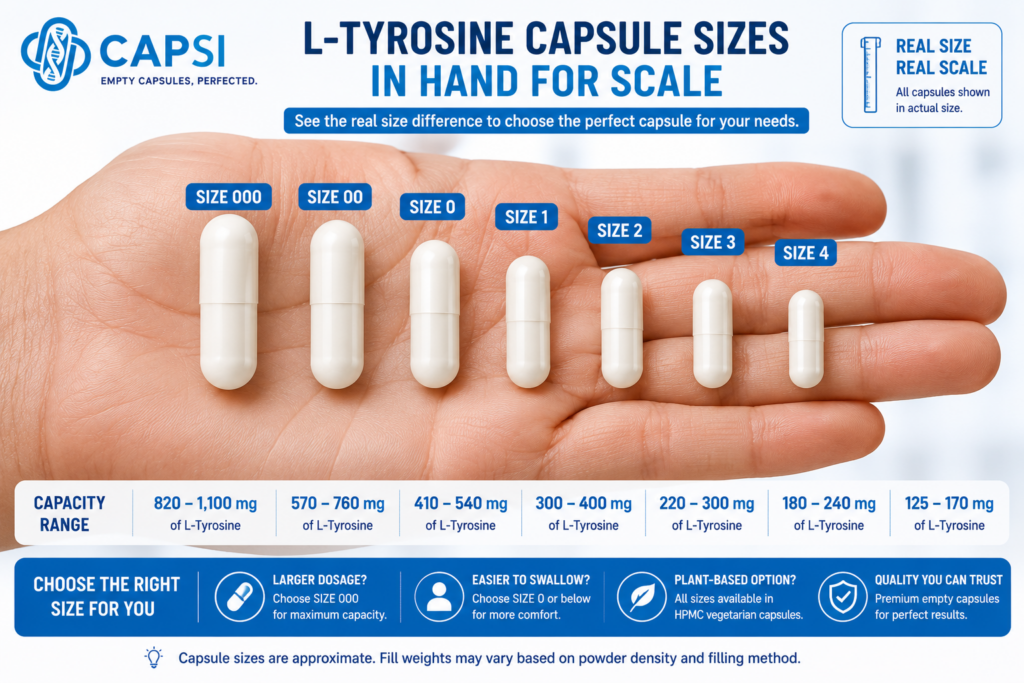
| Goal | Recommended Capsule Size |
|---|---|
| Maximum capacity | Size 000 |
| Best overall choice | Size 00 |
| Easier swallowing | Size 0 |
| Lower-dose formulas | Size 1–2 |
For most L-Tyrosine applications, size 00 capsules are the preferred choice, while size 000 capsules are ideal for high-dose formulations.
Frequently Asked Questions
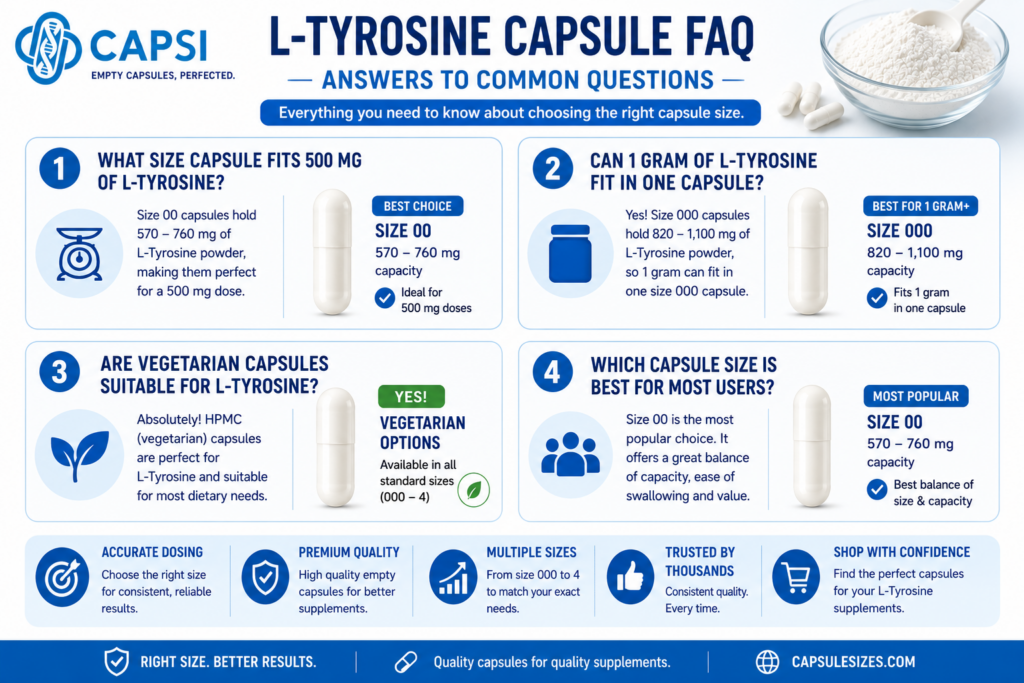
What size capsule holds 500 mg of L-Tyrosine?
A size 0 capsule may hold around 500 mg depending on powder density, while size 00 capsules comfortably hold 500 mg or more.
Can 1 gram of L-Tyrosine fit into one capsule?
Yes. A size 000 capsule can often hold close to or above 1,000 mg of L-Tyrosine.
Is L-Tyrosine suitable for vegetarian capsules?
Yes. L-Tyrosine powder is compatible with HPMC vegetarian capsules.
Which capsule size is most popular?
Size 00 capsules are among the most widely used capsule sizes in the supplement industry.
Does tamping increase fill weight?
Yes. Tamping can significantly increase powder density and the amount of L-Tyrosine that fits into a capsule.
Disclaimer: Capsule fill weights are estimates only and may vary depending on powder characteristics, filling methods, and equipment. This guide is for informational purposes only and does not constitute medical advice.