
Recovery blend powders are among the most popular sports nutrition supplements used by athletes, bodybuilders, and fitness enthusiasts. Whether formulated for muscle recovery, glycogen replenishment, hydration, or general post-workout support, many people choose to encapsulate recovery powders for convenience, portability, and precise dosing.
However, recovery blends are often one of the most challenging supplement types to encapsulate because they frequently contain bulky ingredients such as proteins, carbohydrates, amino acids, and electrolytes. This means selecting the correct capsule size is essential.
In this guide, we’ll explain how much recovery blend powder fits into each capsule size, which capsule sizes work best, and how many capsules are needed for typical serving sizes.
What Is Recovery Blend Powder?
Recovery blend powder is a dietary supplement designed to support the body’s recovery following physical activity. These formulations can vary significantly depending on their intended use.
Common ingredients found in recovery blends include:
- Whey protein isolate or concentrate
- Plant proteins
- Branched-chain amino acids (BCAAs)
- Essential amino acids (EAAs)
- Creatine monohydrate
- Creatine HCL
- L-Glutamine
- Electrolytes
- Carbohydrates
- Vitamins and minerals
- Adaptogens and herbal extracts
Some recovery blends focus on muscle repair, while others aim to replenish energy stores or improve hydration.
Because ingredient density varies widely, the amount of powder that fits into a capsule can differ considerably between formulations.
Why Encapsulate Recovery Blend Powder?
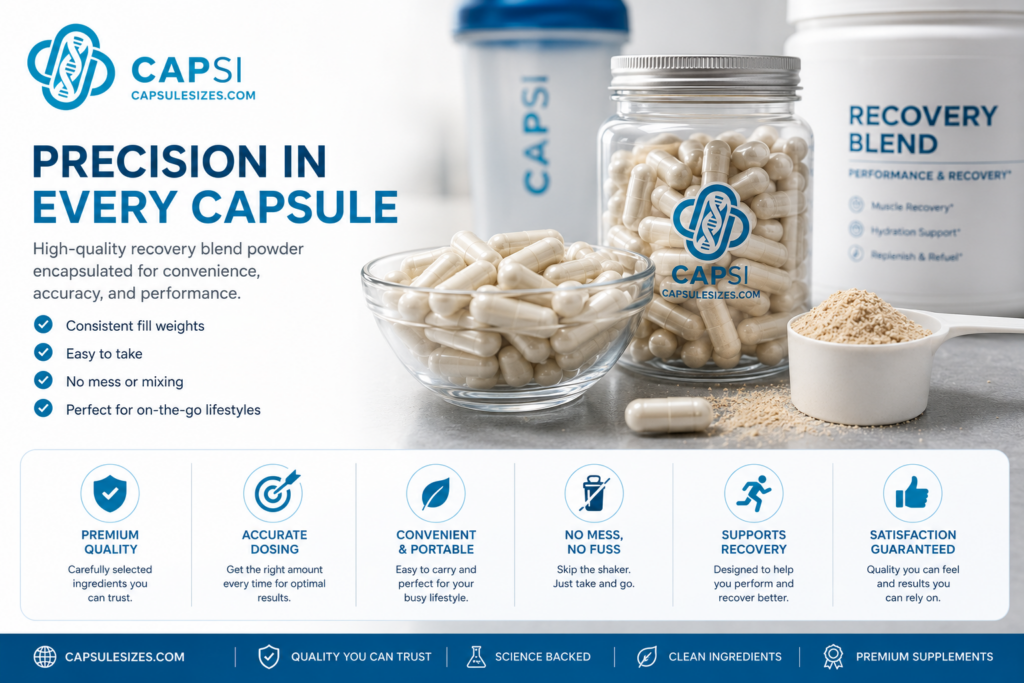
Although recovery supplements are often consumed as drinks, encapsulation offers several advantages:
Improved Convenience
Capsules are easy to carry while travelling, going to the gym, or commuting.
Better Taste Masking
Many recovery ingredients have strong or unpleasant flavours. Capsules eliminate the need to taste the powder.
Accurate Dosing
Capsules provide precise serving sizes and help ensure consistent intake.
Easier Ingredient Stacking
Encapsulation allows users to combine recovery ingredients with other supplements as part of a daily routine.
Reduced Mess
Powders can spill or clump, whereas capsules provide a clean and convenient alternative.
Recovery Blend Powder Density
The amount of powder that fits into a capsule depends primarily on bulk density.
Most recovery blends fall within the following density range:
- Low density: 0.45 g/mL
- Average density: 0.60 g/mL
- High density: 0.75 g/mL
Protein-rich formulations are usually less dense and require larger capsules, while mineral-heavy blends tend to be denser.
Recovery Blend Powder Capsule Size Chart
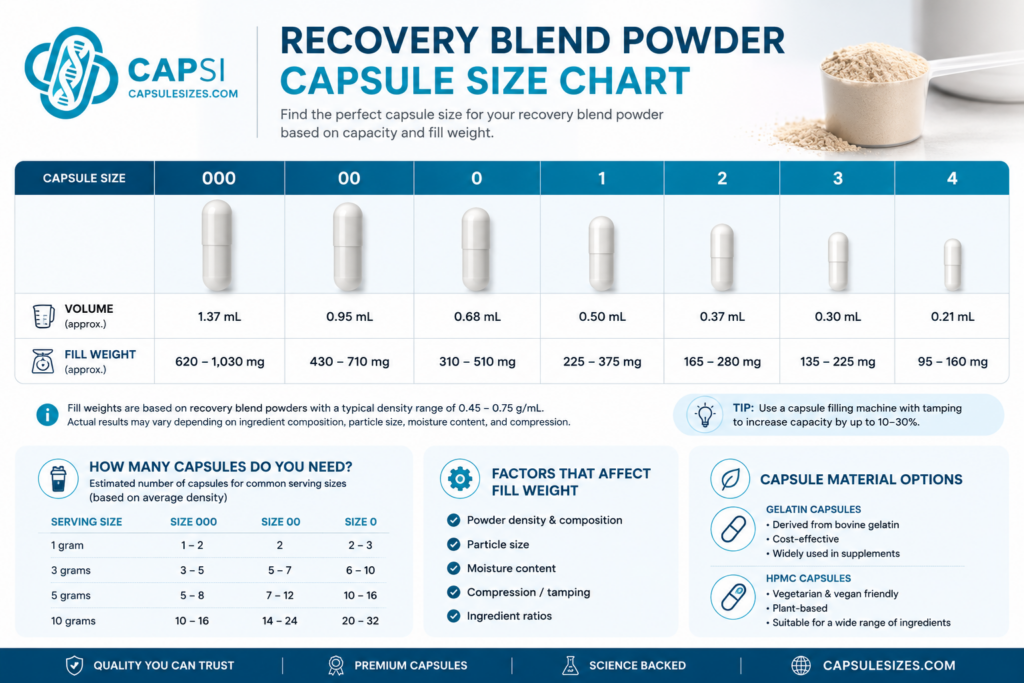
| Capsule Size | Volume | Estimated Fill Weight |
|---|---|---|
| Size 000 | 1.37 mL | 620–1,030 mg |
| Size 00 | 0.95 mL | 430–710 mg |
| Size 0 | 0.68 mL | 310–510 mg |
| Size 1 | 0.50 mL | 225–375 mg |
| Size 2 | 0.37 mL | 165–280 mg |
| Size 3 | 0.30 mL | 135–225 mg |
| Size 4 | 0.21 mL | 95–160 mg |
Note: Actual fill weights vary depending on powder density, moisture content, and compression during filling.
Which Capsule Size Is Best for Recovery Blend Powder?
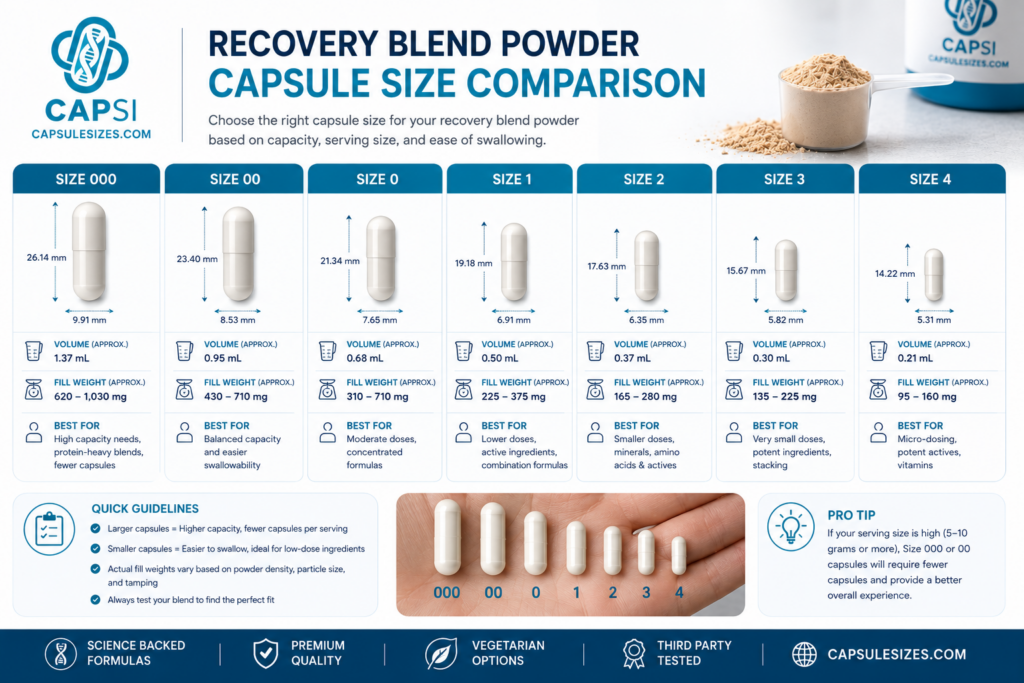
Size 000 Capsules
Size 000 capsules are the largest commonly available capsule size and are often the best choice for recovery blends.
Advantages:
- Highest powder capacity
- Fewer capsules per serving
- Ideal for protein and amino acid blends
Typical fill weight:
- 620–1,030 mg
For users encapsulating large doses, size 000 capsules are generally the most practical option.
Size 00 Capsules
Size 00 capsules are one of the most widely used capsule sizes in the supplement industry.
Advantages:
- Easier to swallow than size 000
- Good balance between capacity and comfort
- Suitable for most recovery formulations
Typical fill weight:
- 430–710 mg
Size 00 capsules are often the preferred choice for home encapsulation.
Size 0 Capsules
Size 0 capsules work best for concentrated formulas or smaller doses.
Typical fill weight:
- 310–510 mg
However, recovery blends often require multiple size 0 capsules per serving.
How Many Capsules Are Needed Per Serving?
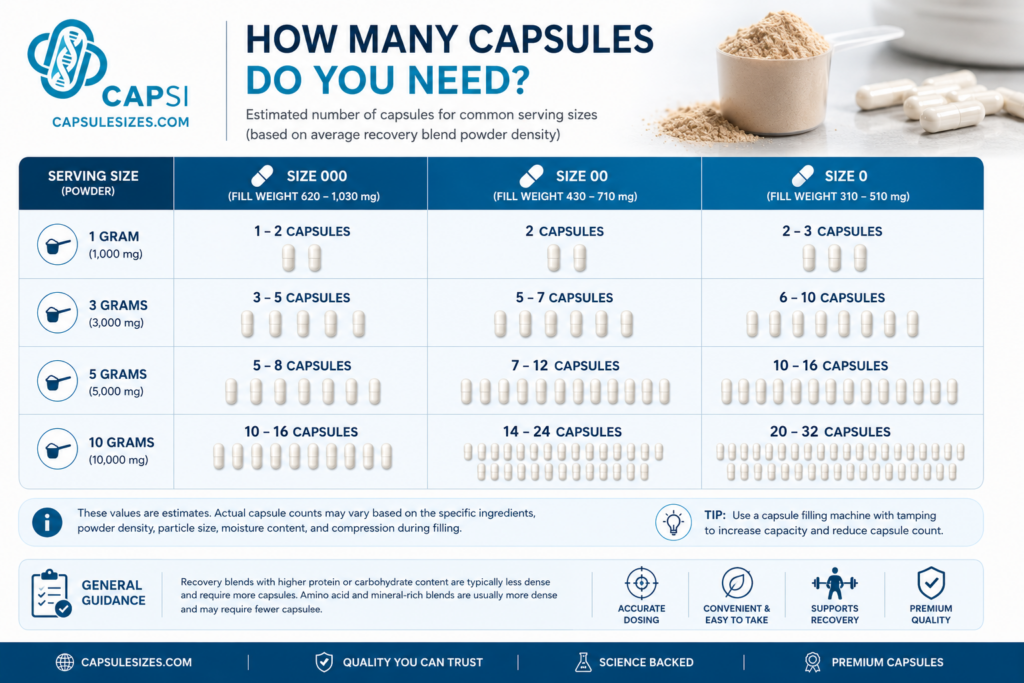
Recovery formulas are frequently dosed in grams rather than milligrams. The following estimates assume average powder density.
| Serving Size | Size 000 | Size 00 | Size 0 |
|---|---|---|---|
| 1 g | 1–2 capsules | 2 capsules | 2–3 capsules |
| 3 g | 3–5 capsules | 5–7 capsules | 6–10 capsules |
| 5 g | 5–8 capsules | 7–12 capsules | 10–16 capsules |
| 10 g | 10–16 capsules | 14–24 capsules | 20–32 capsules |
Large post-workout servings may require many capsules, making powder consumption more practical for some users.
Recovery Blend Ingredients and Capsule Suitability
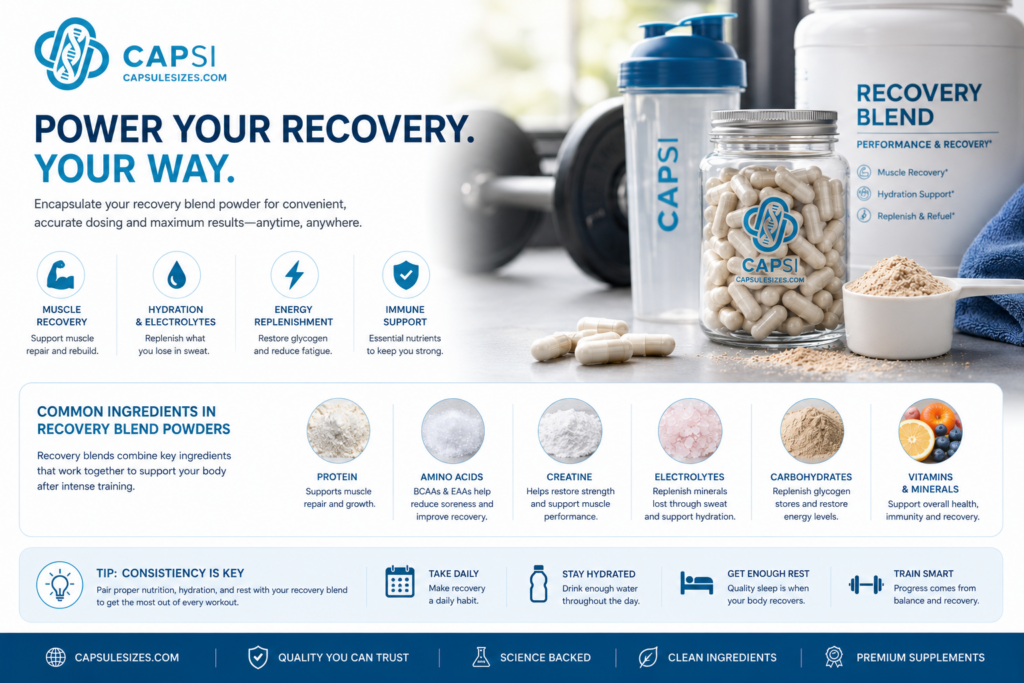
Protein-Based Recovery Blends
Protein powders such as whey, casein, pea protein, and rice protein are often bulky.
Typical protein densities:
- Whey isolate: 0.40–0.60 g/mL
- Plant proteins: 0.35–0.55 g/mL
Because of their low density, protein-heavy blends usually require size 000 capsules.
Amino Acid Recovery Blends
Amino acids often have higher densities than proteins.
Examples include:
- L-Glutamine
- BCAAs
- EAAs
- Taurine
- Beta-Alanine
These ingredients typically encapsulate more efficiently.
Electrolyte Recovery Blends
Electrolytes commonly include:
- Sodium
- Potassium
- Magnesium
- Calcium
Mineral-based powders are generally denser and fit more efficiently into capsules.
Factors Affecting Capsule Fill Weight
Several factors determine how much recovery blend powder fits into a capsule.
Powder Density
Denser powders result in higher fill weights.
Particle Size
Finely milled powders pack more efficiently.
Moisture Content
High moisture can reduce flow and lead to clumping.
Compression
Using tamping tools or capsule filling machines can increase fill weight by 10–30%.
Ingredient Ratios
Blends containing proteins and carbohydrates usually occupy more volume than pure amino acid formulations.
Manual Filling vs Capsule Machines
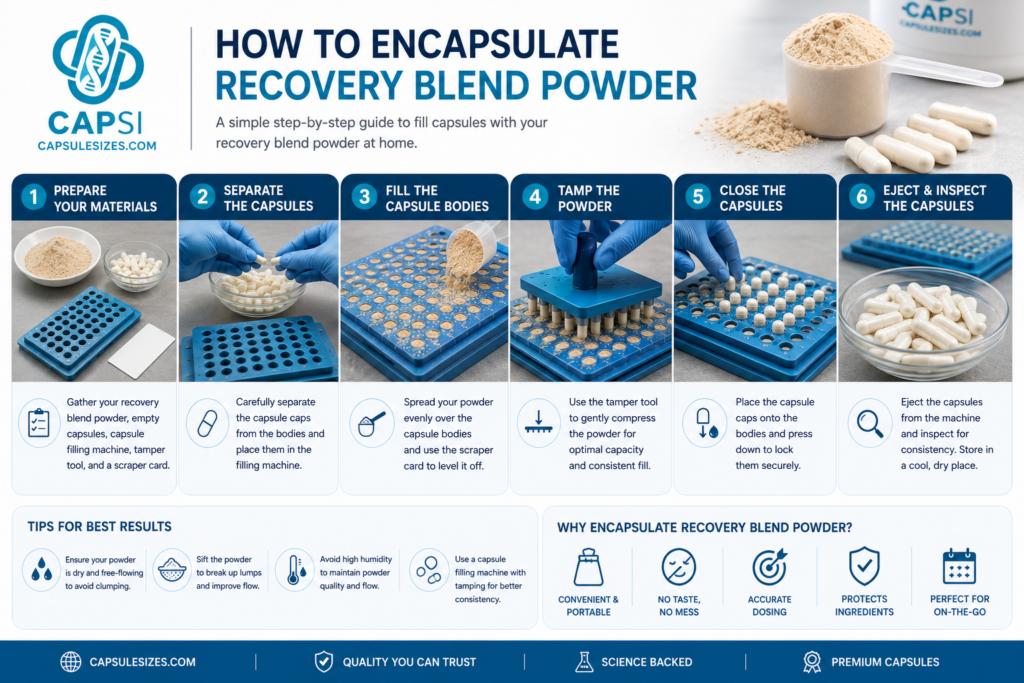
Manual Filling
Manual filling is suitable for small batches and personal use.
Advantages:
- Low equipment cost
- Flexible batch sizes
- Ideal for experimentation
Disadvantages:
- Slower production
- Less consistent fill weights
Capsule Filling Machines
Capsule filling machines provide:
- Faster production
- Improved consistency
- Better compression
- Higher throughput
Users regularly encapsulating recovery blends often benefit from capsule machines.
Gelatin vs HPMC Capsules
Two primary capsule materials are available.
Gelatin Capsules
Gelatin capsules are:
- Cost-effective
- Easy to fill
- Widely available
- Suitable for most supplements
HPMC Capsules
HPMC capsules are:
- Vegetarian and vegan-friendly
- Plant-based
- Suitable for moisture-sensitive ingredients
- Popular in sports nutrition
For vegan recovery formulations, HPMC capsules are often preferred.
Capsule Storage Tips
Proper storage helps maintain capsule quality and stability.
Store capsules:
- In a cool, dry location
- Away from direct sunlight
- In airtight containers
- With desiccants if necessary
Excess moisture can cause capsules to soften or become brittle over time.
Common Encapsulation Challenges
Powder Clumping
Some recovery ingredients absorb moisture from the air.
Solutions include:
- Using desiccants
- Working in low-humidity environments
- Sieving powders before filling
Poor Flowability
Sticky powders may not fill consistently.
Possible solutions:
- Mixing with flow agents
- Grinding coarse particles
- Using capsule machines with tamping capability
Capsule Separation
Overfilling can prevent capsules from locking properly.
Always test fill weights before large production runs.
Are Recovery Blend Capsules Practical?
Recovery blend capsules are most practical when:
- The serving size is under 3–5 grams.
- The formula is highly concentrated.
- Portability is important.
- Taste masking is desired.
For very large post-workout servings of 10–30 grams, powders or drinks may remain more practical.
Recommended Capsule Sizes
Best Overall: Size 000
Ideal for high-capacity recovery formulations.
Best Balance: Size 00
Excellent combination of capacity and swallowability.
Best for Small Servings: Size 0
Suitable for concentrated ingredients or low-dose formulas.
Frequently Asked Questions
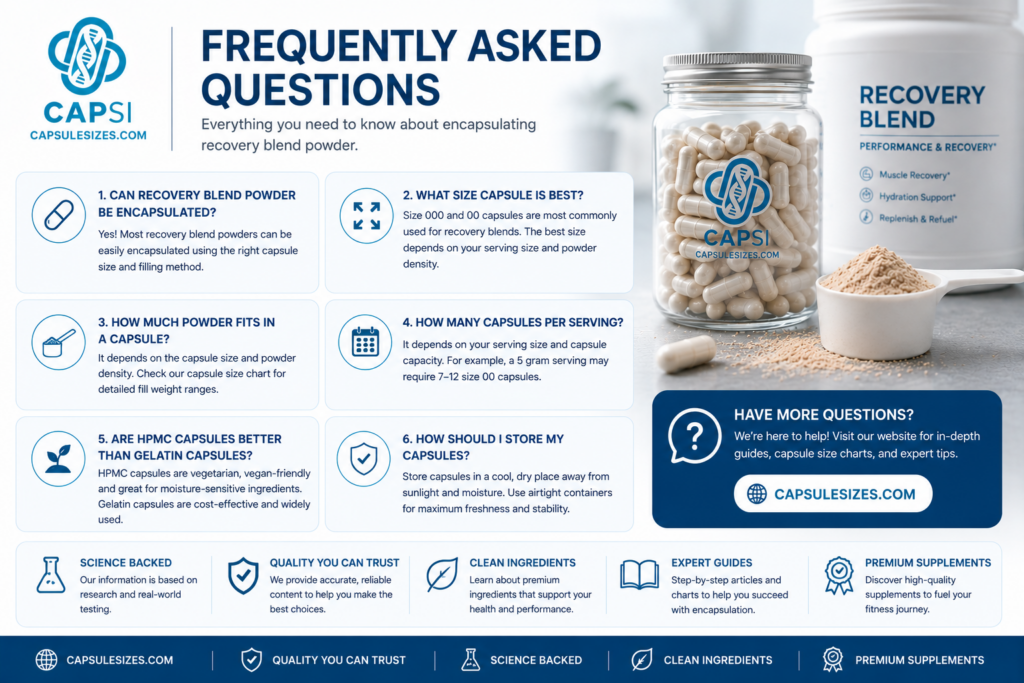
How much recovery blend powder fits into a size 000 capsule?
Most recovery blends fit between 620 mg and 1,030 mg in a size 000 capsule.
What is the best capsule size for recovery powder?
Size 000 is usually best because recovery supplements often require larger doses.
Can protein powder be encapsulated?
Yes, but protein powders are often bulky and may require multiple capsules.
Are HPMC capsules suitable for sports supplements?
Yes. HPMC capsules are vegetarian, vegan-friendly, and widely used in sports nutrition.
How many size 00 capsules equal 5 grams?
Typically 7–12 size 00 capsules, depending on powder density.
Can recovery blend capsules replace post-workout shakes?
Capsules can supplement recovery routines, but very high-dose formulas may still be more practical as powders.
Conclusion
Recovery blend powders can be successfully encapsulated, but choosing the correct capsule size is essential to achieve practical serving sizes and efficient dosing. Because many recovery formulations contain bulky ingredients such as proteins, amino acids, carbohydrates, and electrolytes, larger capsules generally provide the best results.
For most recovery blend powders, size 000 capsules offer the highest capacity and require the fewest capsules per serving, making them the preferred option for larger doses. Size 00 capsules remain an excellent all-round choice, balancing capacity with ease of swallowing, while size 0 capsules are better suited to smaller or more concentrated formulations.
The exact amount of recovery blend powder that fits into a capsule will depend on factors such as powder density, particle size, moisture content, and filling method. Testing a small batch before large-scale encapsulation is always recommended to determine real-world fill weights.
Whether you’re encapsulating recovery powders for convenience, accurate dosing, travel, or taste-free consumption, understanding capsule capacities can help you select the most suitable capsule size for your formulation. By matching your serving size requirements with the appropriate capsule size, you can create a more practical and efficient recovery supplement experience.