L-Ornithine is a popular amino acid used in sports nutrition, recovery supplements, liver support formulas, and wellness products. If you’re looking to encapsulate L-Ornithine powder, choosing the correct capsule size is one of the most important decisions. The right capsule size ensures accurate dosing, good consumer experience, and efficient manufacturing.
This guide explains how much L-Ornithine fits into each capsule size, which capsule type is best, and how to select the ideal capsule for your formulation.
What Is L-Ornithine?
L-Ornithine is a non-protein amino acid that plays an important role in the body’s urea cycle. Its primary function is helping remove excess ammonia from the bloodstream.
L-Ornithine is naturally produced in the body and is often used in dietary supplements aimed at:
- Sports performance
- Recovery support
- Sleep formulations
- Liver health products
- Amino acid blends
- Wellness supplements
The most common form available for encapsulation is L-Ornithine HCl, which is typically a fine, white powder.
Why Encapsulate L-Ornithine?
While L-Ornithine can be consumed as a powder, capsules offer several advantages:
Accurate Dosing
Capsules provide a measured amount of powder per serving.
Improved Taste
Amino acids often have a bitter taste. Encapsulation masks unpleasant flavours.
Convenience
Capsules are easy to transport and consume.
Better Stability
Capsules help protect powders from moisture and oxidation.
What Capsule Size Is Best for L-Ornithine?
The best capsule size depends on your desired dosage and the density of your powder.
L-Ornithine generally has a moderate bulk density, allowing relatively high fill weights in standard capsules.
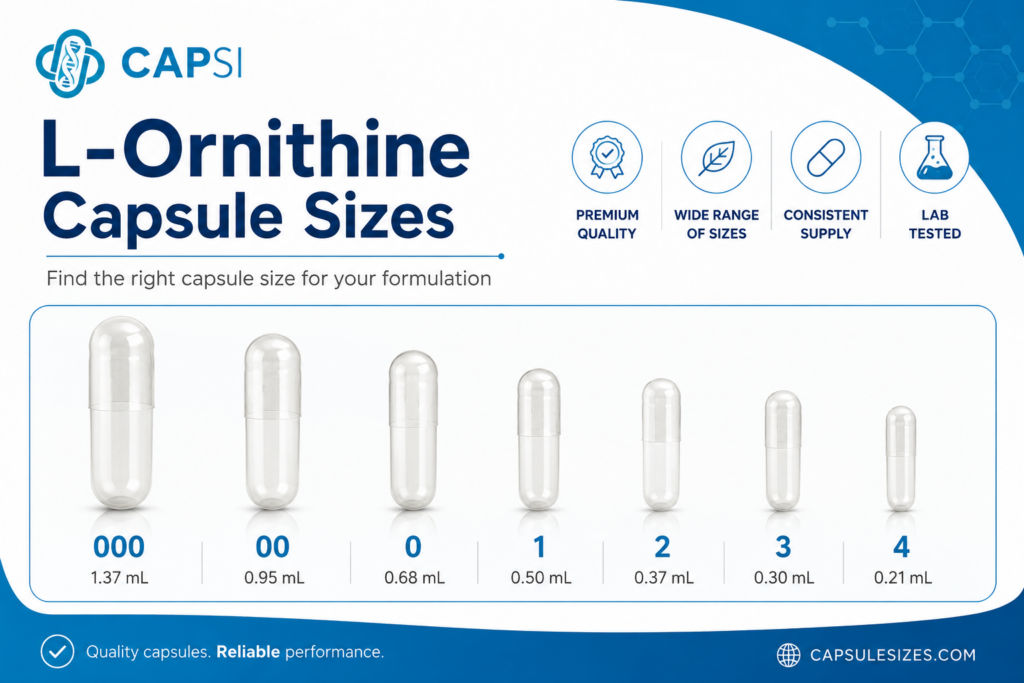
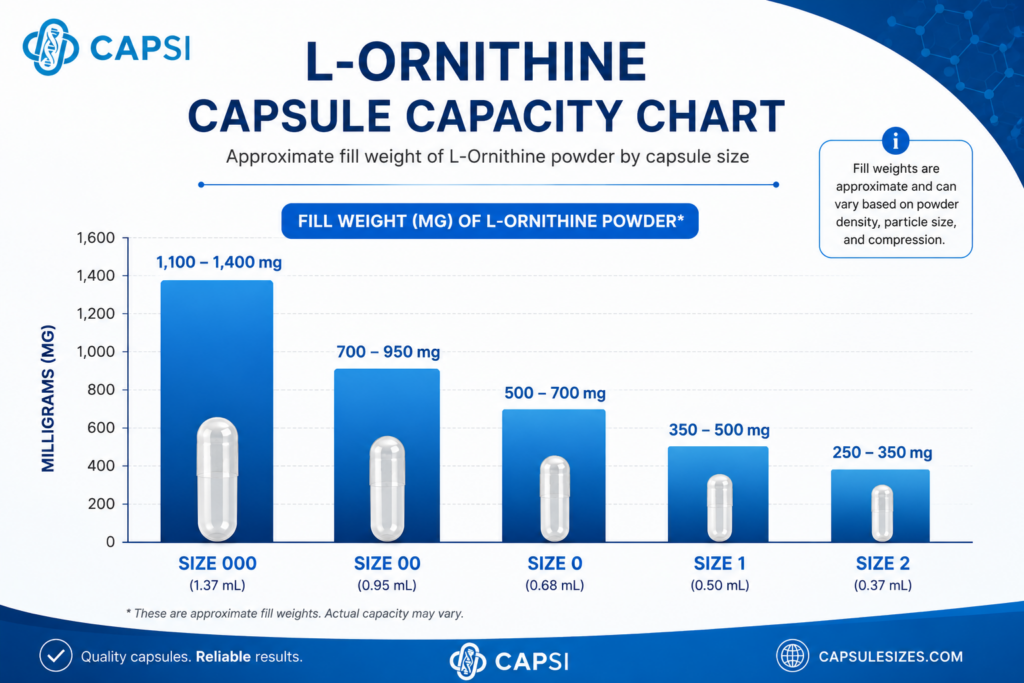
Approximate L-Ornithine Fill Weights
| Capsule Size | Volume (mL) | Approximate L-Ornithine Fill Weight |
|---|---|---|
| 000 | 1.37 mL | 1,100–1,400 mg |
| 00 | 0.95 mL | 700–950 mg |
| 0 | 0.68 mL | 500–700 mg |
| 1 | 0.50 mL | 350–500 mg |
| 2 | 0.37 mL | 250–350 mg |
| 3 | 0.30 mL | 150–250 mg |
| 4 | 0.21 mL | 100–180 mg |
Actual fill weights vary according to powder particle size, moisture content, and compression during filling.
Recommended Capsule Sizes by Dosage
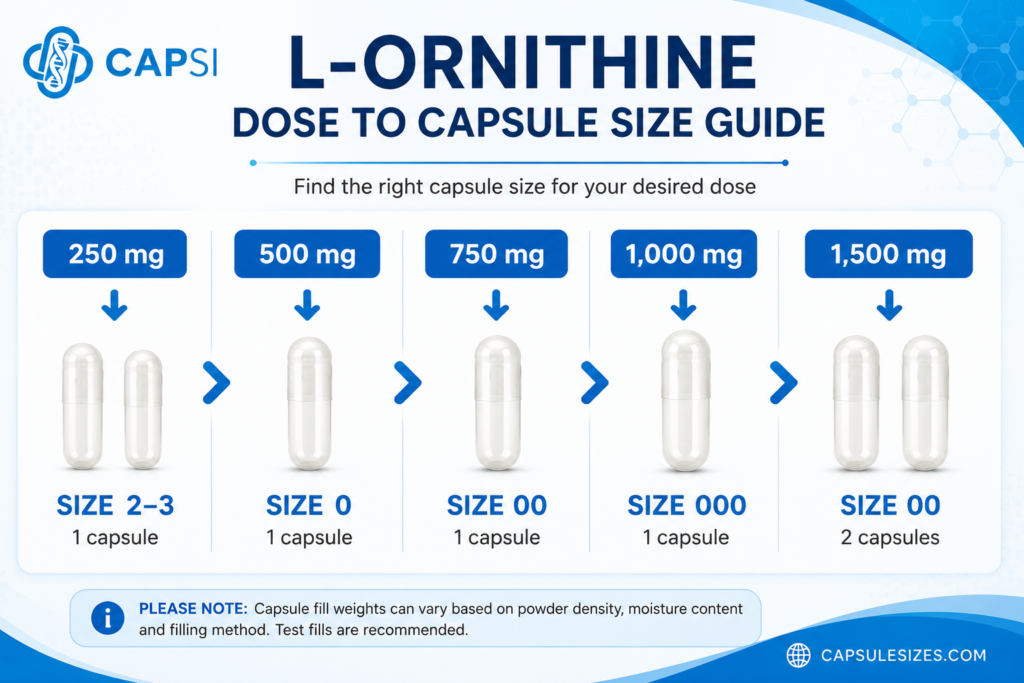
Most L-Ornithine supplements are formulated between 500 mg and 2,000 mg per serving.
| Desired Dose | Recommended Capsule Size |
|---|---|
| 250 mg | Size 2 or 3 |
| 500 mg | Size 0 |
| 750 mg | Size 00 |
| 1,000 mg | Size 00 or 000 |
| 1,500 mg | Size 000 or two Size 00 capsules |
| 2,000 mg | Two Size 000 capsules |
For many manufacturers, size 00 capsules provide the best balance between capacity and swallowability.
Understanding L-Ornithine Powder Density
Capsule fill weight is determined not only by capsule size but also by powder density.
Several factors influence density:
- Particle size distribution
- Moisture content
- Manufacturing process
- Powder flow characteristics
- Degree of compaction
A finely milled L-Ornithine powder may pack more efficiently than a coarser grade.
Because densities vary between suppliers, trial fills are always recommended before commercial production.
Capsule Size Comparison for L-Ornithine
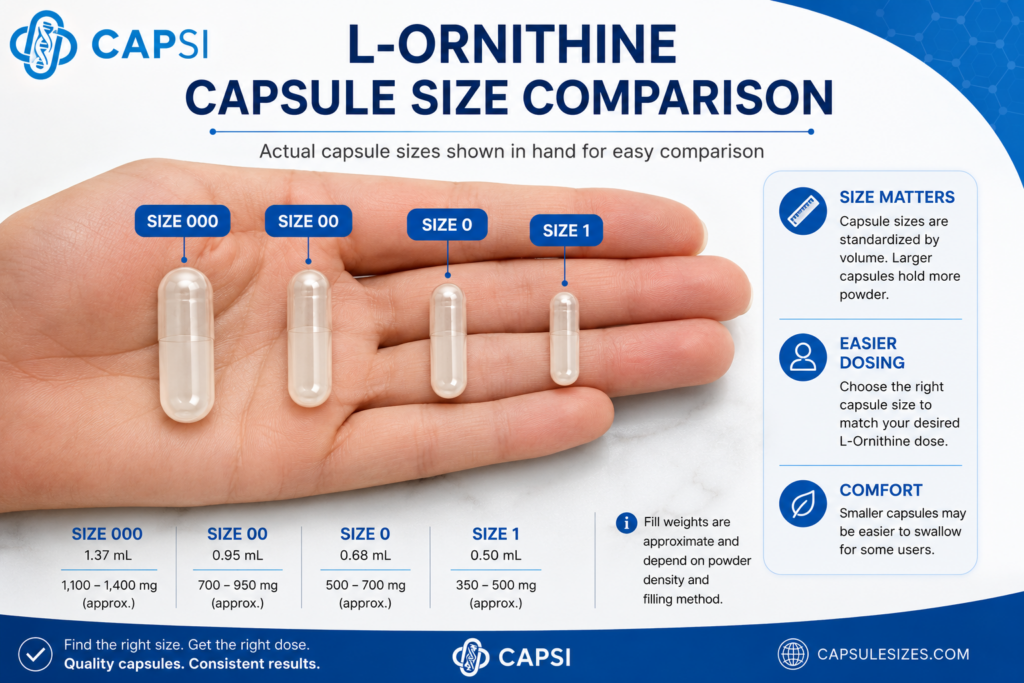
Size 000 Capsules
Size 000 capsules are the largest commonly available capsules.
Advantages:
- Highest fill capacity
- Suitable for high-dose formulas
- Reduces the number of capsules per serving
Disadvantages:
- Larger size may be harder for some users to swallow
Typical capacity: 1,100–1,400 mg of L-Ornithine
Size 00 Capsules
Size 00 capsules are among the most popular supplement capsule sizes worldwide.
Advantages:
- Excellent balance of size and capacity
- Comfortable for most users
- Widely available
Typical capacity: 700–950 mg of L-Ornithine
Many commercial amino acid supplements use size 00 capsules.
Size 0 Capsules
Size 0 capsules are often used for moderate-dose formulations.
Advantages:
- Easy to swallow
- Suitable for daily supplements
- Ideal for 500–700 mg doses
Typical capacity: 500–700 mg of L-Ornithine
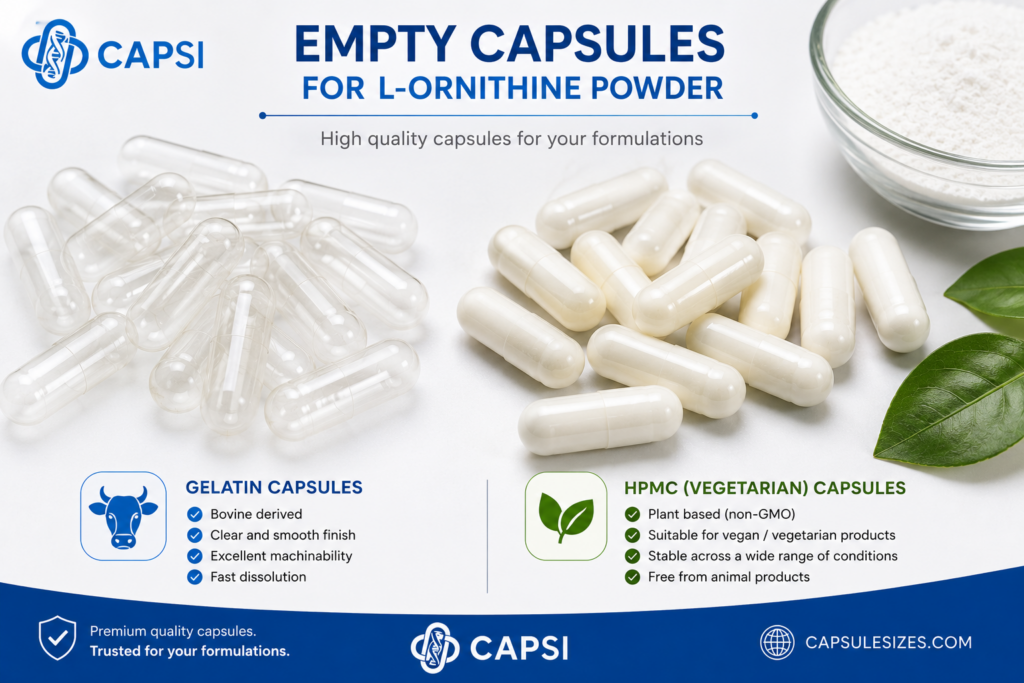
Gelatin vs Vegetarian Capsules
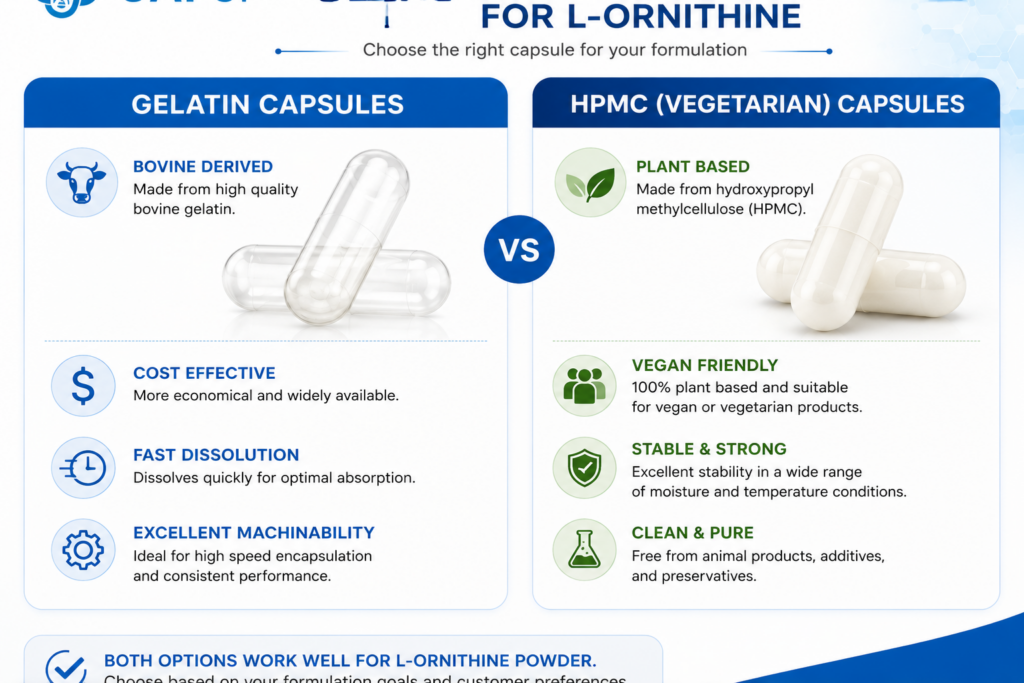
When encapsulating L-Ornithine, you generally have two capsule choices.
Gelatin Capsules
Gelatin capsules are made from bovine gelatin.
Benefits:
- Cost-effective
- Excellent machinability
- Rapid dissolution
- Widely used in commercial production
HPMC Capsules
HPMC capsules are plant-based and suitable for vegetarian and vegan products.
Benefits:
- Animal-free
- Stable under varying humidity
- Suitable for vegan consumers
- Increasingly popular in premium supplements
Both gelatin and HPMC capsules are compatible with L-Ornithine powder.
How Many Capsules Are Needed Per Serving?
The number of capsules required depends on your target dose.
| Serving Size | Capsule Configuration |
|---|---|
| 500 mg | 1 × Size 0 |
| 750 mg | 1 × Size 00 |
| 1,000 mg | 1 × Size 000 or 2 × Size 0 |
| 1,500 mg | 2 × Size 00 |
| 2,000 mg | 2 × Size 000 |
| 3,000 mg | 3 × Size 000 |
These values are estimates and should be verified through test fills.
Encapsulation Tips for L-Ornithine Powder
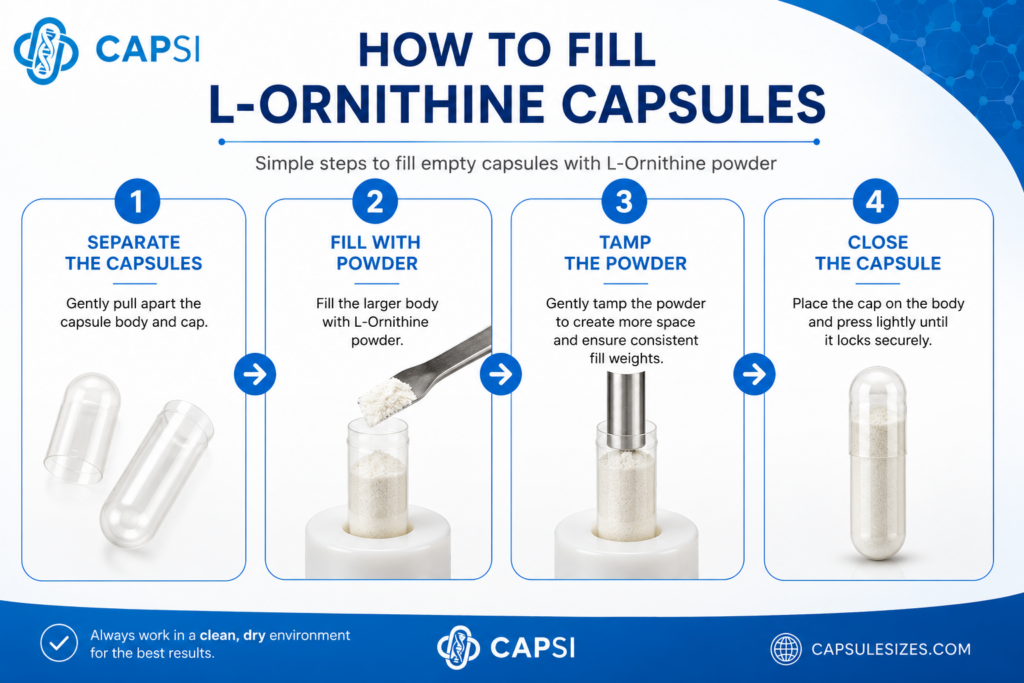
Use Precision Scales
Use accurate scales capable of measuring to at least 0.001 g for formulation work.
Perform Trial Fills
Fill several capsules and weigh them to determine average capacity.
Consider Flow Aids
If powder flow is poor, small amounts of flow agents may improve filling consistency.
Use Desiccants
Moisture can affect powder flow and stability. Desiccants help maintain product quality.
Check Capsule Locking
Ensure capsules close properly to avoid leakage during transport.
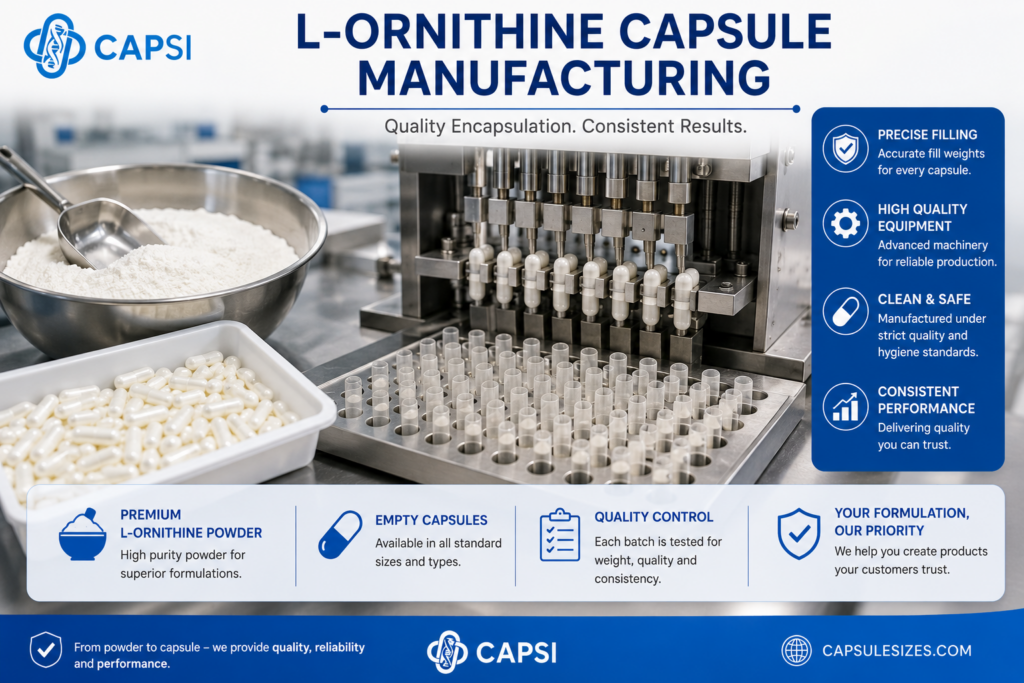
Manual vs Machine Filling
Manual Filling
Suitable for:
- Small batches
- Home encapsulation
- Product testing
Manual capsule filling machines can significantly speed up production.
Semi-Automatic Filling
Suitable for:
- Small businesses
- Contract manufacturers
- Medium production runs
Automatic Filling
Used by large-scale supplement manufacturers producing thousands of capsules per hour.
Storage Recommendations
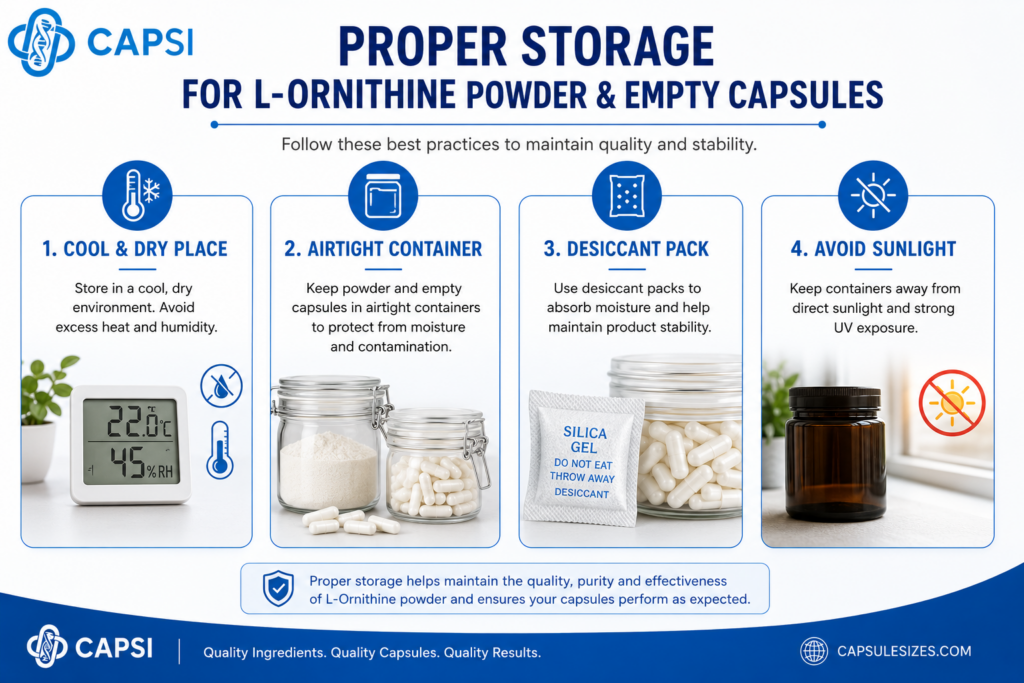
Proper storage helps maintain capsule quality and shelf life.
Store capsules:
- In a cool, dry place
- Away from direct sunlight
- At stable temperatures
- In sealed containers
- With desiccant packs where appropriate
Excess humidity may soften gelatin capsules or affect powder flow.
Common L-Ornithine Formulations
L-Ornithine is frequently combined with other ingredients such as:
- L-Arginine
- Citrulline Malate
- L-Lysine
- Magnesium
- GABA
- Recovery blends
Combination formulas may require larger capsule sizes due to increased fill weight.
Which Capsule Size Should You Choose?
For most applications:
Choose Size 00 If You Want:
- A balance between capacity and ease of swallowing
- Approximately 700–950 mg per capsule
- A widely used industry standard
Choose Size 000 If You Need:
- High-dose formulations
- Fewer capsules per serving
- Maximum fill capacity
Choose Size 0 If You Prefer:
- Smaller capsules
- Moderate doses around 500 mg
- Easier swallowing
Frequently Asked Questions
What size capsule holds 1,000 mg of L-Ornithine?
A size 000 capsule can often hold approximately 1,000–1,400 mg depending on powder density. Some dense powders may also approach 1,000 mg in size 00 capsules.
Is L-Ornithine powder easy to encapsulate?
Yes. L-Ornithine powder generally exhibits good flow characteristics and is suitable for manual or automated filling.
Are vegetarian capsules suitable for L-Ornithine?
Yes. HPMC capsules work very well with L-Ornithine and are ideal for vegan formulations.
Which capsule size is most commonly used?
Size 00 capsules are often the most popular choice because they balance capacity with consumer comfort.
Can capsule capacities vary?
Yes. Powder density, moisture content, and filling pressure all affect the amount of powder that fits into a capsule.
Conclusion
Choosing the right capsule size for L-Ornithine powder is essential for achieving accurate dosing, improving user convenience, and creating an efficient encapsulation process. While the exact fill weight will vary depending on powder density and filling method, most formulations can be successfully encapsulated using sizes 0, 00, or 000.
For moderate doses around 500 mg, size 0 capsules are often a practical choice. For higher-strength formulations, size 00 capsules provide an excellent balance between capacity and ease of swallowing, while size 000 capsules are ideal when maximum fill weight is required. Both gelatin and vegetarian HPMC capsules work well with L-Ornithine powder, allowing manufacturers and home users to select the option that best suits their needs.
Before producing larger batches, it is always advisable to perform test fills using your specific powder and capsule type, as particle size and bulk density can significantly affect capsule capacity. Proper storage in a cool, dry environment will also help maintain capsule quality and ingredient stability.
By understanding capsule capacities and selecting the appropriate size, you can create consistent, professional-quality L-Ornithine formulations while minimising the number of capsules required per serving. Whether you are filling capsules for personal use, small-scale production, or commercial supplement manufacturing, choosing the correct capsule size is a key step toward achieving reliable and accurate results.
For more ingredient-specific capsule sizing guides, explore the CapsuleSizes.com Ingredient Finder and compare capacities across hundreds of powders, amino acids, vitamins, minerals, herbs, and sports nutrition ingredients.
Related Guides
Explore more capsule sizing guides:
Disclaimer
The capsule capacities provided in this guide are estimates based on typical powder characteristics. Actual fill weights may vary depending on supplier specifications, powder density, and encapsulation methods. Always conduct fill trials using your specific ingredient and capsule type before commercial production.