
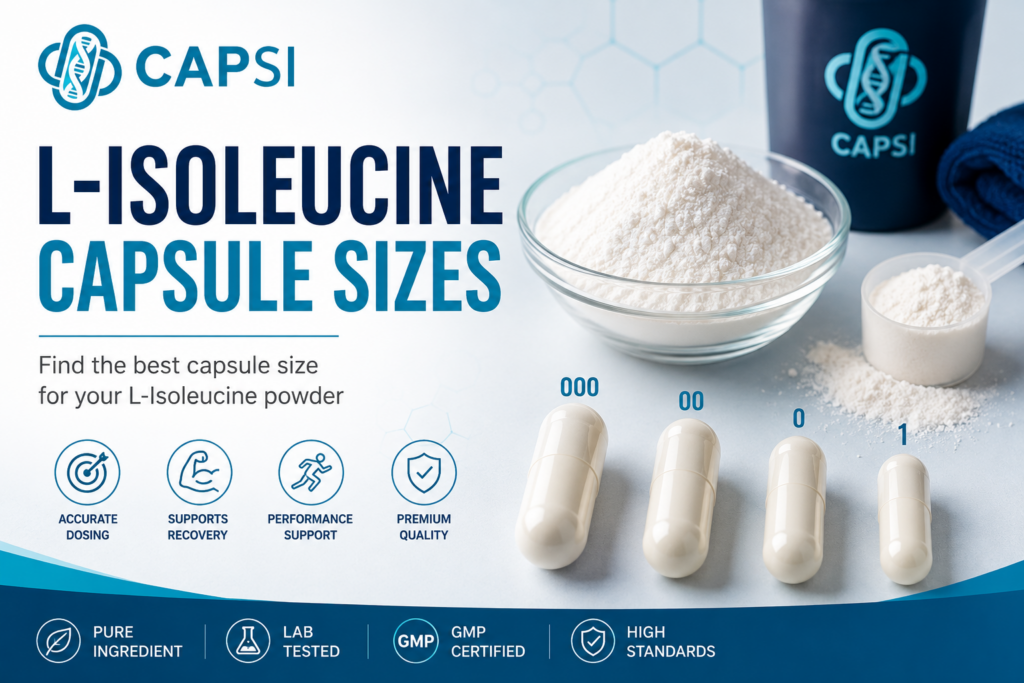
L-Isoleucine is one of the three branched-chain amino acids (BCAAs), alongside leucine and valine. It is commonly used in sports nutrition supplements because of its role in muscle metabolism, energy production, and recovery. If you are making your own capsules or developing a supplement formulation, choosing the correct capsule size is essential.
Unlike some highly concentrated ingredients, amino acid powders such as L-Isoleucine can be relatively bulky. This means the capsule size you choose directly affects how many capsules are needed per serving.
This guide explains everything you need to know about encapsulating L-Isoleucine powder, including capsule capacities, recommended capsule sizes, dosage examples, and storage tips.
What Is L-Isoleucine?
L-Isoleucine is one of the nine essential amino acids. Because the human body cannot produce it naturally, it must be obtained through diet or supplementation.
It belongs to the branched-chain amino acid (BCAA) group:
- L-Leucine
- L-Isoleucine
- L-Valine
These amino acids are popular in sports supplements due to their involvement in muscle protein metabolism and exercise nutrition.
L-Isoleucine is naturally found in foods such as:
- Meat
- Fish
- Eggs
- Dairy products
- Soy
- Legumes
- Nuts and seeds
Supplement manufacturers often sell L-Isoleucine as a standalone powder or combine it with leucine and valine in BCAA formulas.
Why Put L-Isoleucine in Capsules?
Although L-Isoleucine powder can be mixed into drinks, many users prefer capsules because they offer:
Convenience
Capsules are easy to carry and take while travelling or at the gym.
Precise Dosing
Each capsule can contain a measured amount of powder, helping ensure consistency.
Improved Taste
Amino acids can have a bitter or unpleasant flavour. Capsules eliminate the need to taste the powder.
Better Storage
Capsules may help protect powders from moisture and air exposure.
Does L-Isoleucine Powder Work Well in Capsules?
Yes. L-Isoleucine generally encapsulates well, although fill weights vary depending on:
- Particle size
- Powder density
- Moisture content
- Manufacturing process
- Capsule filling method
Because amino acids are often less dense than minerals, larger capsules are frequently preferred.
L-Isoleucine Powder Density
The exact density varies by supplier and manufacturing process, but L-Isoleucine powder typically falls within:
Approximate bulk density:
0.65–0.85 g/mL
This places it in a similar range to many other amino acid powders.
A fluffier powder will fill fewer milligrams per capsule, while denser powders may allow higher fill weights.
L-Isoleucine Capsule Size Chart
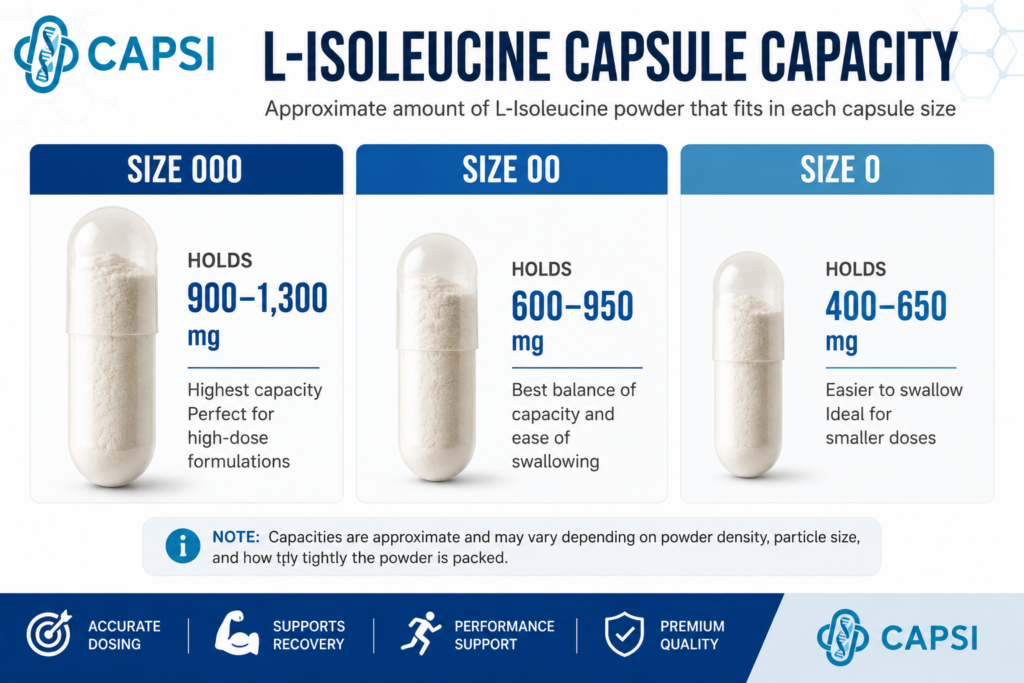
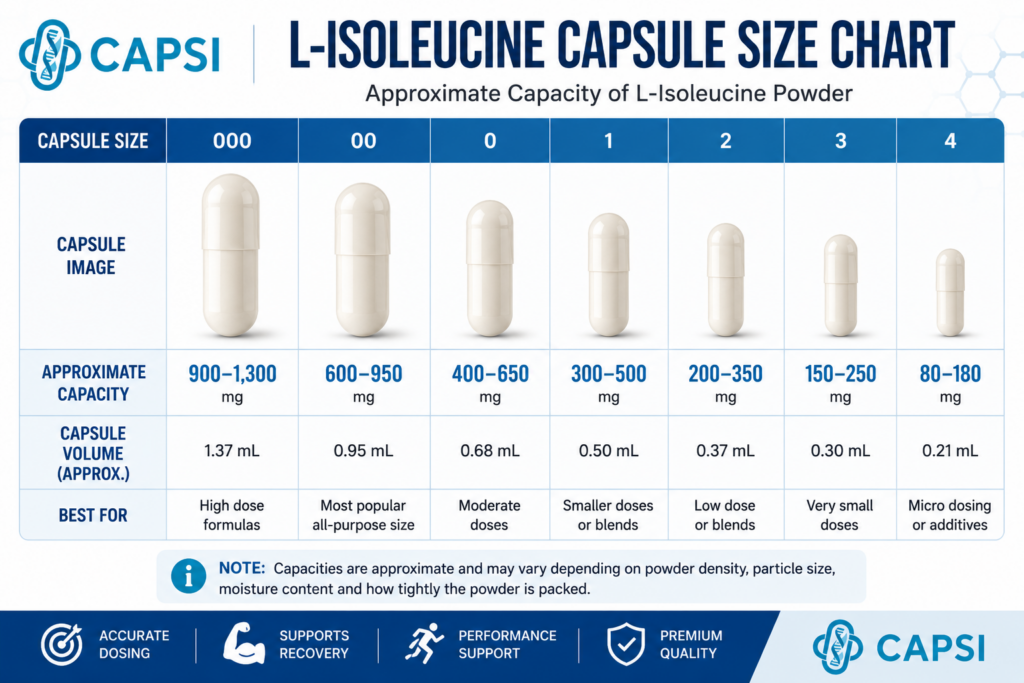
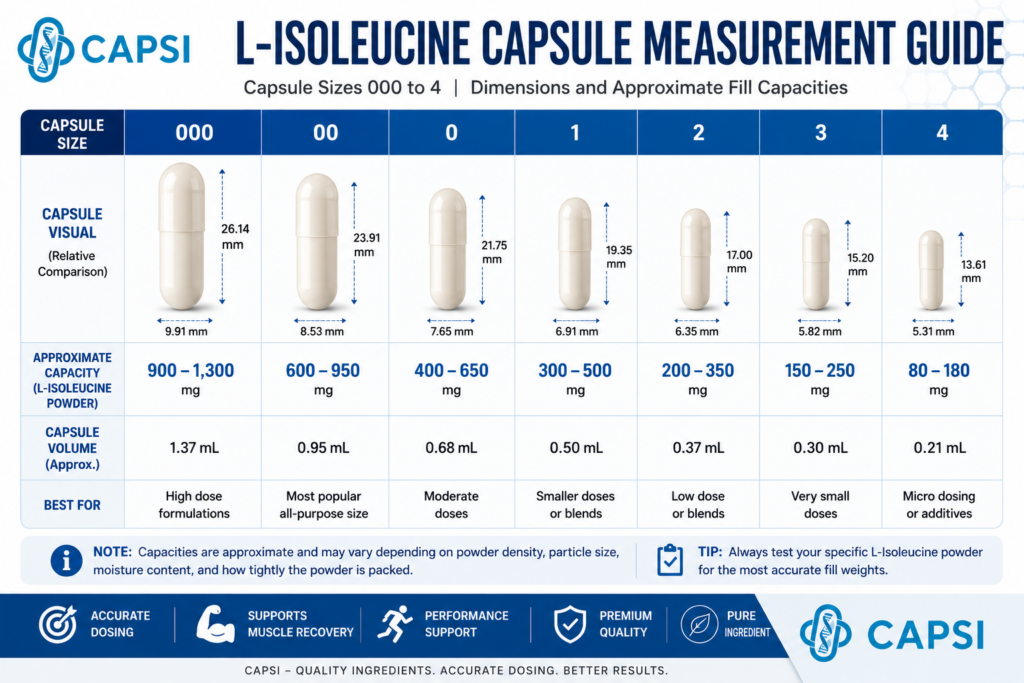
The following figures are approximate and may vary depending on equipment and powder characteristics.
| Capsule Size | Approximate Capacity |
|---|---|
| Size 000 | 900–1,300 mg |
| Size 00 | 600–950 mg |
| Size 0 | 400–650 mg |
| Size 1 | 300–500 mg |
| Size 2 | 200–350 mg |
| Size 3 | 150–250 mg |
| Size 4 | 80–180 mg |
These values assume standard filling methods without excessive compression.
Understanding Capsule Sizes
Capsule sizes range from large to small.
Size 000 Capsules
Size 000 is the largest commonly available empty capsule.
Advantages
- Holds the greatest amount of powder
- Reduces capsules per serving
- Ideal for amino acids and proteins
- Suitable for high-dose formulations
Disadvantages
- Larger capsule size
- May be harder for some people to swallow
Typical L-Isoleucine capacity: 900–1,300 mg
Size 00 Capsules
Size 00 capsules are the most popular size used across the supplement industry.
Advantages
- Excellent balance between capacity and swallowability
- Widely available
- Suitable for home encapsulation
- Commonly used for amino acids
Typical L-Isoleucine capacity: 600–950 mg
For most users, size 00 is the recommended option.
Size 0 Capsules
Size 0 capsules are slightly smaller and easier to swallow.
Advantages
- Easier to consume
- Suitable for lower-dose products
- Popular for daily supplements
Disadvantages
- Requires more capsules for larger doses
Typical L-Isoleucine capacity: 400–650 mg
Size 1 Capsules
Size 1 capsules are frequently used when smaller capsules are desired.
Typical capacity: 300–500 mg
While easy to swallow, they are less efficient for amino acid supplementation because multiple capsules are often required.
How Many Capsules Do You Need?
The number of capsules required depends on your desired serving size and powder density.
500 mg Serving
| Capsule Size | Capsules Needed |
|---|---|
| Size 000 | 1 capsule |
| Size 00 | 1 capsule |
| Size 0 | 1 capsule |
| Size 1 | 1–2 capsules |
1,000 mg (1 g) Serving
| Capsule Size | Capsules Needed |
|---|---|
| Size 000 | 1 capsule |
| Size 00 | 1–2 capsules |
| Size 0 | 2 capsules |
| Size 1 | 2–3 capsules |
2,000 mg (2 g) Serving
| Capsule Size | Capsules Needed |
|---|---|
| Size 000 | 2 capsules |
| Size 00 | 2–3 capsules |
| Size 0 | 3–5 capsules |
| Size 1 | 4–6 capsules |
3,000 mg (3 g) Serving
| Capsule Size | Capsules Needed |
|---|---|
| Size 000 | 3 capsules |
| Size 00 | 4–5 capsules |
| Size 0 | 5–7 capsules |
| Size 1 | 6–10 capsules |
L-Isoleucine vs Other BCAAs
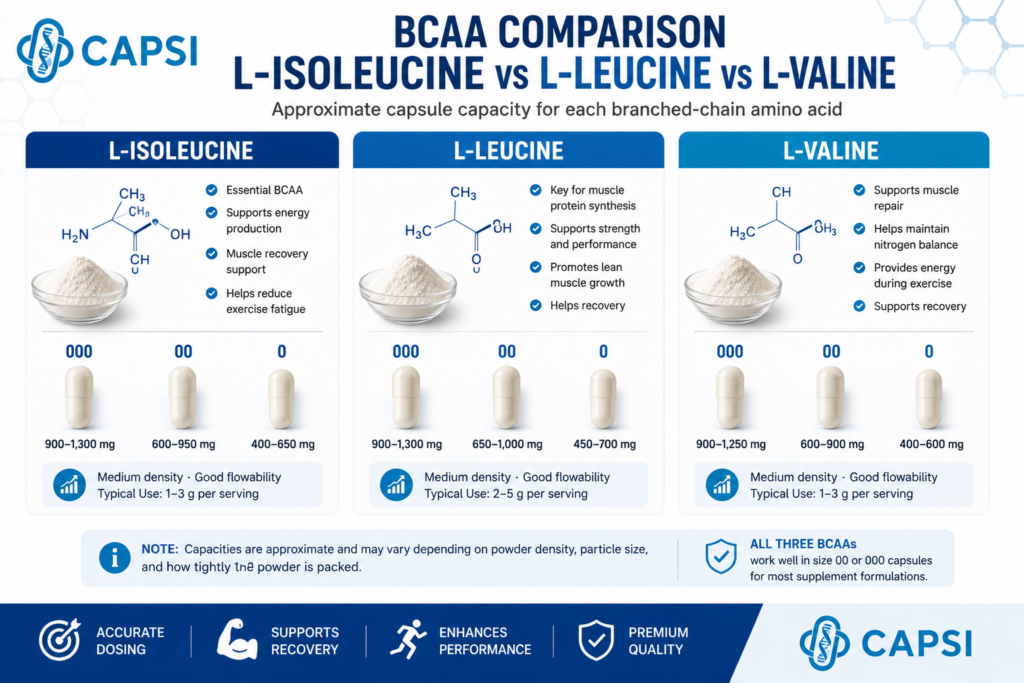
L-Isoleucine is often used alongside leucine and valine.
| Ingredient | Relative Density | Typical Capsule Requirement |
|---|---|---|
| L-Leucine | Moderate | Similar to L-Isoleucine |
| L-Isoleucine | Moderate | Medium to high |
| L-Valine | Moderate | Similar |
| BCAA 2:1:1 Blend | Moderate | Often size 00 or 000 |
Because these powders have comparable densities, capsule recommendations are generally similar across all three amino acids.
Capsule Filling Tips for L-Isoleucine
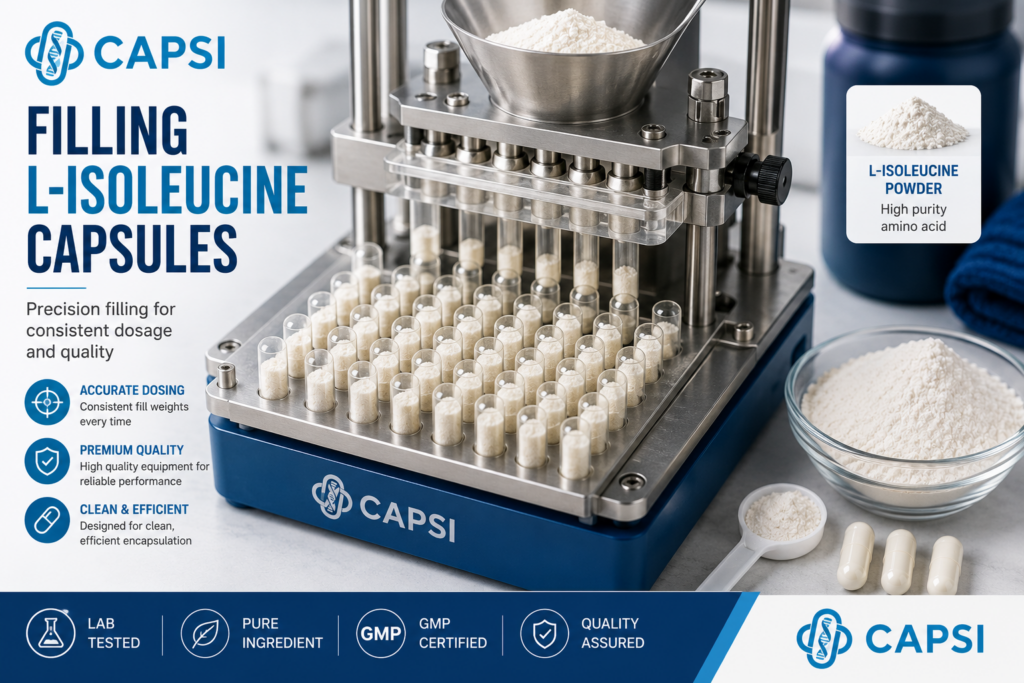
If encapsulating at home or commercially, consider the following:
Use a Capsule Filling Machine
Capsule filling machines:
- Improve consistency
- Increase efficiency
- Reduce waste
- Improve packing density
Manual capsule filling can lead to uneven fill weights.
Tap Powder During Filling
Light tapping helps powder settle inside the capsule body, increasing capacity slightly.
Avoid excessive compression, as overfilled capsules may not close properly.
Weigh Finished Capsules
Using a precision scale helps confirm actual fill weight and ensures consistency across batches.
Gelatin vs Vegetarian Capsules
L-Isoleucine powder is compatible with both capsule materials.
Gelatin Capsules
Benefits
- Cost-effective
- Excellent machinability
- Fast dissolution
- Widely used
Considerations
- Animal-derived
- Unsuitable for vegans and vegetarians
HPMC (Vegetarian) Capsules
HPMC capsules are plant-based and increasingly popular.
Benefits
- Vegan friendly
- Vegetarian suitable
- Stable in varying humidity
- Odourless and tasteless
Considerations
- Slightly more expensive
- Sometimes marginally lower fill weights depending on formulation
Moisture and Storage Considerations
L-Isoleucine powder should be stored correctly to maintain quality.
Best practices include:
- Store in a cool, dry location
- Avoid direct sunlight
- Use airtight containers
- Keep away from moisture
- Consider desiccant packs for long-term storage
Properly stored powder and capsules can remain stable for extended periods when kept under suitable conditions.
Common Uses of L-Isoleucine Supplements
L-Isoleucine is frequently included in:
- Sports nutrition products
- BCAA supplements
- EAA formulas
- Recovery blends
- Pre-workout products
- Intra-workout drinks
- Amino acid stacks
Its inclusion often depends on overall formulation goals and desired amino acid profiles.
Which Capsule Size Should You Choose?
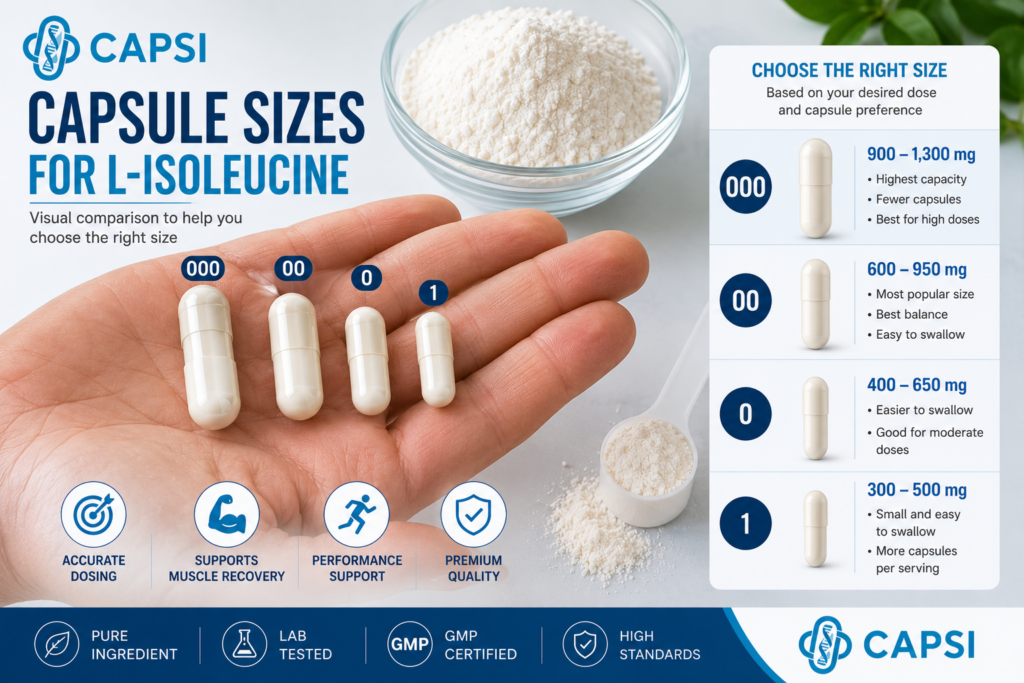
Choose Size 000 If:
✓ You want maximum capacity
✓ You want fewer capsules per serving
✓ You are producing high-dose products
Choose Size 00 If:
✓ You want the best all-round capsule
✓ You need a balance of size and capacity
✓ You want an industry-standard capsule
For most applications, size 00 capsules are the recommended choice.
Choose Size 0 If:
✓ Easier swallowing is important
✓ Lower doses are used
✓ You do not mind taking extra capsules
Frequently Asked Questions
How much L-Isoleucine fits in a size 00 capsule?
Typically around 600–950 mg, depending on powder density and filling method.
What is the best capsule size for L-Isoleucine?
For most users, size 00 capsules provide the best balance between capacity and ease of swallowing.
Can L-Isoleucine be mixed with other ingredients?
Yes. It is frequently blended with:
- L-Leucine
- L-Valine
- Electrolytes
- Essential amino acids
- Pre-workout ingredients
Are capsule capacities exact?
No. Actual fill weights vary according to:
- Powder density
- Capsule material
- Filling pressure
- Equipment used
Testing with your specific powder is always recommended.
Are vegetarian capsules suitable for L-Isoleucine?
Yes. HPMC capsules work very well with amino acid powders and are suitable for vegan formulations.
Final Thoughts
L-Isoleucine is a versatile amino acid that encapsulates well in both gelatin and vegetarian capsules. Because amino acid powders can be relatively bulky, selecting the right capsule size is important for convenience and user experience.
For most formulations:
- Size 00 capsules offer the best overall balance.
- Size 000 capsules are ideal for high-dose products.
- Size 0 capsules work well when smaller capsules are preferred.
If you are encapsulating L-Isoleucine powder, testing your specific powder density is the best way to determine exact capsule capacities.