
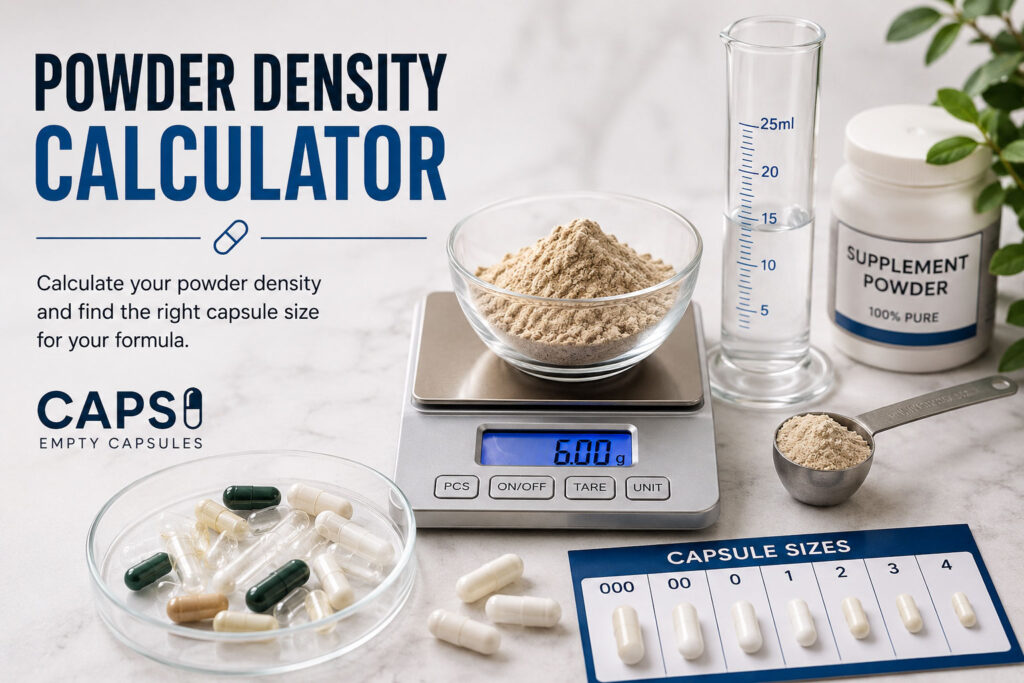
Use this calculator to estimate the density of your powder and work out how much may fit inside an empty capsule.
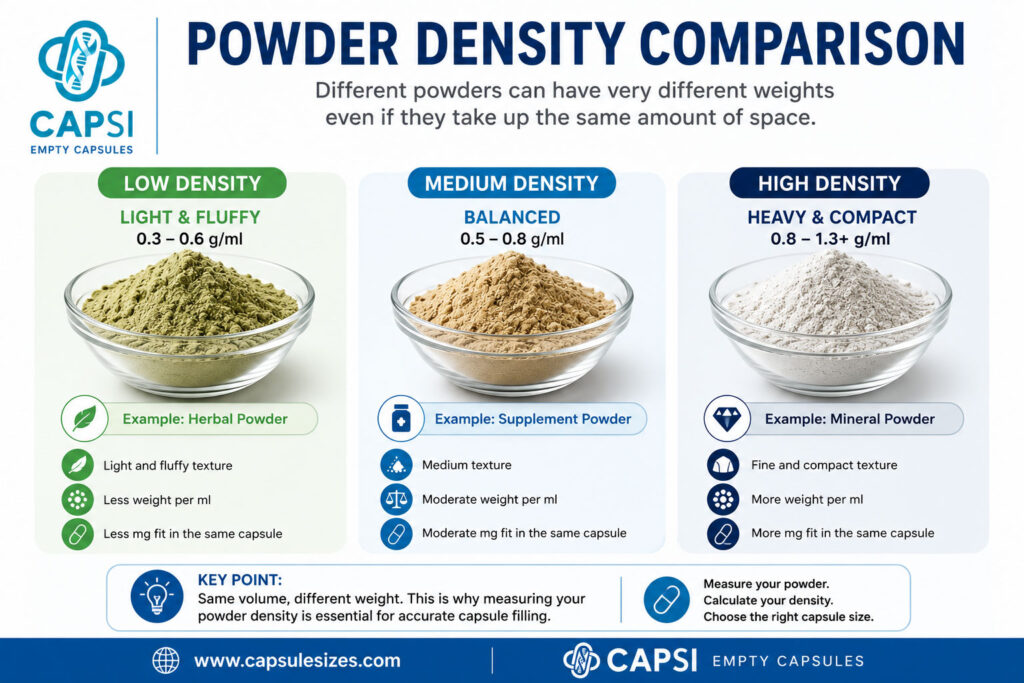
Powder density is important because two powders can weigh very differently even if they take up the same space. A fine heavy powder may fit more milligrams into a capsule, while a fluffy or light powder may fit much less.
Powder Density Calculator
Calculate your powder density in g/ml to estimate how much powder may fit inside empty capsules.
Formula: Density = Weight ÷ Volume
What Is Powder Density?
Powder density tells you how much a powder weighs for a certain amount of space. It is usually measured in g/ml (grams per millilitre).
This is important when filling empty capsules because different powders can have very different weights even if they take up the same amount of space.
A heavy compact powder may fit much more into a capsule than a light fluffy powder.
Why Powder Density Matters for Capsules
Empty capsules are measured by volume, not by weight.
This means the amount of powder that fits inside a capsule depends on how dense the powder is.
For example:
- A dense mineral powder may hold 800mg+
- A light herbal powder may only hold 300–500mg
Even though both are using the exact same capsule size.
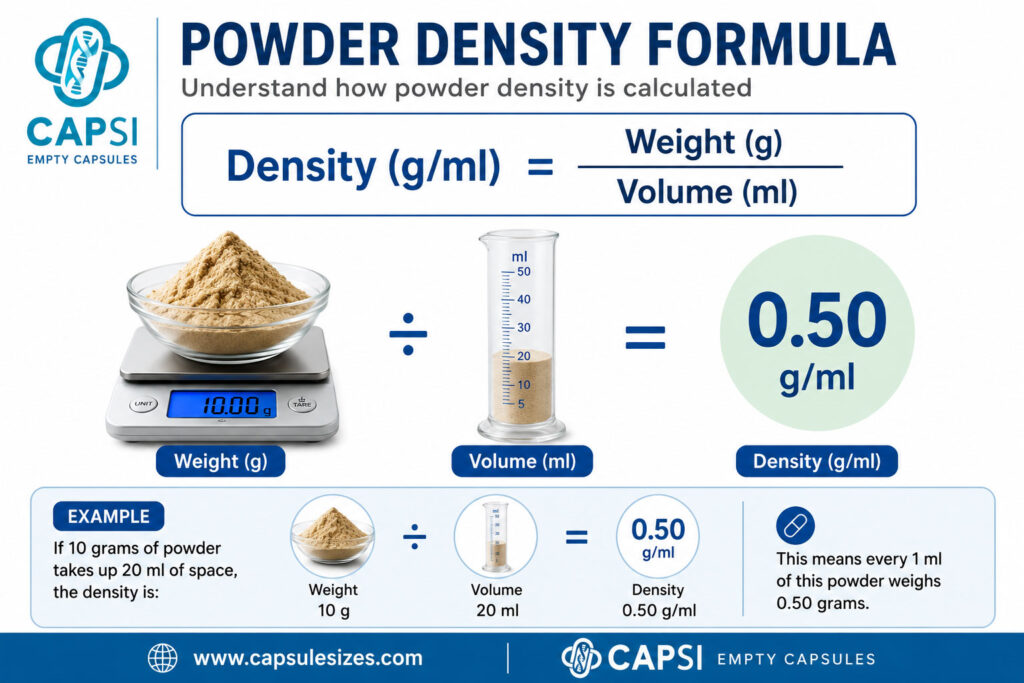
Powder Density Formula
Powder density is calculated using this formula:
Density=VolumeWeight
Example
If:
- Powder weight = 10g
- Powder volume = 20ml
Then:
2010=0.5 g/ml
The powder density is:
0.5 g/ml
How to Measure Powder Density at Home
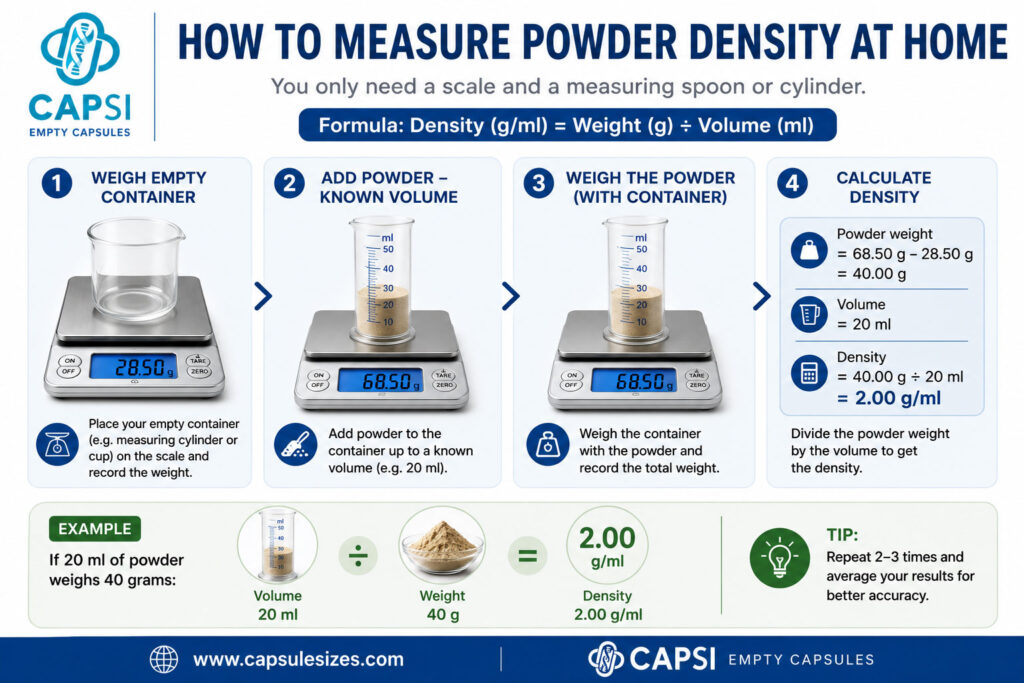
You can estimate powder density using a scale and a measuring spoon or measuring cylinder.
Simple method:
- Weigh an empty container
- Add a known volume of powder
- Weigh the powder
- Divide the weight by the volume
Example:
- 10ml powder weighs 6g
106=0.6 g/ml
So the density is approximately 0.6 g/ml.
Typical Powder Density Examples
| Powder Type | Typical Density |
|---|---|
| Light herbal powders | 0.3 – 0.6 g/ml |
| Medium supplement powders | 0.5 – 0.8 g/ml |
| Dense mineral powders | 0.8 – 1.3 g/ml |
| Fine compact powders | 1.0+ g/ml |
These are only estimates. Actual density varies depending on grind size, moisture, and compression.
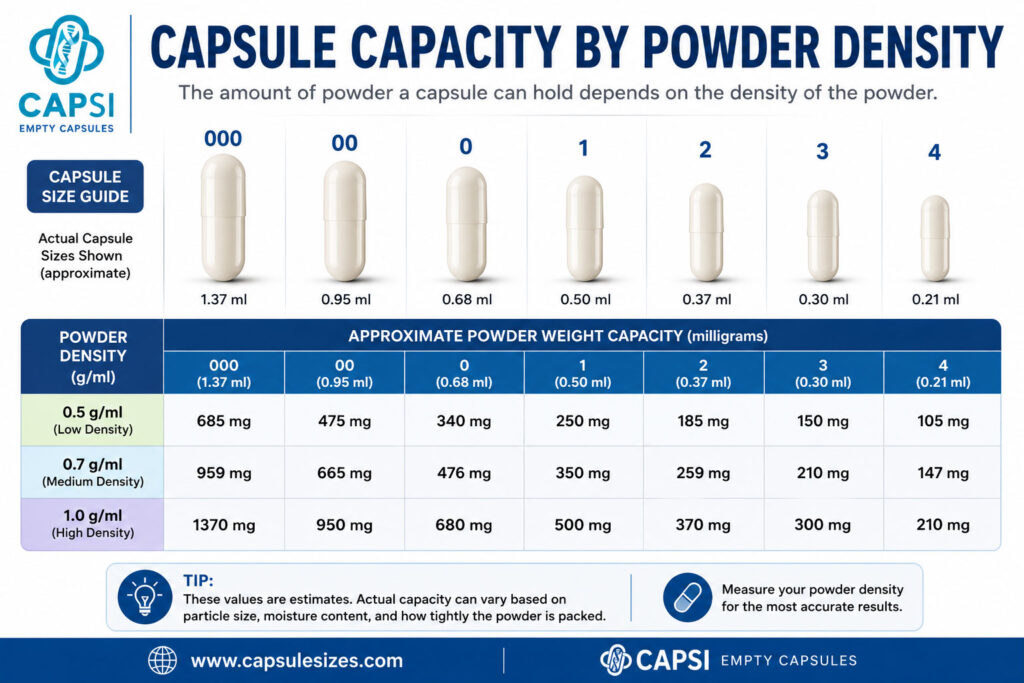
Capsule Capacity by Powder Density
| Capsule Size | Approx. Volume | At 0.5 g/ml | At 0.7 g/ml | At 1.0 g/ml |
|---|---|---|---|---|
| 000 | 1.37ml | 685mg | 959mg | 1370mg |
| 00 | 0.95ml | 475mg | 665mg | 950mg |
| 0 | 0.68ml | 340mg | 476mg | 680mg |
| 1 | 0.50ml | 250mg | 350mg | 500mg |
| 2 | 0.37ml | 185mg | 259mg | 370mg |
| 3 | 0.30ml | 150mg | 210mg | 300mg |
| 4 | 0.21ml | 105mg | 147mg | 210mg |
Best Capsule Size for Your Powder
Once you know your powder density, you can estimate the best capsule size for your desired dosage.
Larger doses often require:
- Size 000
- Size 00
- Size 0
Smaller doses may suit:
- Size 1
- Size 2
- Size 3
- Size 4
You can also use our Capsule Size Calculator to estimate capsule capacities.
Frequently Asked Questions
What is powder density?
Powder density is the weight of powder compared with the amount of space it takes up.
Why does powder density affect capsule filling?
Capsules have a fixed internal volume. Dense powders weigh more inside the same capsule.
Can I use this calculator for herbal powders?
Yes. This calculator works for herbs, supplements, protein powders, vitamins, minerals, and many other dry powders.
Does tamping powder increase capsule capacity?
Yes. Compressing or tamping powder can increase how much fits inside a capsule.
What density should I use if I do not know my powder density?
A rough starting estimate for many powders is around 0.6 g/ml, but testing your own powder gives better accuracy.