
Rice protein powder has become one of the most popular plant-based protein supplements available today. Derived primarily from brown rice, it provides a convenient source of protein for vegans, vegetarians, athletes, and individuals looking to avoid dairy-based protein products. While rice protein powder is most commonly mixed into shakes and smoothies, some users prefer to encapsulate it for convenience, accurate dosing, portability, or inclusion in custom supplement blends.
One of the most common questions people ask is: What capsule size is best for rice protein powder?
The answer depends on the density of the powder, the desired serving size, and the type of capsule being used. However, in most cases, size 000 capsules provide the best balance between capacity and practicality.
What Is Rice Protein Powder?
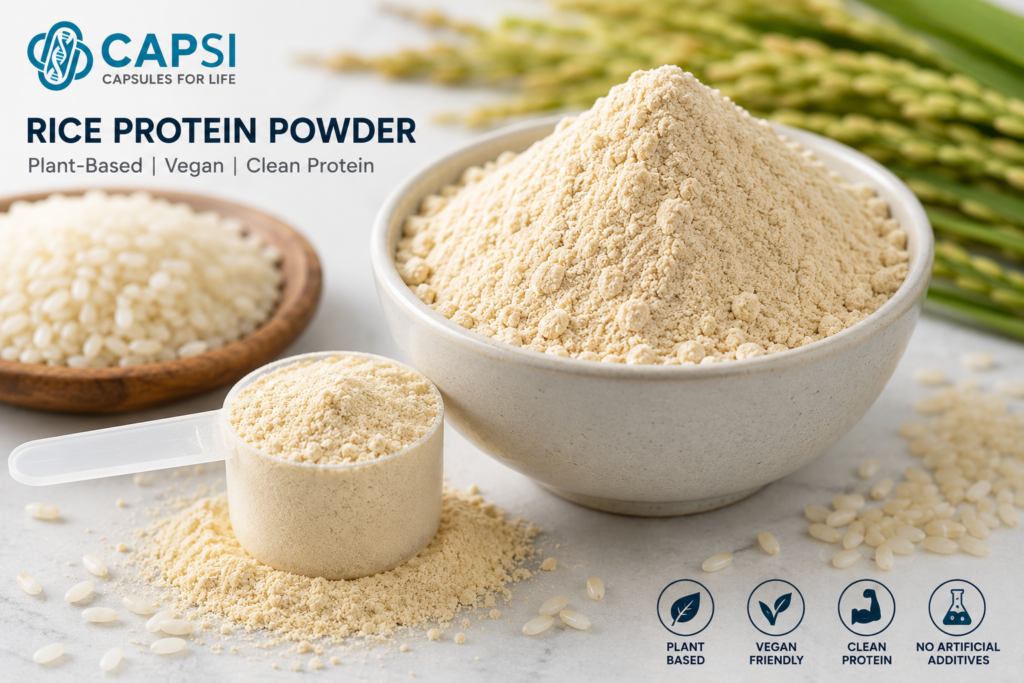
Rice protein powder is produced by separating protein from brown rice through various filtration and processing methods. The resulting powder contains a concentrated amount of protein while retaining many of the nutritional benefits associated with rice.
Rice protein is commonly used by:
- Vegans and vegetarians
- Individuals with dairy allergies
- Athletes seeking plant-based protein sources
- People sensitive to soy protein
- Supplement manufacturers producing vegan formulations
Unlike whey protein, rice protein is entirely plant-based and generally well tolerated by those with food sensitivities.
What Capsule Size Is Best for Rice Protein Powder?
Because rice protein powder is relatively light and fluffy compared to dense ingredients such as minerals, amino acids, or botanical extracts, it requires larger capsules to hold meaningful amounts.
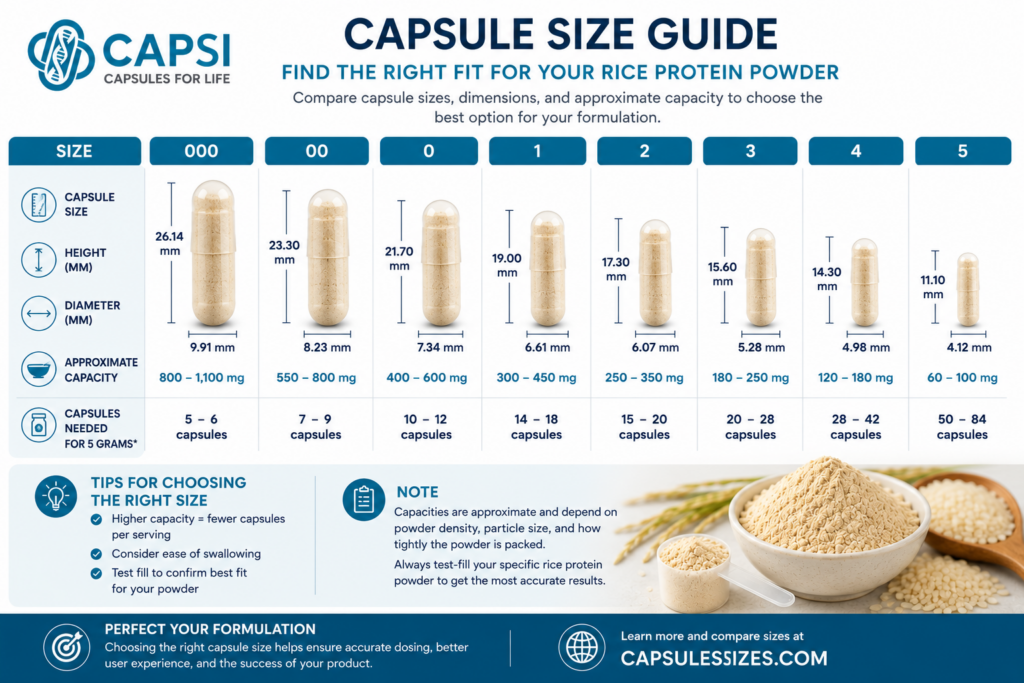
Recommended Capsule Sizes
| Capsule Size | Approximate Capacity |
|---|---|
| 000 | 800–1,100 mg |
| 00 | 550–800 mg |
| 0 | 400–600 mg |
| 1 | 300–450 mg |
| 2 | 200–350 mg |
Actual fill weights vary depending on:
- Powder density
- Moisture content
- Milling process
- Particle size
- Filling technique
For most rice protein powders, size 000 capsules are strongly recommended because they maximize capacity and reduce the total number of capsules required.
Why Rice Protein Powder Requires Large Capsules
Many supplement ingredients are highly concentrated and dense. For example, a capsule may easily hold hundreds of milligrams of vitamins, minerals, or herbal extracts.
Protein powders are different.
Rice protein contains larger particles and more air space between particles. This means fewer grams fit into a given capsule volume.
As a result:
- Small capsules fill quickly
- More capsules are required per serving
- Larger capsule sizes become more practical
This is why size 000 capsules are frequently selected when encapsulating any type of protein powder.
Rice Protein Capsule Capacity Guide
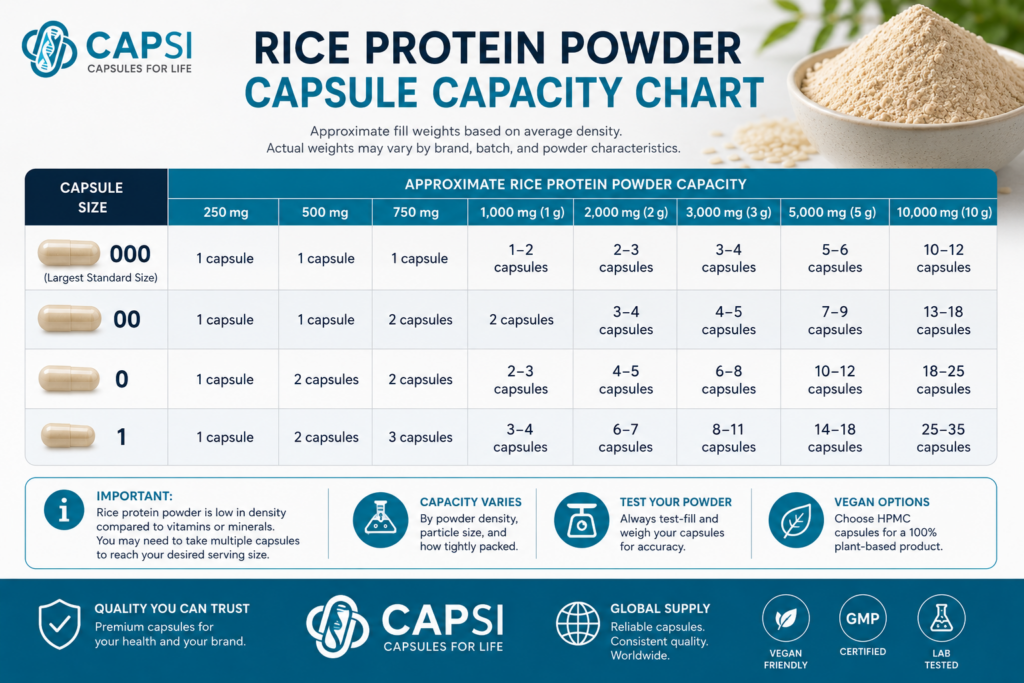
The following estimates illustrate how many capsules may be required.
For Size 000 Capsules
| Desired Amount | Capsules Required |
|---|---|
| 1 gram | 1–2 capsules |
| 2 grams | 2–3 capsules |
| 3 grams | 3–4 capsules |
| 5 grams | 5–6 capsules |
| 10 grams | 10–12 capsules |
For Size 00 Capsules
| Desired Amount | Capsules Required |
|---|---|
| 1 gram | 2 capsules |
| 3 grams | 4–5 capsules |
| 5 grams | 7–9 capsules |
| 10 grams | 13–18 capsules |
This demonstrates why larger capsule sizes are generally preferred when working with protein powders.
Size 000 vs Size 00 for Rice Protein Powder
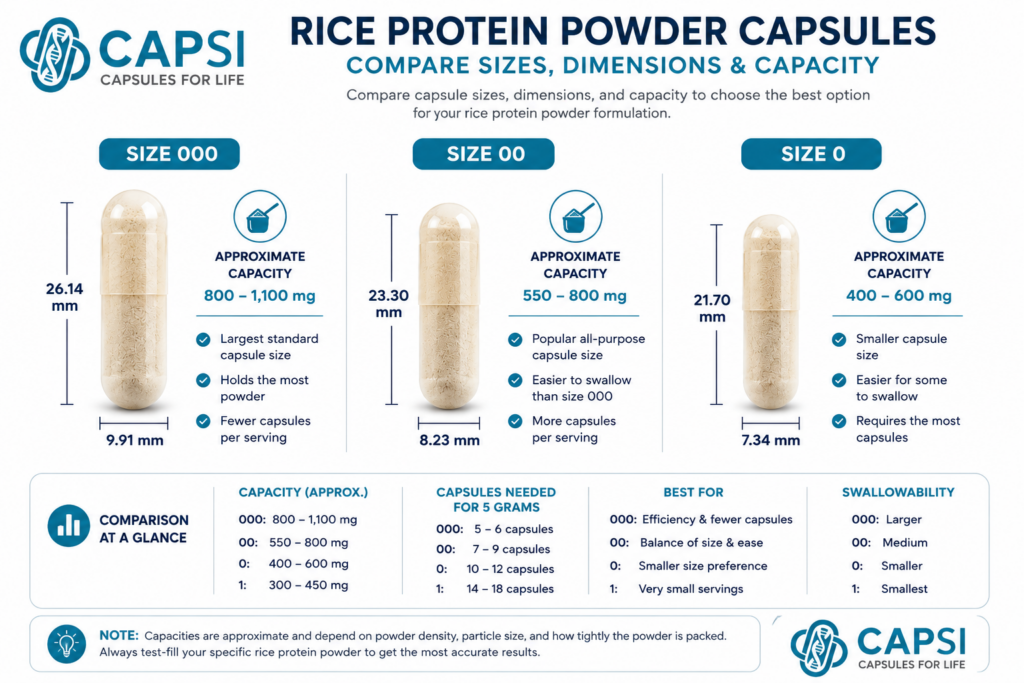
Many people choose between size 000 and size 00 capsules.
Size 000 Capsules
Advantages:
- Highest standard capsule capacity
- Fewer capsules per serving
- Faster filling process
- More practical for protein powders
Disadvantages:
- Larger to swallow
- Slightly higher material costs
Size 00 Capsules
Advantages:
- Easier for some users to swallow
- Widely available
- Popular all-purpose capsule size
Disadvantages:
- Lower capacity
- More capsules needed per serving
For rice protein powder specifically, size 000 capsules are usually the better choice.
Rice Protein Powder Density Considerations
Not all rice protein powders behave identically.
Factors that influence capsule capacity include:
Fine-Milled Powders
Finely processed rice protein generally packs more efficiently and may achieve higher fill weights.
Coarse Powders
Coarser powders contain more air gaps and usually result in lower fill weights.
Organic Rice Protein
Organic rice protein powders may vary in density depending on processing methods and source materials.
Protein Percentage
Higher-protein formulations may have slightly different flow and packing characteristics compared with lower-concentration products.
Testing a small batch is always recommended before committing to large-scale production.
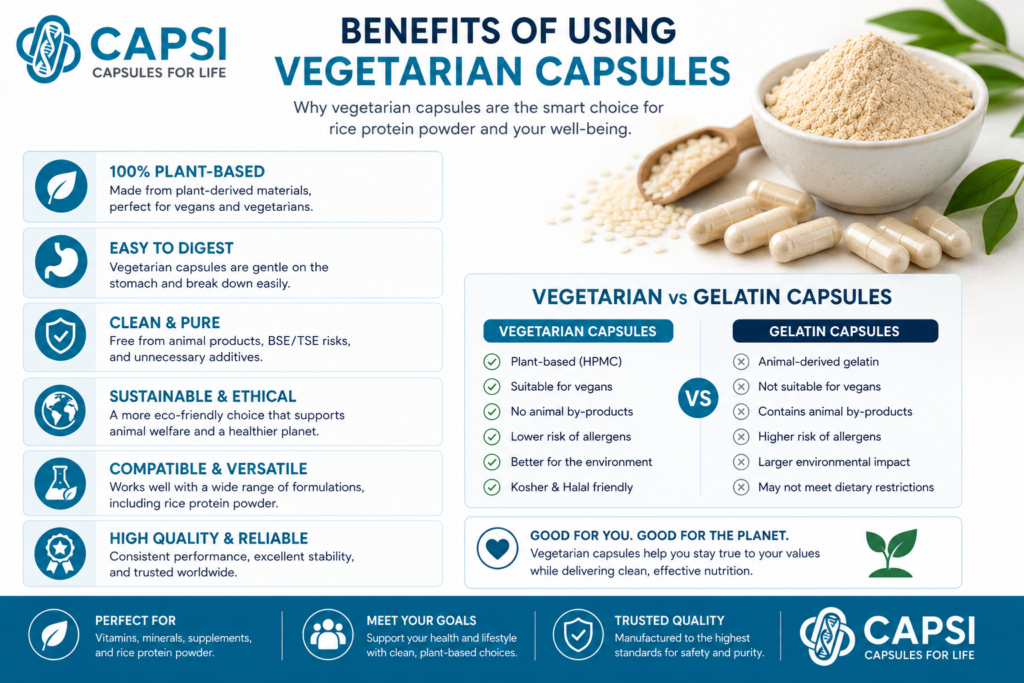
Vegetarian Capsules for Rice Protein Powder
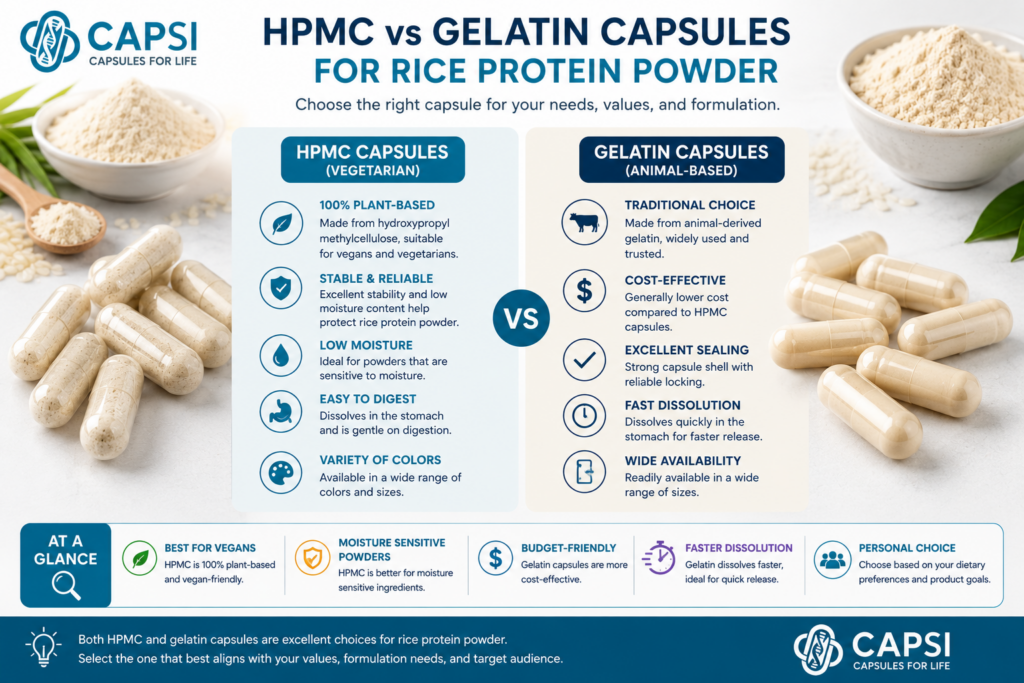
Since rice protein is plant-based, many users prefer vegetarian capsules to maintain a fully vegan product.
HPMC Capsules
HPMC capsules are made from hydroxypropyl methylcellulose and offer several advantages:
- Vegan friendly
- Vegetarian friendly
- Suitable for plant-based supplements
- Stable under varying conditions
- Popular among health-conscious consumers
Pullulan Capsules
Pullulan capsules are another plant-based option.
Benefits include:
- Excellent oxygen barrier properties
- Suitable for premium supplements
- Vegan compatible
Gelatin Capsules
Gelatin capsules remain popular because they are economical and easy to fill.
Benefits include:
- Cost-effective
- Strong and reliable
- Widely available
However, gelatin capsules are not suitable for vegan formulations.
Can Rice Protein Powder Be Encapsulated at Home?
Yes.
Many people encapsulate rice protein powder at home using manual capsule filling machines.
Typical equipment includes:
- Empty capsules
- Capsule filling machine
- Powder spreader
- Tamper tool
- Digital scale
A simple capsule filler can dramatically increase productivity compared with filling capsules individually.
Tips for Filling Rice Protein Capsules
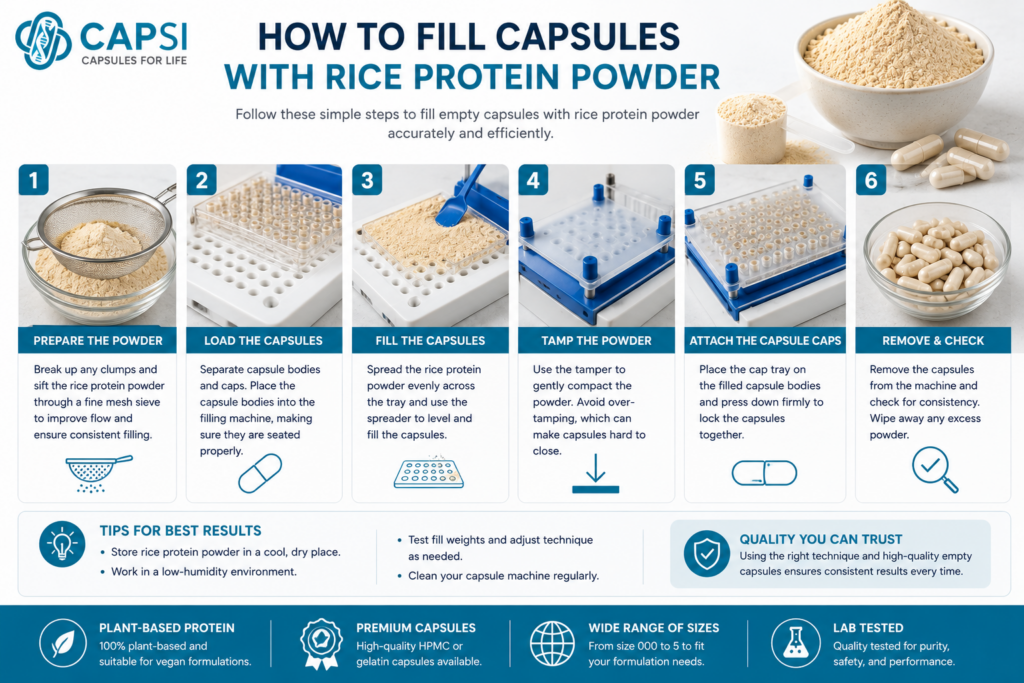
Use a Capsule Machine
A filling machine improves consistency and saves time.
Break Up Clumps
Protein powders can sometimes clump due to humidity.
Passing the powder through a fine sieve can improve flow.
Test Fill Weights
Weigh several finished capsules to establish average capacity.
Store in Dry Conditions
Moisture can affect both the powder and the capsule shell.
Avoid Over-Tamping
Compressing powder excessively may make capsules difficult to close and can lead to inconsistent filling.
Rice Protein Powder vs Other Protein Powders
Rice Protein vs Whey Protein
Whey protein is generally denser and may fit slightly more efficiently into capsules.
Rice protein offers:
- Plant-based sourcing
- Dairy-free formulation
- Vegan suitability
Rice Protein vs Pea Protein
Both are popular vegan proteins.
Pea protein often has a similar bulk density and usually requires comparable capsule sizes.
Rice Protein vs Hemp Protein
Hemp protein is often coarser and less dense, which can result in lower capsule capacities.
Rice Protein vs Casein Protein
Casein tends to be denser than many plant proteins and may achieve slightly higher fill weights.
Who Uses Rice Protein Capsules?
Rice protein capsules may be useful for:
- Travellers
- Athletes
- Capsule manufacturers
- Custom supplement formulators
- Individuals avoiding flavoured protein shakes
Although capsules provide convenience, larger protein servings are typically easier to consume as powders mixed into liquids.
Is Encapsulating Rice Protein Practical?
For smaller doses, absolutely.
For example:
- 1–5 grams per day is manageable
- Custom supplement blends work well
- Travel use is convenient
For larger protein intakes of 20–30 grams or more, shakes remain the more practical option because they require significantly fewer servings.
Choosing the Right Empty Capsules
When selecting empty capsules for rice protein powder, consider:
- Capsule size
- Shell material
- Intended serving size
- Filling equipment compatibility
- Storage conditions
Most users find that size 000 capsules provide the most efficient solution for rice protein powder.
Frequently Asked Questions
What capsule size is best for rice protein powder?
For most rice protein powders, size 000 capsules are the best choice. They offer the highest capacity among standard capsule sizes and reduce the number of capsules needed per serving.
How much rice protein powder fits in a size 000 capsule?
A size 000 capsule typically holds approximately 800–1,100 mg of rice protein powder. Actual capacity may vary depending on powder density, particle size, and filling method.
How much rice protein powder fits in a size 00 capsule?
Size 00 capsules generally hold around 550–800 mg of rice protein powder. They are a popular alternative to size 000 capsules for users who prefer a slightly smaller capsule.
How many capsules are needed for 5 grams of rice protein powder?
The number of capsules required depends on the capsule size used:
- Size 000: approximately 5–6 capsules
- Size 00: approximately 7–9 capsules
- Size 0: approximately 10–12 capsules
Can rice protein powder be put into capsules?
Yes. Rice protein powder can be encapsulated using empty gelatin or vegetarian capsules. Many users encapsulate rice protein for convenience, portability, or custom supplement formulations.
Are HPMC capsules suitable for rice protein powder?
Yes. HPMC capsules are an excellent option for rice protein powder because they are vegan-friendly, plant-based, and suitable for vegetarian formulations.
Are gelatin capsules suitable for rice protein powder?
Yes. Gelatin capsules work well with rice protein powder and are often easier to fill. However, they are not suitable for vegan or vegetarian products.
Is rice protein powder vegan?
Rice protein powder is naturally plant-based and is generally considered vegan. When paired with HPMC capsules, it creates a fully vegan supplement.
Which capsule size requires the fewest capsules per serving?
Size 000 capsules require the fewest capsules per serving because they have the largest capacity of standard two-piece capsules.
Is it practical to take rice protein powder in capsules?
Rice protein capsules are practical for smaller daily servings or travel use. However, for larger protein intakes of 20–30 grams, mixing the powder into a shake is usually more convenient.
Does rice protein powder have a low density?
Yes. Rice protein powder is less dense than many vitamins and minerals, meaning it occupies more space and typically requires larger capsules.
Can I fill rice protein capsules at home?
Absolutely. With a capsule filling machine, digital scale, and empty capsules, you can easily encapsulate rice protein powder at home.
Should I choose size 000 or size 00 capsules?
If minimizing the number of capsules is your priority, size 000 capsules are usually the better option. If ease of swallowing is more important, size 00 capsules may be preferred.
How should rice protein capsules be stored?
Store rice protein capsules in a cool, dry place away from direct sunlight and humidity. Proper storage helps maintain capsule integrity and powder quality.
Can rice protein powder be combined with other ingredients in capsules?
Yes. Rice protein powder is often blended with ingredients such as pea protein, amino acids, vitamins, or botanical extracts to create custom formulations. Always test capsule fill weights when using blends.
Conclusion
Rice protein powder is one of the most popular plant-based protein supplements available. Due to its relatively low density and bulky nature, larger capsules are generally required when encapsulating the powder.
For most applications:
- Size 000 capsules are the best choice.
- Size 00 capsules are a workable alternative.
- HPMC capsules are ideal for vegan formulations.
- Testing actual fill weights is always recommended.
If your goal is to minimize the number of capsules per serving while maximizing efficiency, size 000 capsules are typically the preferred option for rice protein powder.
Related guides
- Capsule Sizes for Protein Powder
- Capsule Sizes for Pea Protein Powder
- Capsule Sizes for Hemp Protein Powder
- Capsule Sizes for Casein Protein Powder
- Capsule Sizes for Whey Protein Isolate
- Capsule Sizes for Whey Protein Concentrate
- Capsule Sizes for EAA Powder
- Capsule Sizes for Buffered Creatine
- Capsule Sizes for Creatine HCL
- Capsule Sizes for L-Citrulline
- Capsule Sizes for Citrulline Malate
- Capsule Size Chart
- Capsule Capacity Chart
- Capsule Volume Chart
- How Many mg Fit in a Capsule?
- Capsule Sizes Explained