
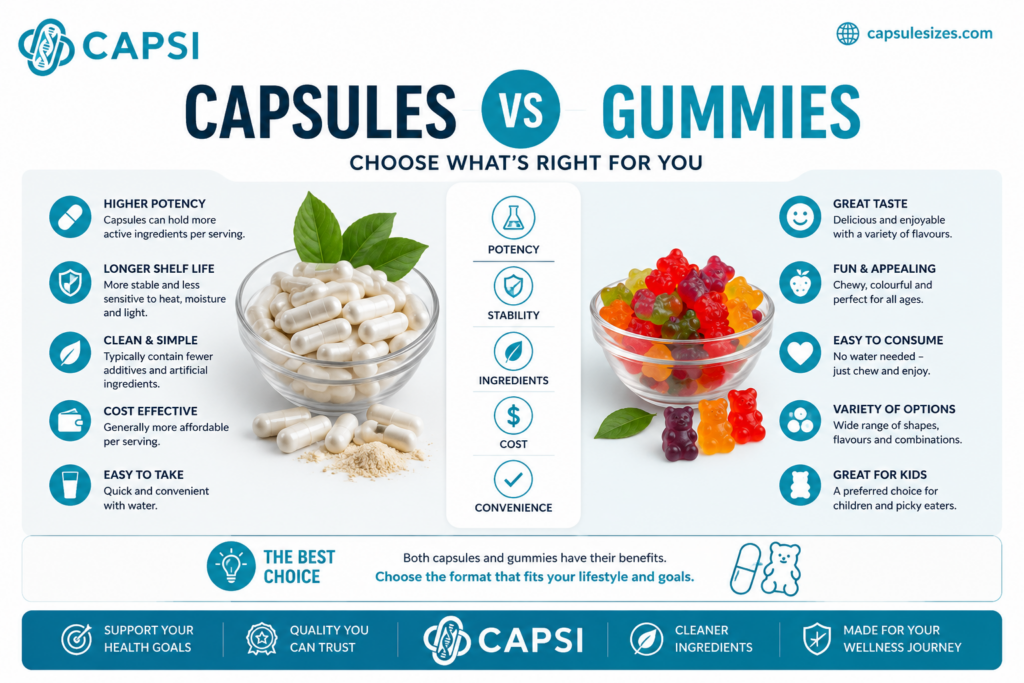
When shopping for supplements, you’ll often come across two popular formats: capsules and gummies. Both are designed to deliver vitamins, minerals, herbal extracts, probiotics, and other active ingredients, but they differ significantly in how they are manufactured, how much ingredient they can contain, how long they last, and the overall user experience they provide.
Gummies have become increasingly popular thanks to their pleasant taste and convenience, while capsules remain the preferred option for many manufacturers and consumers due to their higher ingredient capacity, cleaner formulations, and superior shelf life.
In this guide, we’ll compare capsules and gummies in detail, examining everything from ingredient capacity and storage stability to cost, convenience, and suitability for different users.
What Are Capsules?
Capsules are small shells designed to hold powdered, granulated, or pelletised ingredients. Once swallowed, the capsule shell dissolves and releases the contents.
Capsules are commonly made from:
- Gelatin (animal-derived)
- HPMC (Hydroxypropyl Methylcellulose), suitable for vegetarians and vegans
Capsules are available in multiple sizes, ranging from Size 000 (largest) to Size 4 (smallest), allowing manufacturers to select the most suitable format for different ingredient volumes.
One of the biggest advantages of capsules is their flexibility. They can accommodate a wide variety of ingredients without requiring sweeteners, flavourings, colours, or other additives.
What Are Gummies?
Gummies are chewable supplements made using active ingredients combined with sweeteners, flavourings, colours, and gelling agents.
They are designed to provide a pleasant experience and are especially popular among people who dislike swallowing capsules or tablets.
Most gummies contain:
- Active ingredients
- Sweeteners
- Flavourings
- Colourings
- Pectin or gelatin
- Acids and preservatives
Although gummies are enjoyable to consume, the additional ingredients required to create their texture and flavour often limit the amount of active ingredient each gummy can contain.
Quick Comparison
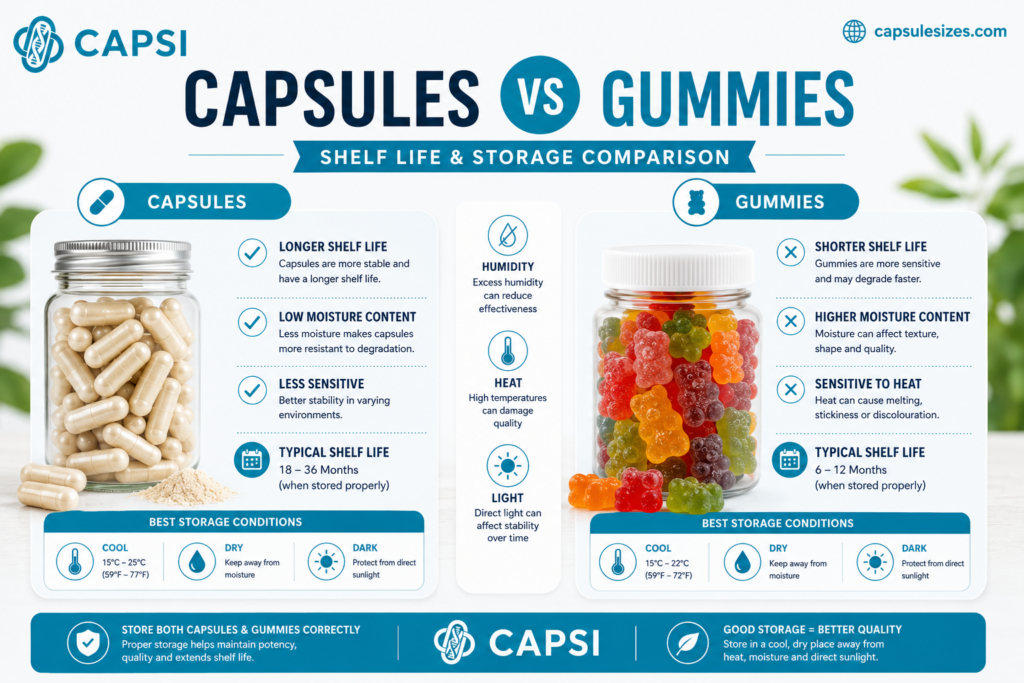
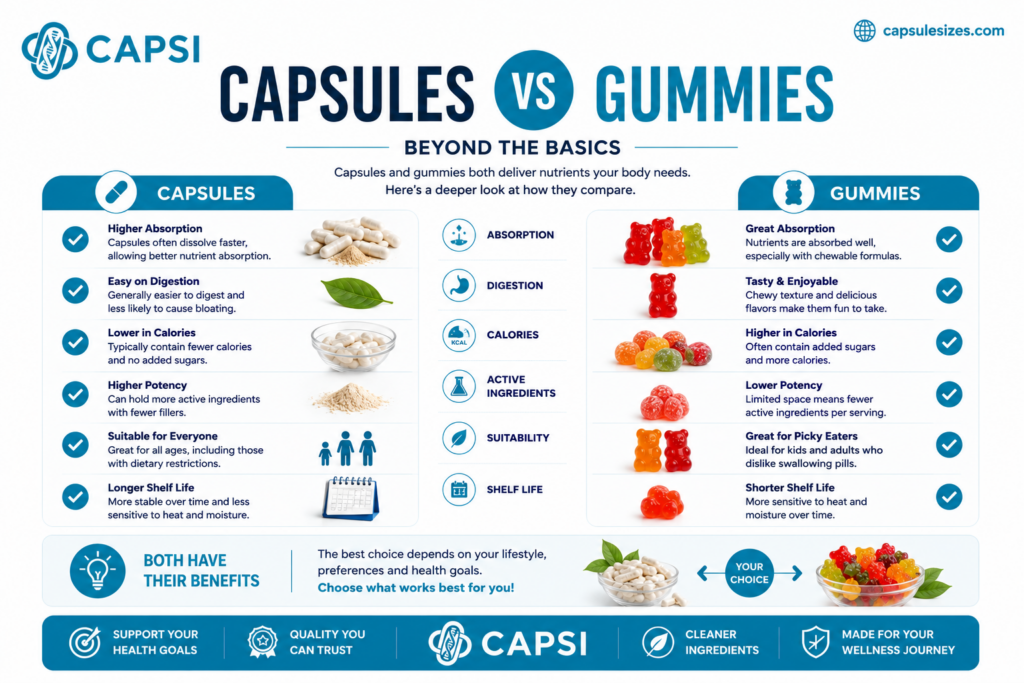
| Feature | Capsules | Gummies |
|---|---|---|
| Ingredient Capacity | High | Lower |
| Taste | Neutral | Flavoured |
| Sugar Content | Usually None | Often Present |
| Additives | Minimal | Usually More |
| Shelf Life | Longer | Shorter |
| Cost | Lower | Higher |
| Vegan Options | Available | Available |
| Convenience | Requires Water | Can Be Chewed |
| Stability | Excellent | Moderate |
Ingredient Capacity Comparison
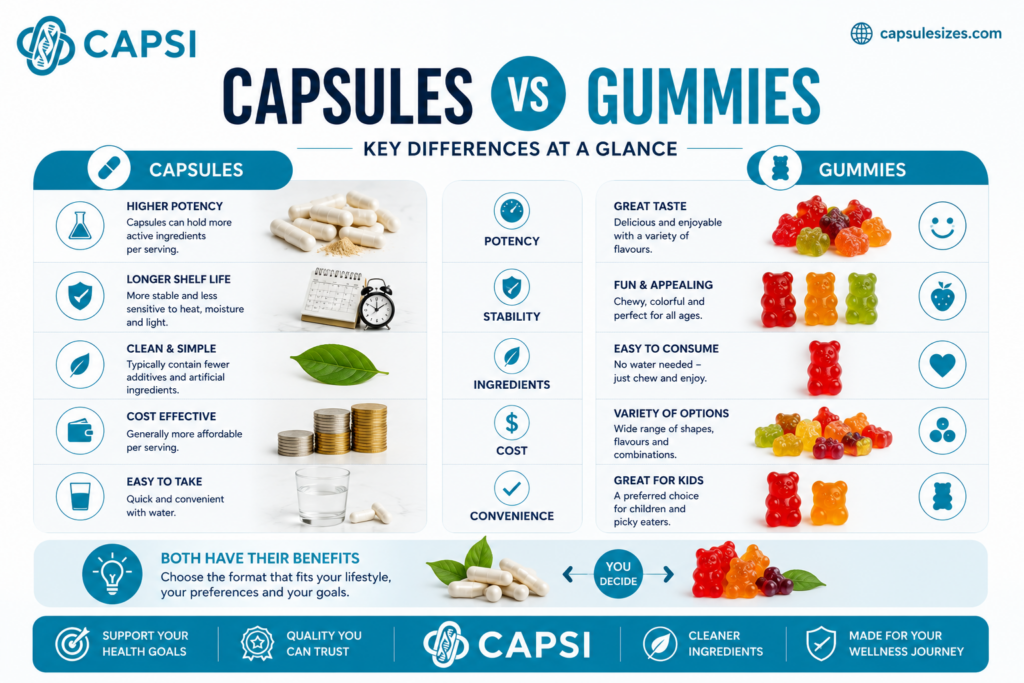
One of the most significant differences between capsules and gummies is ingredient capacity.
Typical Capsule Capacity
| Capsule Size | Approximate Capacity |
|---|---|
| Size 000 | 800–1,400 mg |
| Size 00 | 600–1,000 mg |
| Size 0 | 400–700 mg |
| Size 1 | 300–500 mg |
Typical Gummy Capacity
Most gummies contain approximately:
- 100–500 mg per piece
- Often require multiple gummies per serving
Because capsules can hold significantly more active ingredients, they are often used for high-strength formulations and concentrated herbal extracts.
Winner: Capsules
If maximum ingredient capacity is important, capsules are generally the superior option.
Taste and User Experience
This is where gummies often shine.
Many consumers enjoy gummies because they:
- Taste pleasant
- Require no water
- Feel more like a treat than a supplement
- Are easier for children and some adults to consume
Capsules, by contrast, are designed for functionality rather than flavour. Most capsules have little or no taste when swallowed correctly.
Winner: Gummies
For flavour and enjoyment, gummies have a clear advantage.
Ingredients and Additives
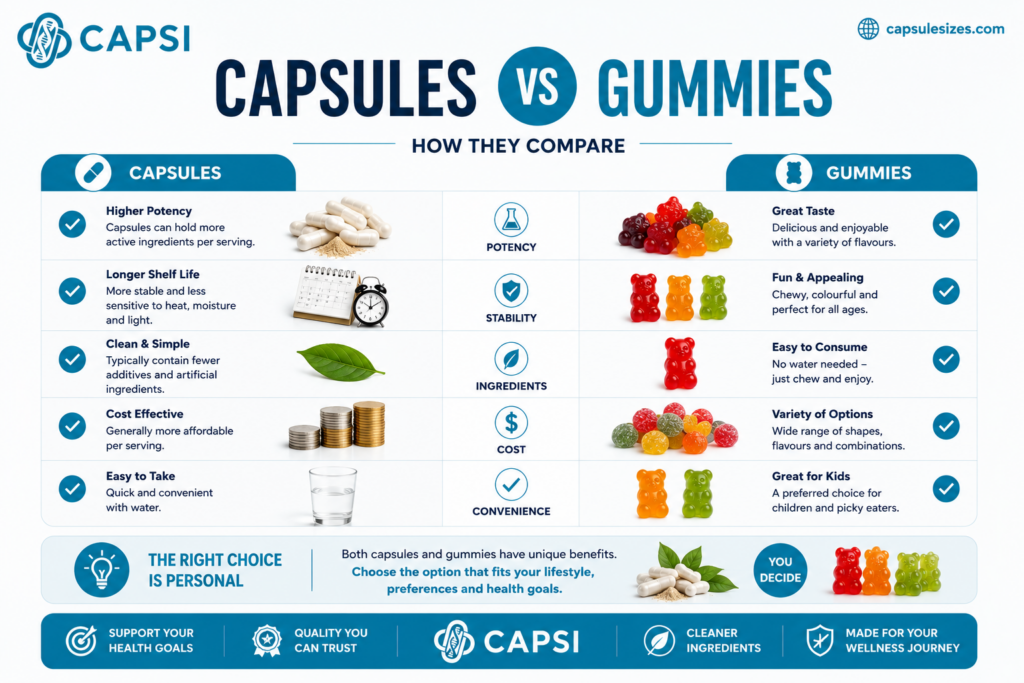
Capsules are often favoured by consumers looking for cleaner formulations.
A typical capsule product may contain only:
- Active ingredient
- Capsule shell
Many gummy products require additional ingredients including:
- Sweeteners
- Flavourings
- Colourings
- Gelling agents
- Preservatives
Although these ingredients are generally considered safe, they may not appeal to consumers seeking the simplest possible formulation.
Winner: Capsules
Capsules typically offer cleaner ingredient lists and fewer additives.
Sugar Content
Many gummies contain sugar or alternative sweeteners to improve flavour and texture.
While sugar-free gummies exist, they often use:
- Maltitol
- Sorbitol
- Stevia
- Other sugar substitutes
Capsules generally contain no added sugar.
For consumers monitoring sugar intake, capsules are often the preferred choice.
Winner: Capsules
Shelf Life and Storage
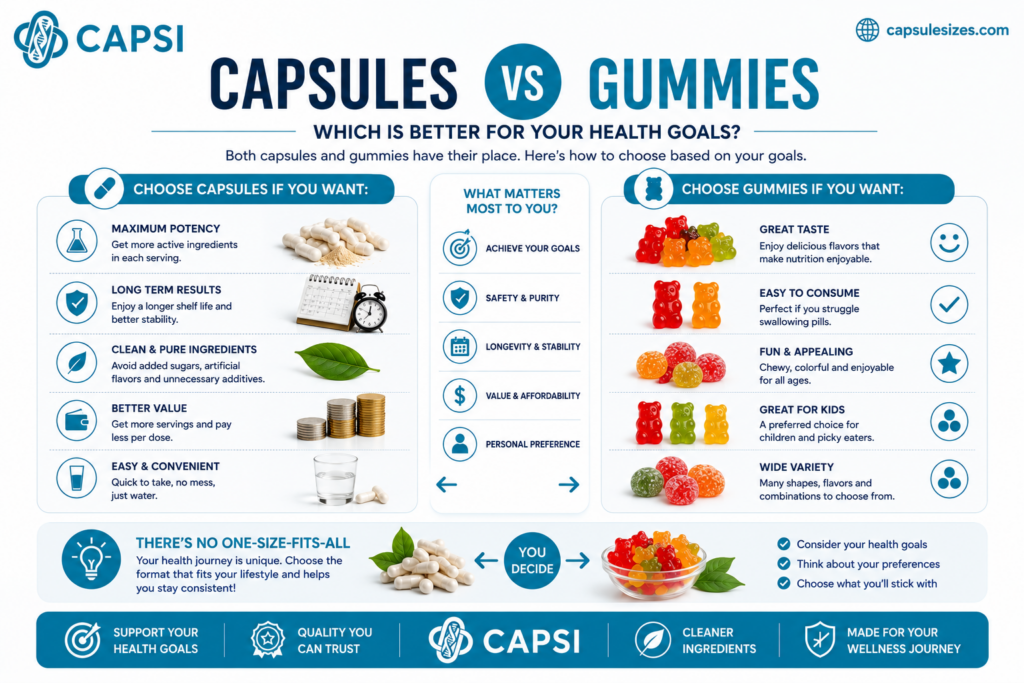
Capsules generally have a longer shelf life because they contain less moisture and fewer ingredients susceptible to degradation.
Capsules are typically:
- More resistant to heat
- More resistant to humidity
- Easier to store long-term
Gummies can become:
- Sticky
- Hard
- Soft
- Misshapen
when exposed to heat or moisture.
Typical Shelf Life
Capsules
- Often 18–36 months
Gummies
- Often 6–24 months
depending on formulation and packaging.
Winner: Capsules
Manufacturing Complexity
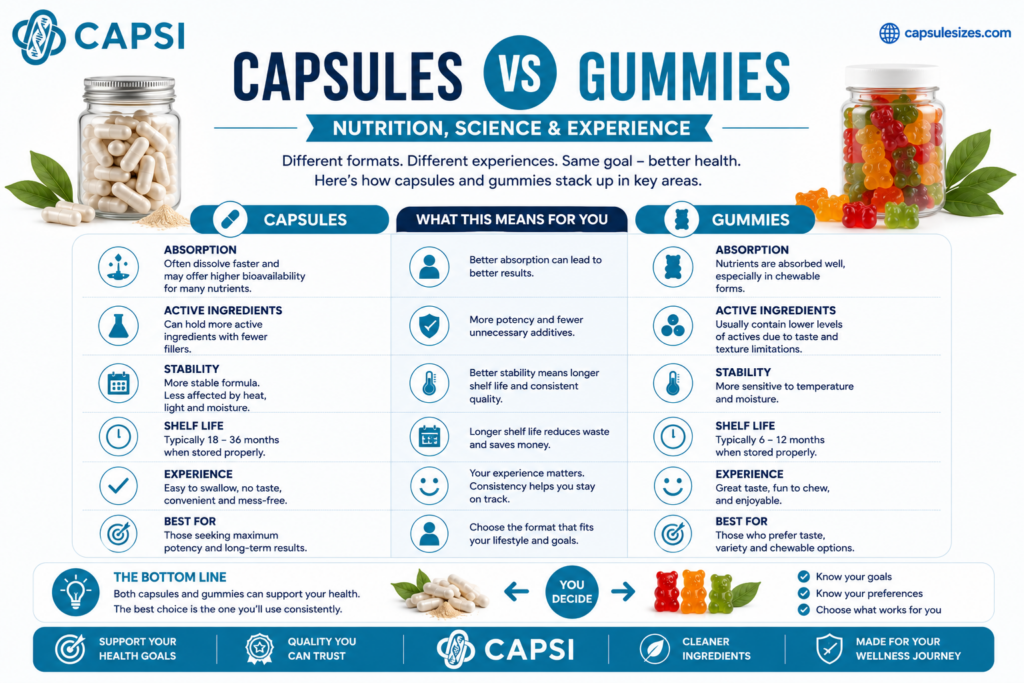
Capsule production is generally straightforward.
The process involves:
- Preparing ingredients
- Filling capsule shells
- Closing capsules
- Quality inspection
- Packaging
Gummy production typically requires:
- Mixing ingredients
- Heating and cooking
- Depositing into moulds
- Cooling and setting
- Coating
- Packaging
The additional steps increase production costs and complexity.
Winner: Capsules
Cost Comparison
Because capsules require fewer ingredients and simpler manufacturing processes, they are usually more cost-effective.
Capsules often provide:
- Lower production costs
- Lower shipping costs
- Better value per serving
Gummies tend to cost more because of:
- Additional ingredients
- More complex manufacturing
- Larger packaging requirements
Winner: Capsules
Vegan and Vegetarian Options
Both formats are available in vegan-friendly versions.
Vegan Capsules
Most vegan capsules are manufactured from HPMC.
Benefits include:
- Plant-based
- Suitable for vegans
- Widely available
Vegan Gummies
Vegan gummies typically use pectin instead of gelatin.
Benefits include:
- Plant-based
- Chewable
- Suitable for vegan consumers
Winner: Draw
Both formats offer excellent vegan alternatives.
Who Should Choose Capsules?
Capsules are often the best choice if you:
- Want higher ingredient doses
- Prefer minimal additives
- Need longer shelf life
- Want sugar-free options
- Value cost-effectiveness
- Prefer cleaner ingredient labels
Capsules are particularly popular among supplement manufacturers and consumers seeking concentrated formulations.
Who Should Choose Gummies?
Gummies may be the better choice if you:
- Prioritise taste
- Dislike swallowing capsules
- Want a more enjoyable experience
- Need a convenient option without water
- Are purchasing supplements for children
For some users, consistency is easier when supplements are enjoyable to take.
Frequently Asked Questions
Are capsules healthier than gummies?
Capsules often contain fewer additives and less sugar, but both formats can be effective depending on the formulation.
Do gummies work as well as capsules?
Yes. Both can be effective delivery formats. The effectiveness depends primarily on the active ingredient rather than whether it is delivered in a capsule or gummy.
Why do gummies contain less active ingredient?
Gummies require space for sweeteners, flavourings, and gelling agents, reducing the amount of active ingredient each piece can contain.
Do capsules absorb better?
Absorption depends on the ingredient itself. However, capsules often dissolve quickly and can accommodate larger doses.
Which format lasts longer?
Capsules generally have a longer shelf life because they contain less moisture and fewer stability-sensitive ingredients.
Are vegan capsules available?
Yes. HPMC capsules are widely used for vegan and vegetarian products.
Do gummies always contain sugar?
No. Sugar-free gummies are available, although they usually contain alternative sweeteners.
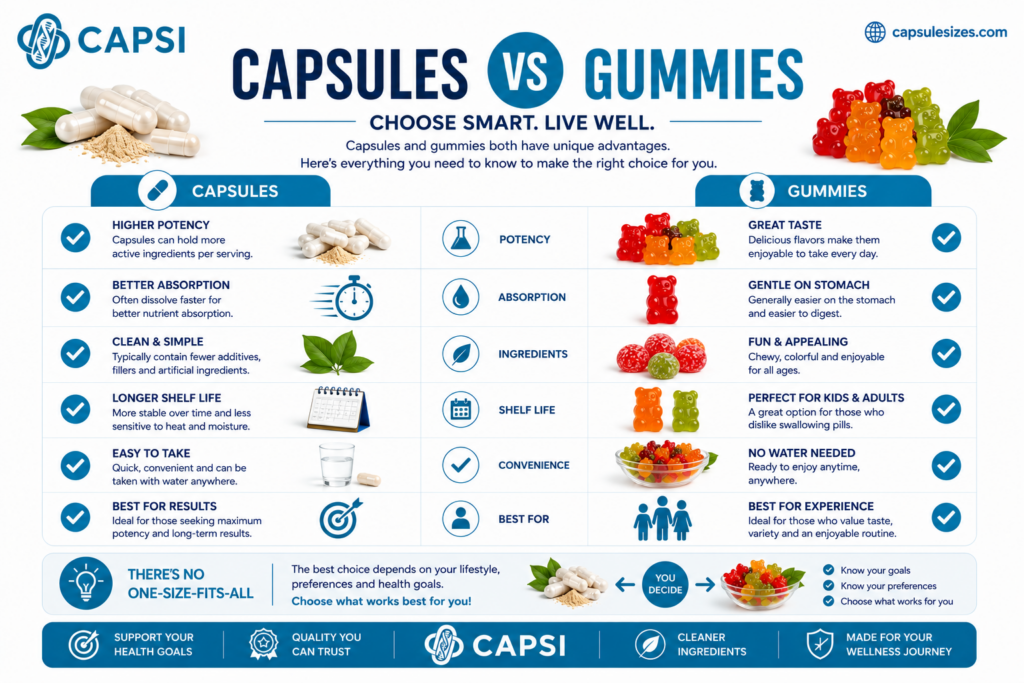
Final Verdict
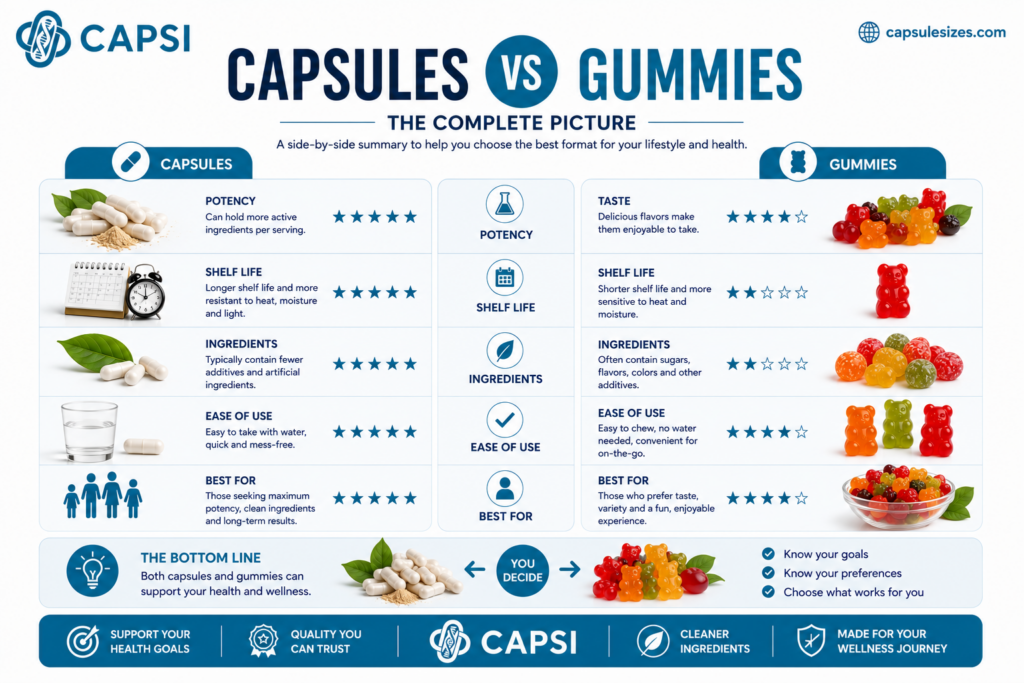
Both capsules and gummies have their advantages, and neither format is universally better for every user.
Gummies provide excellent taste, convenience, and ease of use, making them appealing for people who dislike swallowing capsules.
Capsules, however, offer higher ingredient capacity, cleaner formulations, fewer additives, longer shelf life, and better overall value. For high-strength supplements and consumers seeking simple, efficient formulations, capsules are often the preferred option.
Ultimately, the best choice depends on your personal preferences, health goals, and lifestyle.