
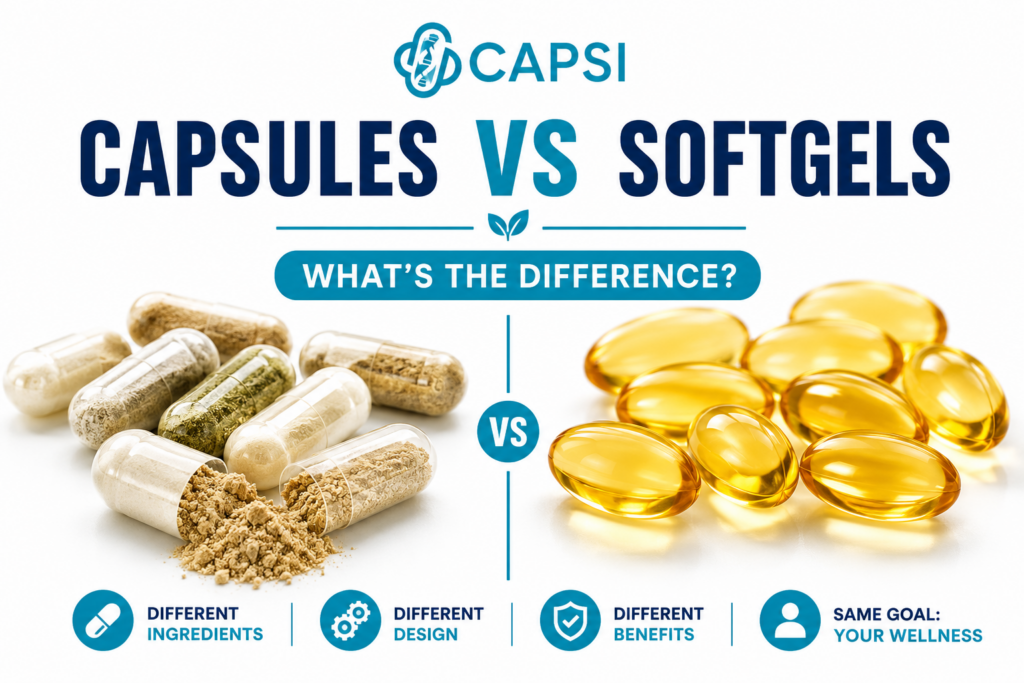
Capsules and softgels are two of the most popular supplement delivery formats available today. While they may look similar, they are designed for different types of ingredients and offer distinct advantages. Capsules are commonly used for powders, while softgels are ideal for oils and liquid formulations. Understanding the differences can help you choose the right option for your supplement needs.
What Are Capsules?
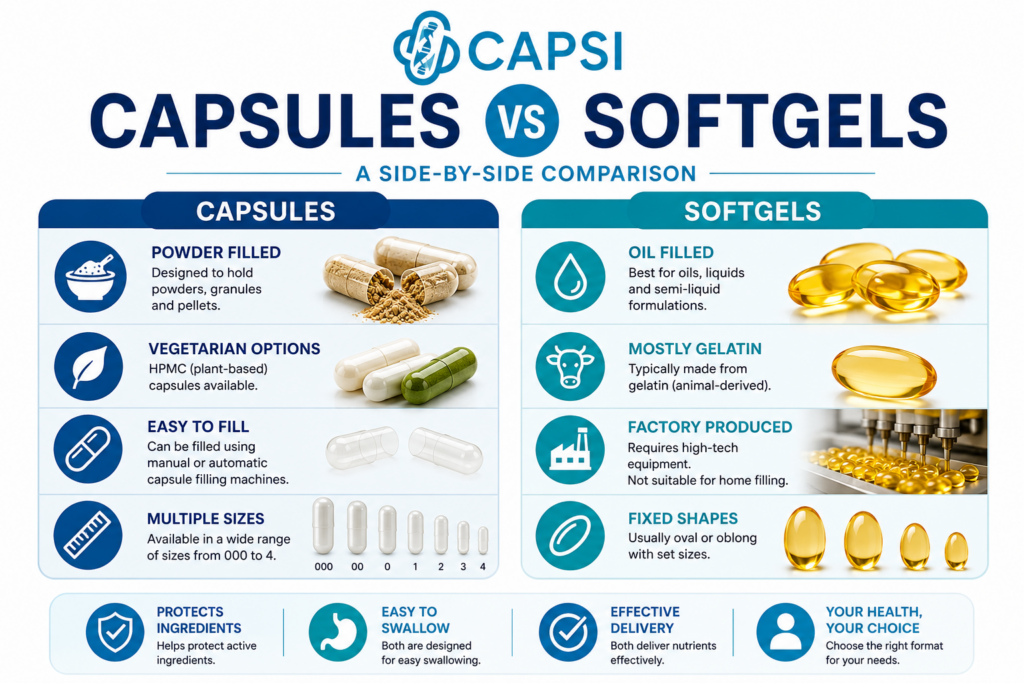
Capsules are small containers designed to hold powders, granules, pellets, or certain liquid formulations. Most capsules consist of two separate pieces that fit together to create a sealed shell.
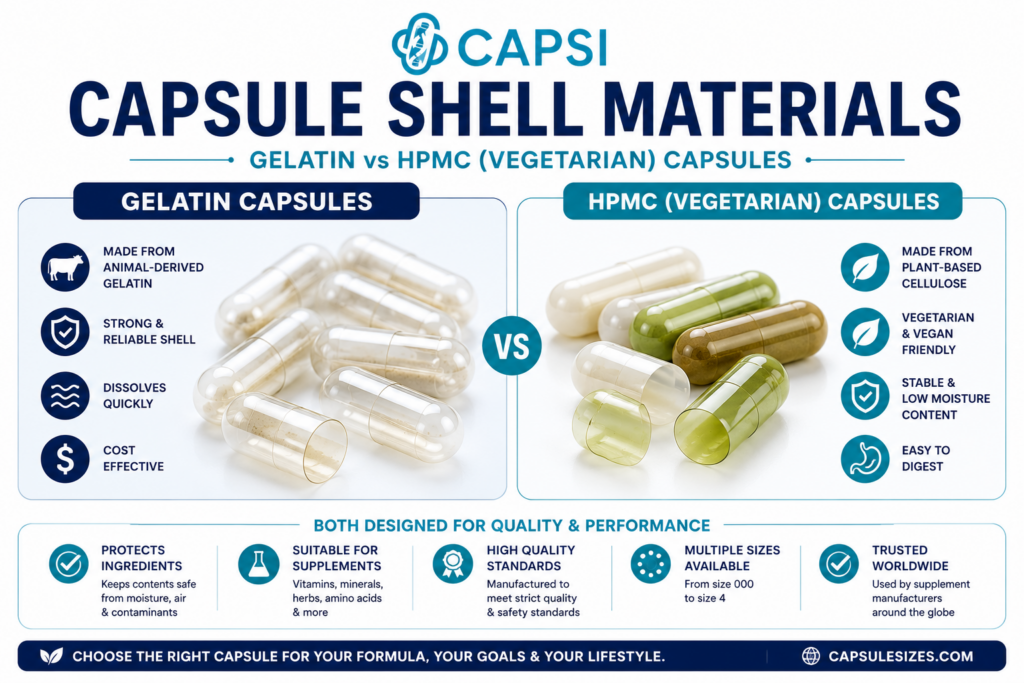
The two most common capsule materials are:
- Gelatin capsules – made from animal-derived gelatin.
- HPMC capsules – vegetarian and vegan-friendly capsules made from plant cellulose.
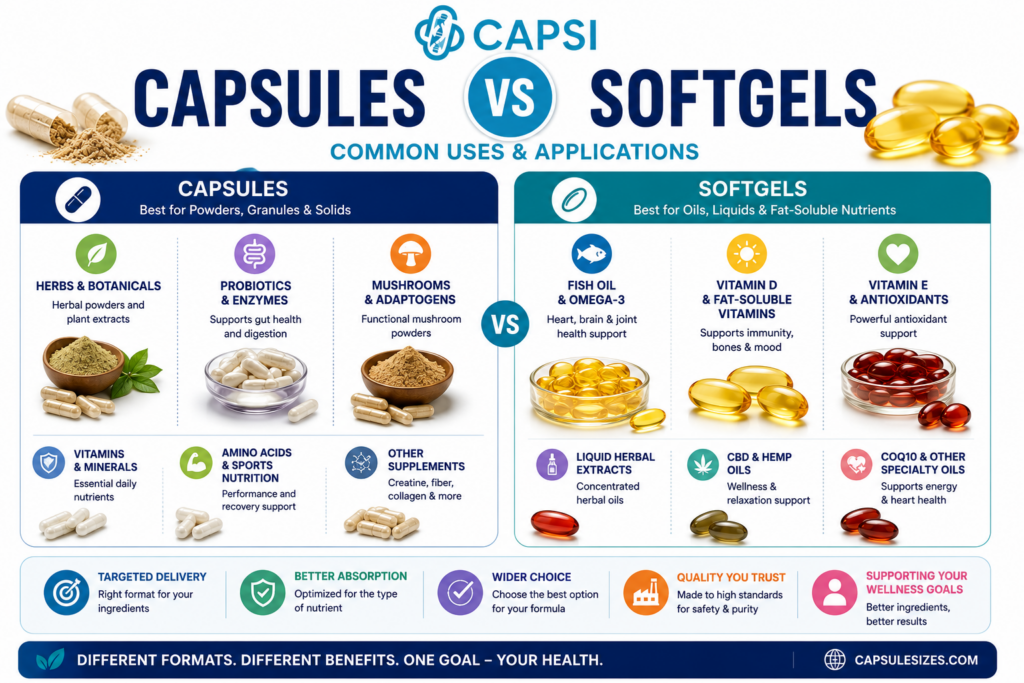
Capsules are widely used for:
- Herbal supplements
- Vitamins and minerals
- Probiotics
- Mushroom powders
- Amino acids
- Sports nutrition products
They are available in standard sizes ranging from size 000 (largest) to size 4 (smallest).
What Are Softgels?
Softgels are one-piece capsules manufactured from a flexible gelatin shell that surrounds a liquid, oil, or semi-liquid filling.
Unlike standard capsules, softgels are permanently sealed during production.
Softgels are commonly used for:
- Fish oil
- Omega-3 supplements
- Vitamin D
- Vitamin E
- CoQ10
- CBD oils
- Liquid herbal extracts
Their smooth surface makes them popular with consumers who prefer an easy-to-swallow supplement.
Capsules vs Softgels: Key Differences
| Feature | Capsules | Softgels |
|---|---|---|
| Construction | Two-piece shell | One-piece sealed shell |
| Typical Fill | Powders and granules | Oils and liquids |
| Vegetarian Options | Yes | Limited |
| Manufacturing Cost | Lower | Higher |
| Home Filling | Possible | Not practical |
| Customisation | Easy | More complex |
| Common Uses | Herbs, vitamins, minerals | Fish oils, vitamin D, liquid supplements |
| Shelf Stability | Excellent for powders | Excellent for oils when stored correctly |
Which Is Better for Powders?
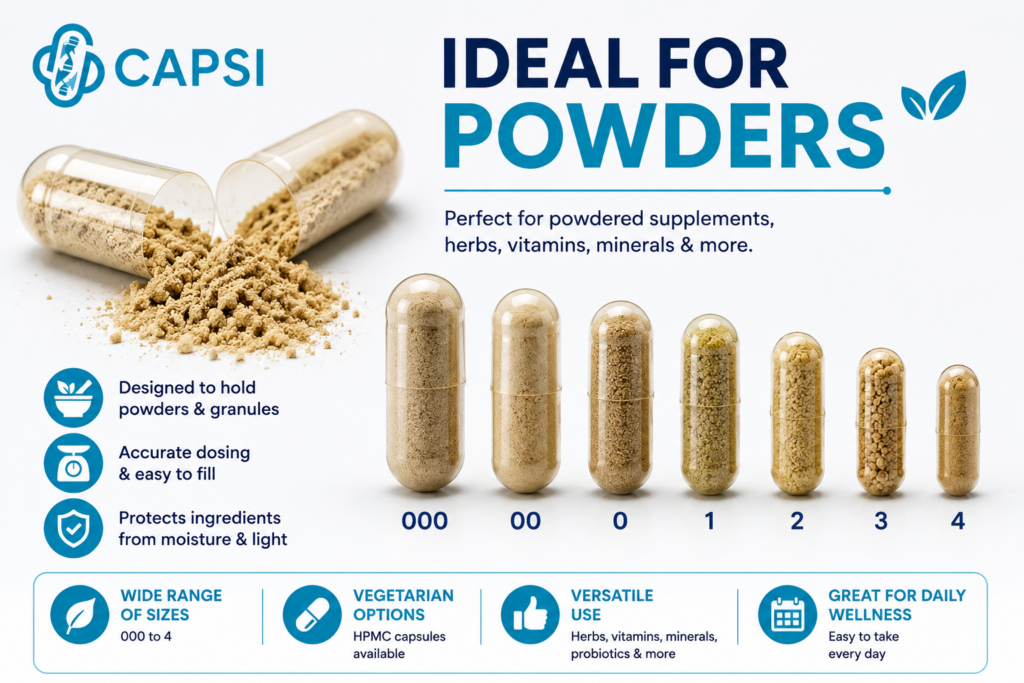
Capsules are the preferred option for powdered ingredients.
Common examples include:
- Ashwagandha
- Turmeric
- Lion’s Mane
- Magnesium
- Creatine
- Probiotics
Powders can be accurately measured and filled into capsules using manual or automatic capsule-filling machines.
For this reason, capsules remain the most widely used format for dietary supplements.
Which Is Better for Oils?
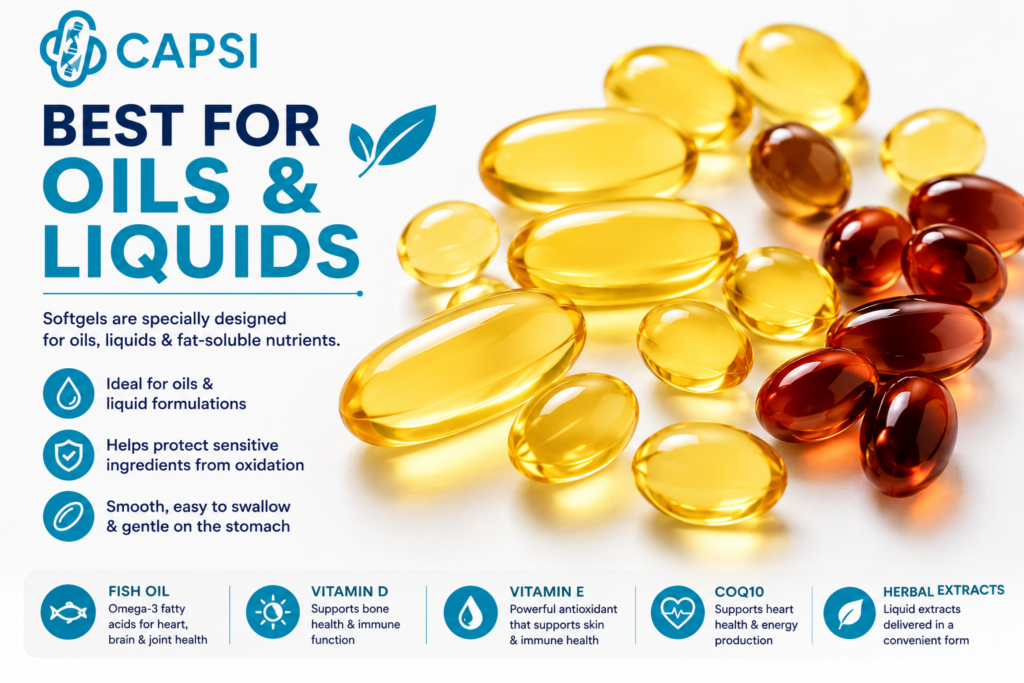
Softgels are specifically designed for oil-based ingredients.
Examples include:
- Fish oil
- Krill oil
- Vitamin D3
- Vitamin E
- MCT oil
- Liquid herbal extracts
The sealed shell helps prevent leaks and protects the ingredients from oxidation.
Are Capsules or Softgels Easier to Swallow?
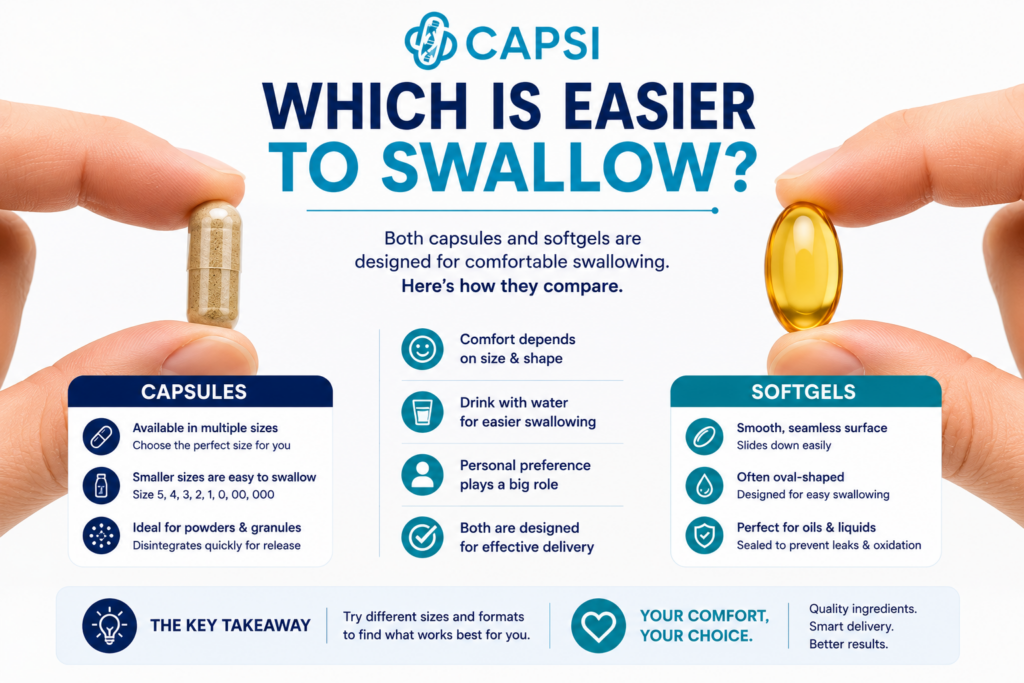
Many people find softgels easier to swallow because they:
- Have a smooth, seamless surface
- Are often oval-shaped
- Slide down easily with water
However, capsule size usually has a greater impact on swallowing comfort than the format itself.
For example, a small size 1 capsule may be easier to swallow than a large omega-3 softgel.
Absorption: Capsules vs Softgels
A common misconception is that softgels are always absorbed better than capsules.
In reality, absorption depends on:
- The ingredient itself
- The formulation
- Whether the nutrient is water-soluble or fat-soluble
Softgels may offer advantages for fat-soluble nutrients such as:
- Vitamin D
- Vitamin E
- Vitamin K
- Omega-3 fatty acids
Meanwhile, powdered supplements often work perfectly well in traditional capsules.
There is no universal winner when it comes to absorption.
Advantages of Capsules
Pros
- Available in vegetarian and vegan options
- Ideal for powders and granules
- Lower production costs
- Easy to customise
- Available in multiple sizes
- Suitable for home filling
Cons
- Not ideal for large volumes of oil
- Some powders may settle during storage
Advantages of Softgels
Pros
- Perfect for oils and liquid formulations
- Easy to swallow
- Protect sensitive ingredients
- Professional appearance
- Can improve delivery of fat-soluble nutrients
Cons
- Higher manufacturing costs
- Limited vegetarian options
- Cannot easily be produced at home
- More complex manufacturing process
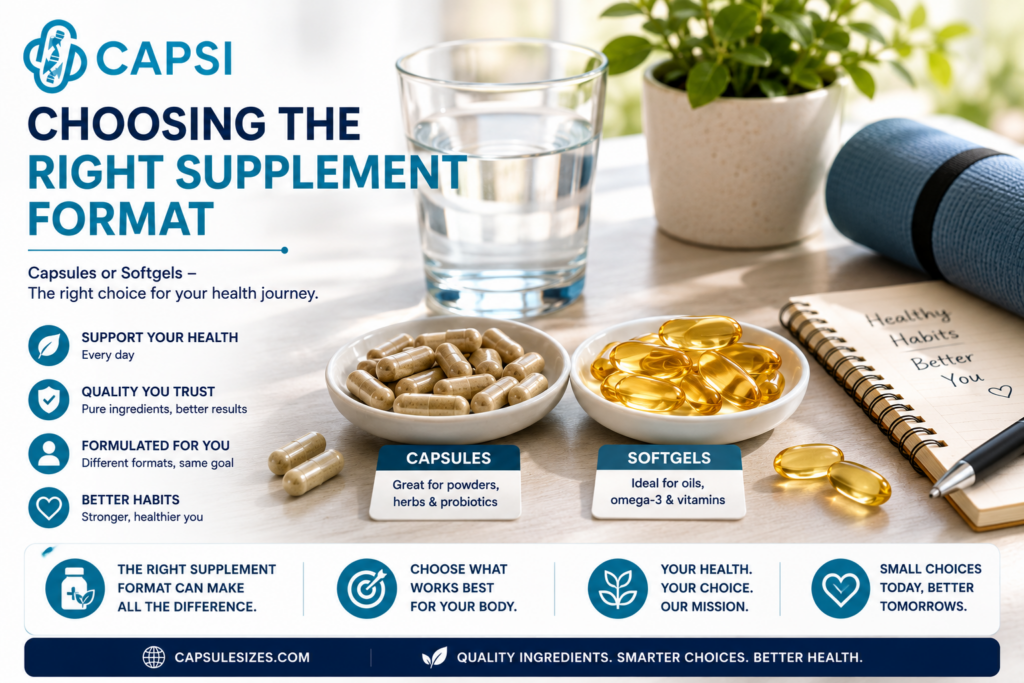
Which Option Is Best?
The best choice depends on the ingredient being used.
Choose capsules if you need:
- Powdered supplements
- Herbal extracts
- Probiotics
- Vitamins and minerals
- Vegetarian or vegan options
- Flexible capsule sizing
Choose softgels if you need:
- Fish oils
- Omega-3 supplements
- Fat-soluble vitamins
- Liquid formulations
- Oil-based ingredients
Frequently Asked Questions
Are softgels the same as capsules?
Softgels are a type of capsule, but they are manufactured as a single sealed unit rather than a two-piece shell.
Can softgels contain powder?
Softgels are generally designed for liquids and oils. Powders are usually better suited to traditional capsules.
Are capsules vegetarian?
HPMC capsules are vegetarian and vegan-friendly. Standard gelatin capsules are animal-derived.
Do softgels absorb faster?
Some oil-based nutrients may benefit from softgel delivery, but absorption depends on the formulation and ingredient rather than the capsule type alone.
Which lasts longer?
Both formats can have excellent shelf lives when stored correctly. Powder-filled capsules are often particularly stable because they contain very little moisture.
Can you fill softgels at home?
No. Softgels require specialist manufacturing equipment. Traditional capsules can be filled at home using capsule-filling machines.
Final Thoughts
Both capsules and softgels are effective ways to deliver dietary supplements.
Capsules offer flexibility, lower manufacturing costs, vegetarian options, and compatibility with powdered ingredients. Softgels excel when used for oils, liquid extracts, and fat-soluble nutrients.
For most powdered supplements, capsules remain the preferred choice. For fish oils, omega-3 products, and liquid formulations, softgels are often the better option.