MCT powder has become one of the most popular ingredients in the health and wellness industry, especially among ketogenic diet followers, athletes, and those looking for convenient energy support. If you’re planning to encapsulate MCT powder at home or manufacture your own supplements, selecting the correct capsule size is essential.
The amount of MCT powder that fits into a capsule depends on the powder’s density, carrier ingredients, and filling method. In this comprehensive guide, we’ll explain how much MCT powder fits into each capsule size, which capsule sizes work best, and how to maximise fill weight.
What Is MCT Powder?
MCT stands for Medium-Chain Triglycerides, which are fats that are rapidly absorbed and converted into energy by the body. Unlike long-chain fats, MCTs are metabolised quickly by the liver and can be used as an immediate energy source.
MCTs are most commonly sourced from:
- Coconut oil
- Palm kernel oil
The most common MCT fatty acids include:
- C8 (Caprylic Acid) – fast energy and ketone production
- C10 (Capric Acid) – sustained energy support
- C12 (Lauric Acid) – sometimes included but behaves more like a long-chain fat
MCT oil is often spray-dried into powder form using carrier ingredients, making it easier to mix into drinks and encapsulate.
Why Encapsulate MCT Powder?
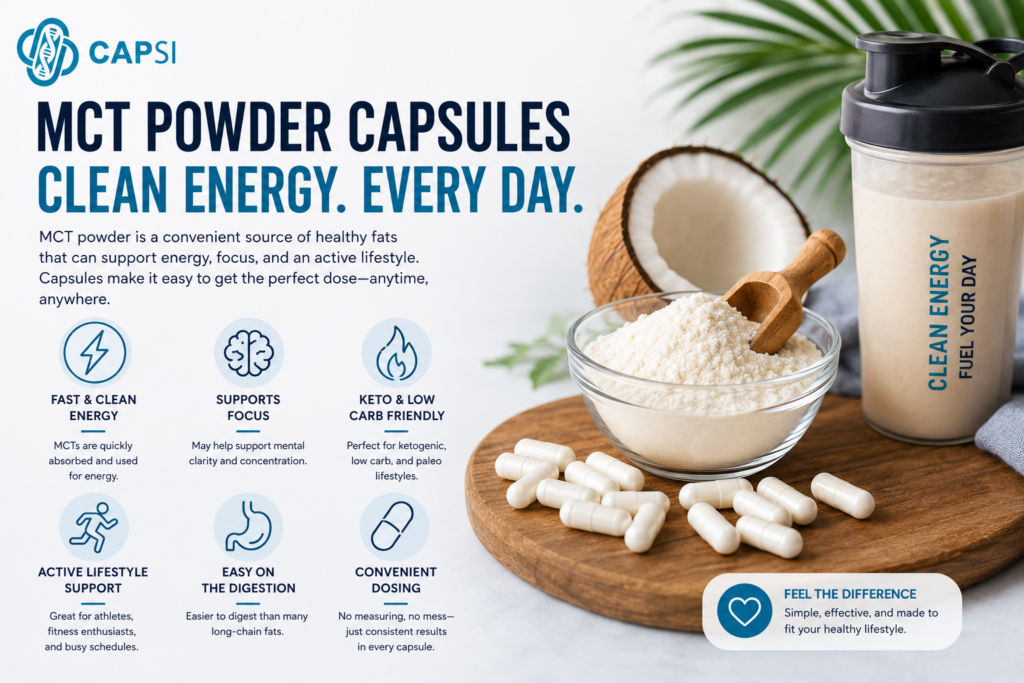
There are several reasons why people prefer MCT powder capsules over loose powder:
Convenience
Capsules eliminate the need to measure powder each day.
Portability
Capsules can easily be carried while travelling or at work.
Taste Masking
Some MCT powders have a creamy or slightly oily taste that users may wish to avoid.
Precise Dosing
Capsules provide consistent serving sizes.
DIY Supplements
Home encapsulation allows users to create custom blends with ingredients such as:
- Collagen
- Electrolytes
- L-Carnitine
- Creatine
- Mushroom extracts
- Greens powders
MCT Powder Density Explained
The biggest factor affecting capsule capacity is powder density.
Unlike pure ingredients, MCT powder usually contains carriers to absorb the oil and improve flow.
Common carrier ingredients include:
- Acacia fiber
- Tapioca fiber
- Maltodextrin
- Gum arabic
- Resistant starch
Because formulations vary between manufacturers, two MCT powders may produce very different fill weights in identical capsules.
Some MCT powders are:
- Light and fluffy
- Fine and dense
- Highly compressible
- Free-flowing
As a result, fill weights should always be considered estimates.
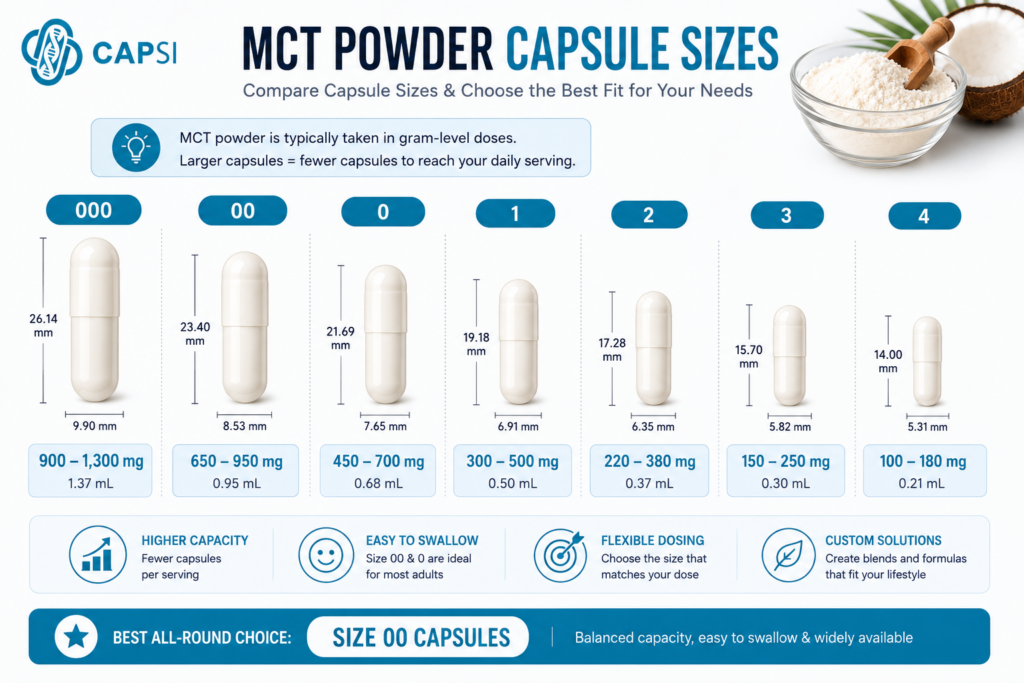
MCT Powder Capsule Size Chart
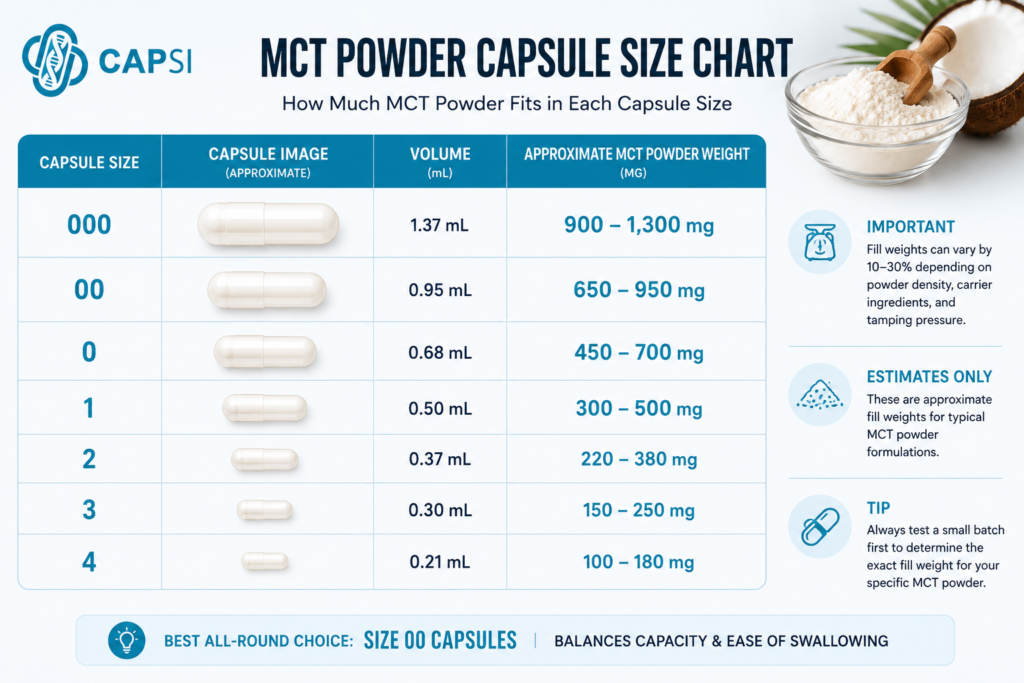
The following table provides approximate fill weights for typical MCT powder formulations.
| Capsule Size | Volume (mL) | Approximate MCT Powder Weight |
|---|---|---|
| 000 | 1.37 mL | 900–1,300 mg |
| 00 | 0.95 mL | 650–950 mg |
| 0 | 0.68 mL | 450–700 mg |
| 1 | 0.50 mL | 300–500 mg |
| 2 | 0.37 mL | 220–380 mg |
| 3 | 0.30 mL | 150–250 mg |
| 4 | 0.21 mL | 100–180 mg |
Note: Actual capacities may vary by 10–30% depending on tamping pressure and powder characteristics.
Which Capsule Size Is Best for MCT Powder?
Size 000 Capsules
Size 000 capsules are the largest commonly available capsules.
Advantages:
- Highest fill capacity
- Fewer capsules per serving
- Ideal for gram-level doses
Disadvantages:
- Larger and harder for some people to swallow
Typical capacity:
900–1,300 mg of MCT powder
Size 00 Capsules
Size 00 is generally considered the most versatile capsule size.
Advantages:
- Easy to swallow for most adults
- Widely available
- Compatible with most capsule filling machines
Typical capacity:
650–950 mg of MCT powder
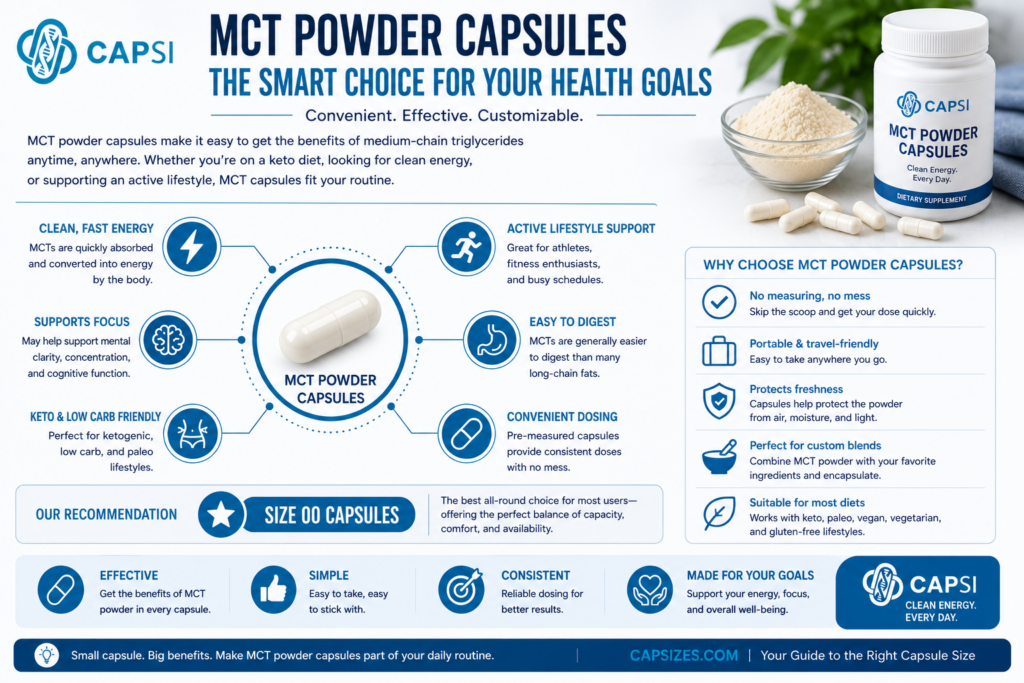
For most users, Size 00 capsules are the best overall choice.
Size 0 Capsules
Size 0 capsules offer a balance between comfort and capacity.
Typical capacity:
450–700 mg
Ideal for:
- Smaller doses
- Sensitive users
- Stacked supplements
Sizes 1–4
Smaller capsules may be suitable for:
- Children (where appropriate)
- Combination formulas
- Lower dosages
However, MCT powder is usually consumed in larger quantities, making these sizes less practical.
How Many Capsules Do You Need?
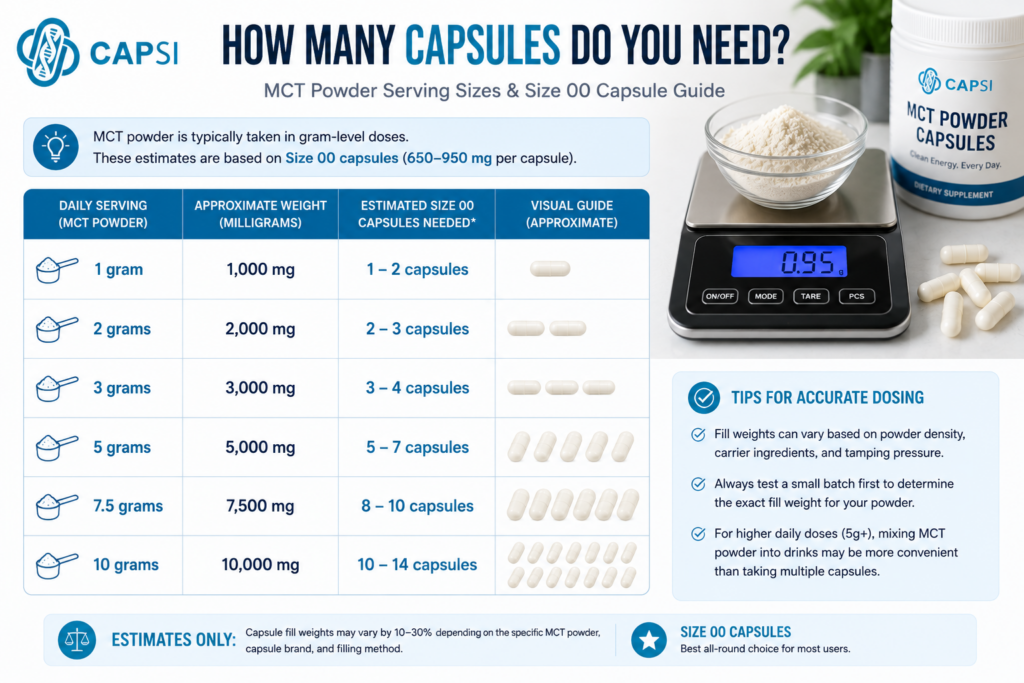
MCT powder is often taken in doses of 1–10 grams per day.
Example Daily Intake
| Daily Serving | Approximate Size 00 Capsules Required |
|---|---|
| 1 g | 1–2 capsules |
| 2 g | 2–3 capsules |
| 3 g | 3–4 capsules |
| 5 g | 5–7 capsules |
| 10 g | 10–14 capsules |
Higher daily doses may be more convenient as powder mixed into drinks rather than capsules.
MCT Powder vs MCT Oil for Capsules
MCT Powder
- Easy to encapsulate
- Flows well in filling machines
- Suitable for home filling
- Longer shelf stability
MCT Oil
- Requires specialised liquid-filling equipment
- Cannot easily be filled into standard two-piece capsules
- May leak if improperly encapsulated
For DIY encapsulation, MCT powder is significantly easier to work with.
Factors That Affect MCT Powder Fill Weight
1. Carrier Ingredients
Different carrier materials change bulk density.
For example:
- Acacia fiber formulations may be lighter.
- Tapioca carriers may be denser.
- Maltodextrin blends often flow better.
2. Powder Particle Size
Fine powders generally pack more tightly than coarse powders.
3. Tamping Pressure
Using a capsule machine with multiple tamping stages can increase fill weights by 10–30%.
4. Humidity
Moisture can cause:
- Clumping
- Reduced flow
- Uneven capsule filling
Store MCT powder in a cool, dry environment.
Gelatin vs Vegetarian Capsules for MCT Powder
MCT powder works well in both capsule materials.
Gelatin Capsules
Benefits:
- Cost-effective
- Strong structure
- Excellent machinability
HPMC (Vegetarian) Capsules
Benefits:
- Vegan friendly
- Plant based
- Suitable for vegetarian and religious dietary requirements
Both capsule types generally perform equally well with MCT powder.
How to Fill MCT Powder Capsules
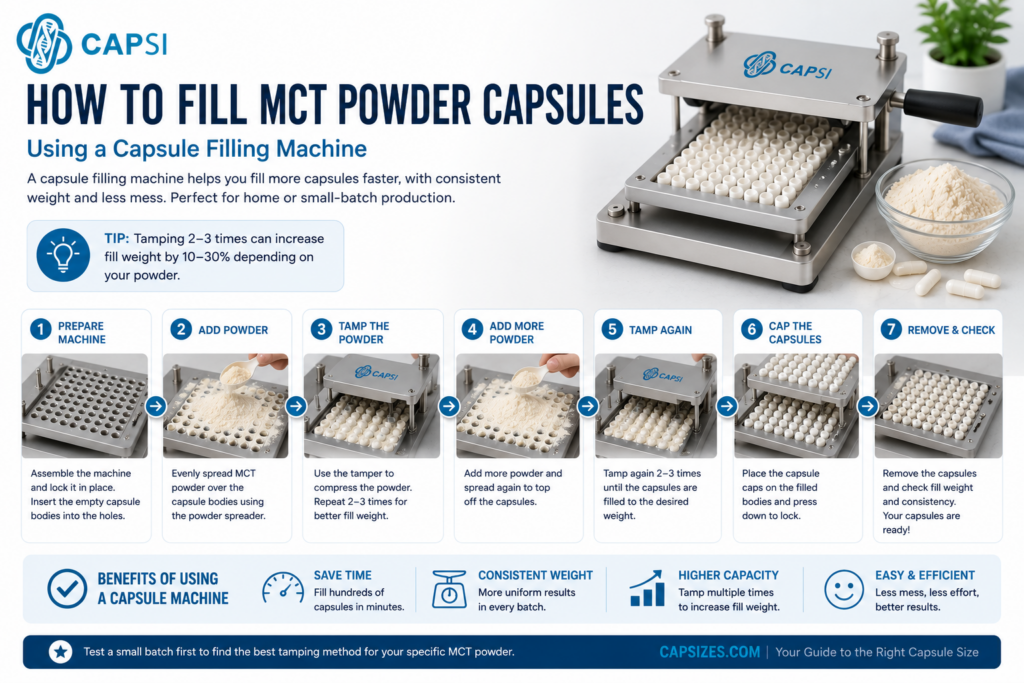
Equipment Needed
- Empty capsules
- Capsule filling machine
- MCT powder
- Tamper tool
- Digital scale
Filling Process
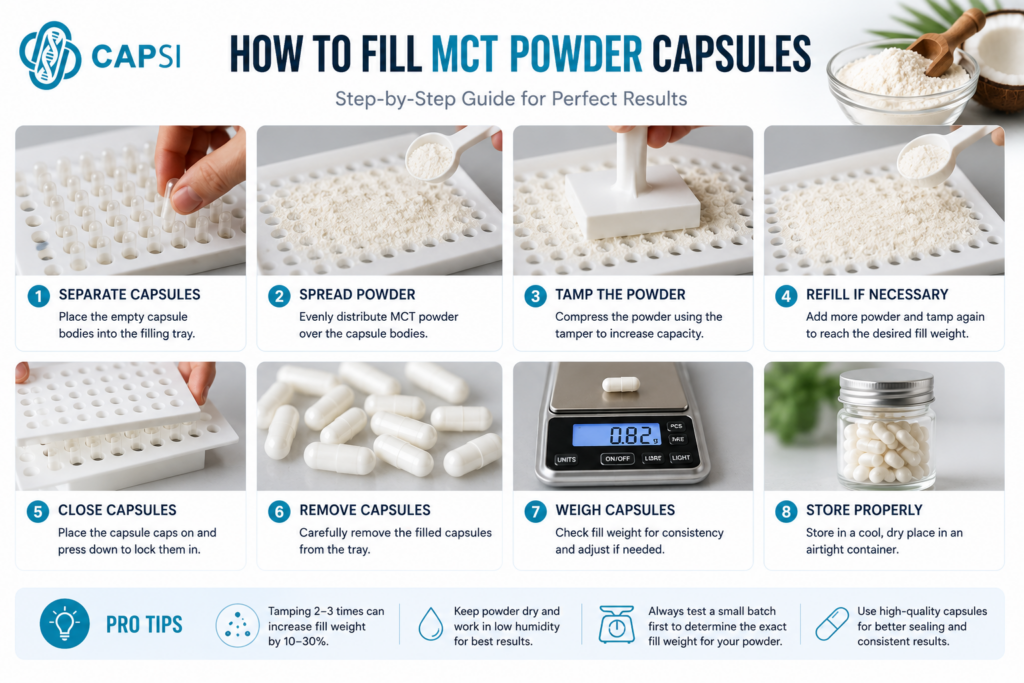
Step 1: Separate Capsules
Place capsule bodies into the filling tray.
Step 2: Spread Powder
Evenly distribute MCT powder over the capsule bodies.
Step 3: Tamp the Powder
Compress the powder using the tamper.
Step 4: Refill if Necessary
Repeat filling until capsules reach the desired capacity.
Step 5: Close Capsules
Attach the capsule caps securely.
Step 6: Weigh Capsules
Use a scale to confirm consistent fill weights.
How Accurate Are Capsule Capacity Estimates?
Capsule capacity charts provide estimates only.
Actual results depend on:
- Powder density
- Carrier type
- Capsule manufacturer
- Filling method
- Compression force
- Environmental conditions
Testing with a small batch is always recommended before large-scale production.
Storage Recommendations
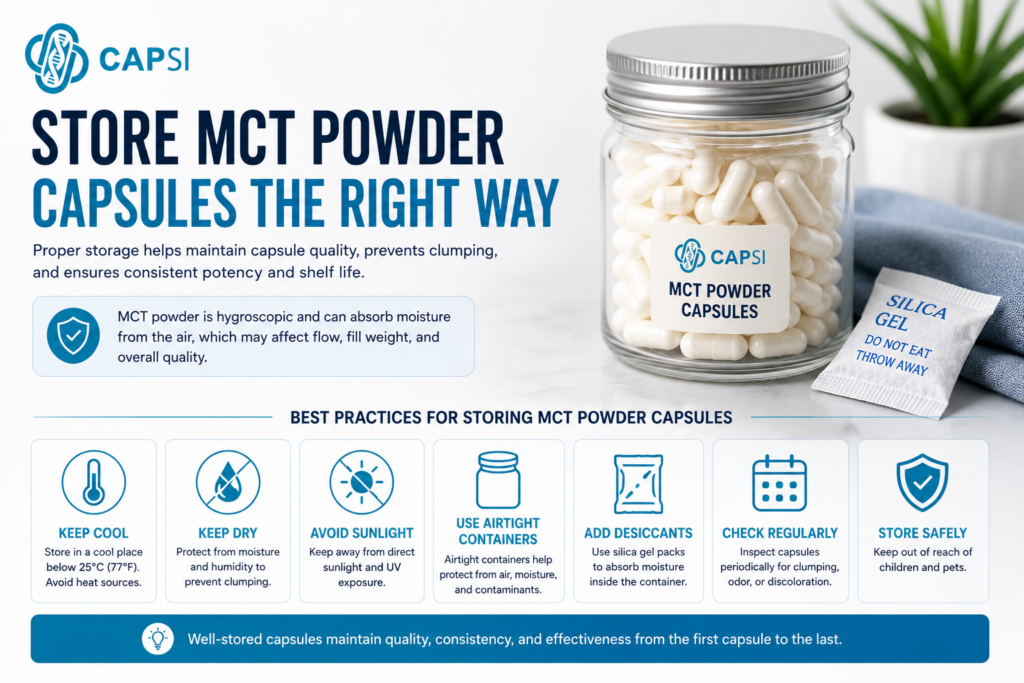
To maintain quality:
- Store capsules below 25°C
- Avoid direct sunlight
- Use airtight containers
- Add desiccants if necessary
- Keep humidity low
Proper storage helps maintain flowability and shelf life.
Can You Mix MCT Powder With Other Ingredients?
Yes. MCT powder is commonly blended with:
- Collagen peptides
- Electrolytes
- L-Theanine
- Mushroom extracts
- Greens powders
- Amino acids
- Adaptogens
When mixing ingredients, calculate the total powder weight to determine the best capsule size.
Frequently Asked Questions
What capsule size is best for MCT powder?
For most applications, Size 00 capsules offer the best balance between capacity and ease of swallowing.
How much MCT powder fits in a Size 00 capsule?
Typically between 650 mg and 950 mg, depending on density and tamping.
Can MCT powder be encapsulated at home?
Yes. MCT powder is one of the easiest nutritional powders to encapsulate using a manual capsule filling machine.
Is MCT powder better than MCT oil for capsules?
Yes. Powder is significantly easier to encapsulate and store.
Are vegetarian capsules suitable for MCT powder?
Absolutely. HPMC capsules are commonly used with MCT powder.
Can MCT powder clump?
Yes. Exposure to moisture and humidity may cause clumping, which can reduce filling efficiency.
How many capsules equal 5 grams of MCT powder?
Approximately 5–7 Size 00 capsules, depending on the powder density.