
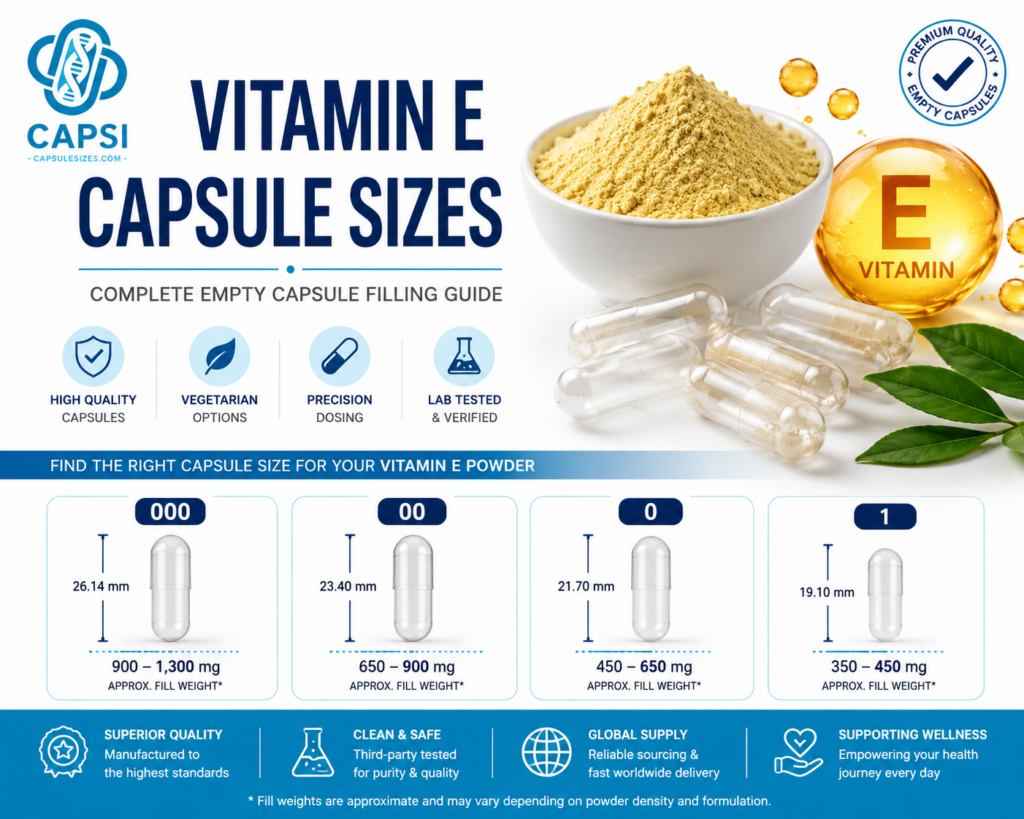
Vitamin E is a fat-soluble vitamin commonly used in dietary supplements, skincare formulations, antioxidant blends, and wellness products. While many commercial Vitamin E supplements are sold as softgels containing oil, powdered Vitamin E ingredients can also be encapsulated using standard hard capsules.
If you are filling your own capsules or manufacturing supplements, understanding capsule capacity and size requirements is important because Vitamin E powders can vary significantly in density depending on the formulation and carrier used.
This guide explains the best capsule sizes for Vitamin E powder, estimated fill weights, and how to choose the most suitable empty capsule size.
What Is Vitamin E?
Vitamin E refers to a group of antioxidant compounds known as tocopherols and tocotrienols. The most common form used in supplements is alpha-tocopherol.
Vitamin E is commonly found in:
- Antioxidant supplements
- Skin and beauty formulations
- Multivitamin products
- Immune support supplements
- Sports nutrition products
- Healthy ageing formulas
Many powdered Vitamin E ingredients are spray-dried onto carriers to improve flowability and allow encapsulation into hard capsules.
Why Encapsulate Vitamin E Powder?
Powder-filled capsules offer several advantages:
- Easy and accurate dosing
- No taste or odour issues
- Convenient daily use
- Suitable for custom formulations
- Can be combined with other vitamins and minerals
- Available in vegetarian or gelatin capsules
For powdered Vitamin E, hard capsules are often the preferred option for small-scale production and home encapsulation.
Vitamin E Powder Density
The density of Vitamin E powder depends heavily on:
- Concentration of Vitamin E
- Carrier material used
- Moisture content
- Particle size
- Manufacturing process
Most Vitamin E powders fall into the medium-density powder category.
Typical bulk density:
0.45–0.75 g/ml
This means capsule capacities can vary significantly between suppliers.
Vitamin E Capsule Size Chart
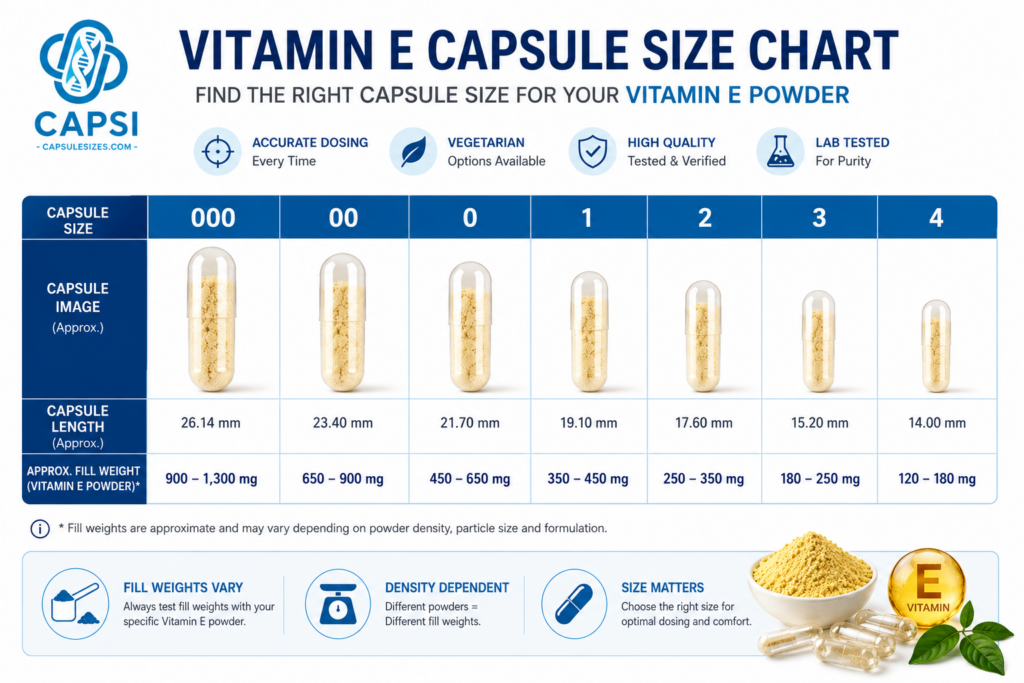
| Capsule Size | Approximate Vitamin E Powder Capacity |
|---|---|
| Size 4 | 120–180 mg |
| Size 3 | 180–250 mg |
| Size 2 | 250–350 mg |
| Size 1 | 350–450 mg |
| Size 0 | 450–650 mg |
| Size 00 | 650–900 mg |
| Size 000 | 900–1,300 mg |
These values are estimates only and actual fill weights should always be verified through testing.
Best Capsule Size for Vitamin E
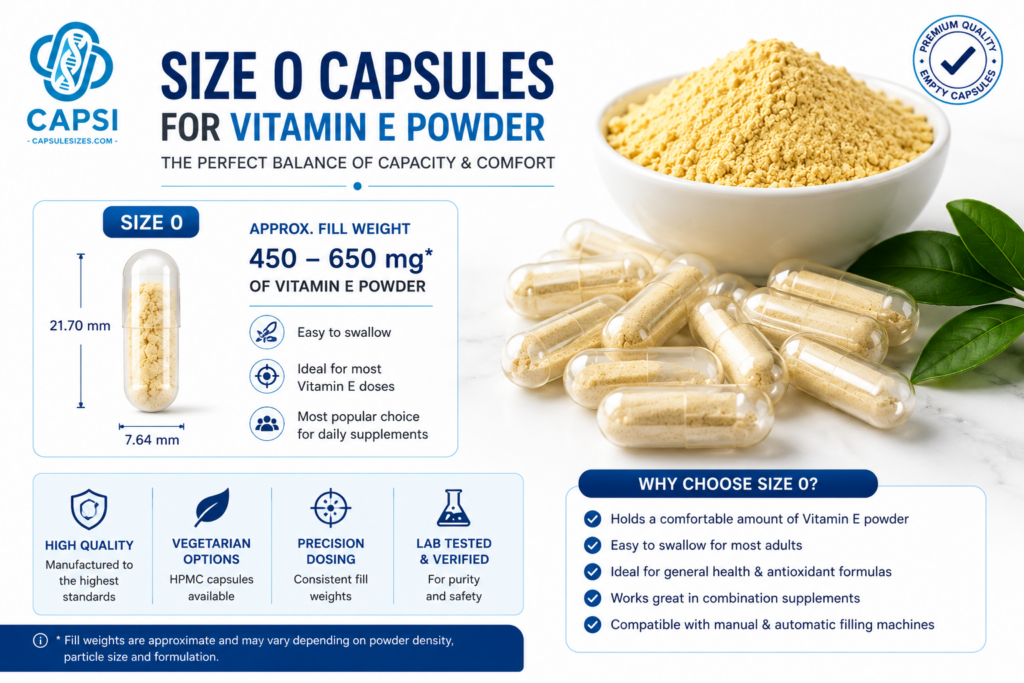
Size 0 Capsules
Size 0 capsules are one of the most popular choices for Vitamin E powder.
Typical capacity:
450–650 mg
Advantages:
- Easy to swallow
- Suitable for most Vitamin E formulations
- Popular consumer supplement size
- Compatible with manual capsule filling machines
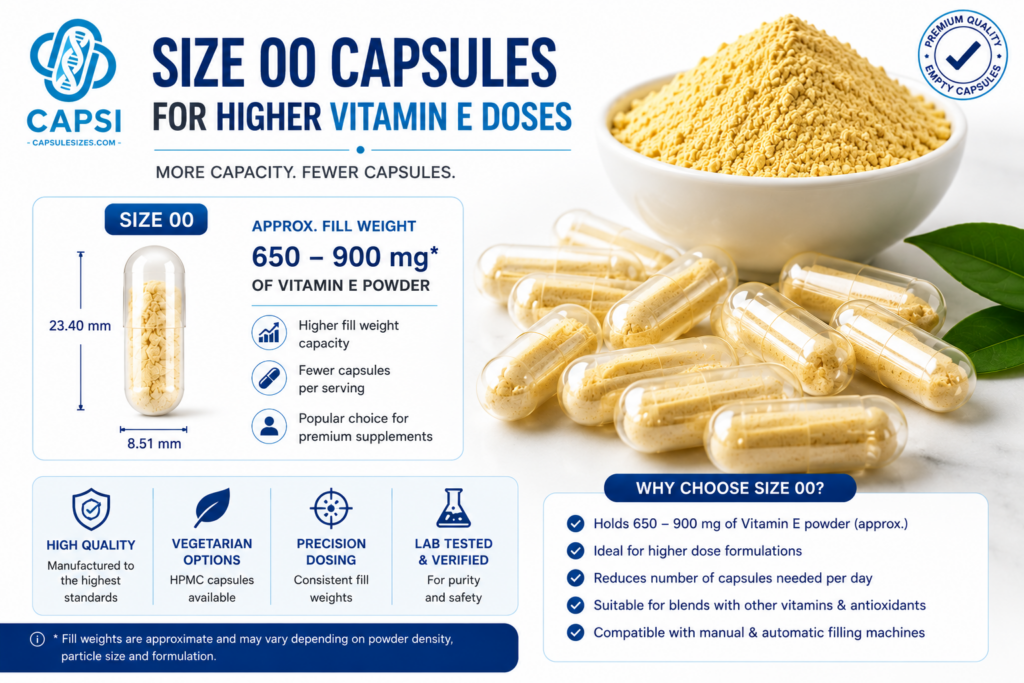
Size 00 Capsules
Size 00 capsules are often used when larger doses are required.
Typical capacity:
650–900 mg
Benefits:
- Higher fill weight
- Fewer capsules required per serving
- Popular commercial supplement size
Size 00 is often considered the best balance between capacity and ease of swallowing.
Size 000 Capsules
For very large formulations or blended products, size 000 capsules offer maximum capacity.
Typical capacity:
900–1,300 mg
Benefits:
- Largest common capsule size
- Maximum ingredient loading
- Reduces the number of capsules needed
However, some users may find size 000 capsules harder to swallow.
Vitamin E Powder Fill Examples
200 mg Vitamin E Powder
Possible capsule sizes:
- Size 3
- Size 2
- Size 1
400 mg Vitamin E Powder
Possible capsule sizes:
- Size 1
- Size 0
600 mg Vitamin E Powder
Possible capsule sizes:
- Size 0
- Size 00
1,000 mg Vitamin E Powder
Possible capsule sizes:
- Size 000
Actual capsule size selection depends on the powder’s bulk density.
Gelatin vs Vegetarian Capsules for Vitamin E
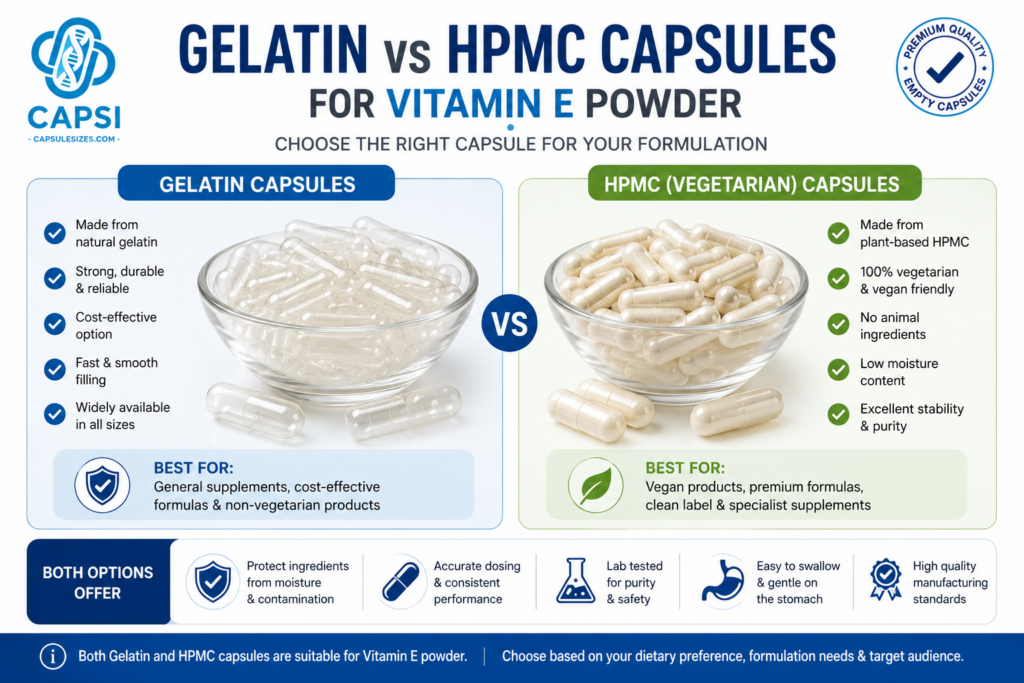
Gelatin Capsules
Advantages:
- Cost-effective
- Strong and durable
- Fast filling
- Widely available
Suitable for:
- General supplement manufacturing
- Home capsule filling
HPMC Vegetarian Capsules
Advantages:
- Plant-based
- Vegan-friendly
- Suitable for vegetarian products
- Lower moisture content
Suitable for:
- Vegan supplements
- Premium formulations
- Specialist nutritional products
Can Vitamin E Be Combined With Other Ingredients?
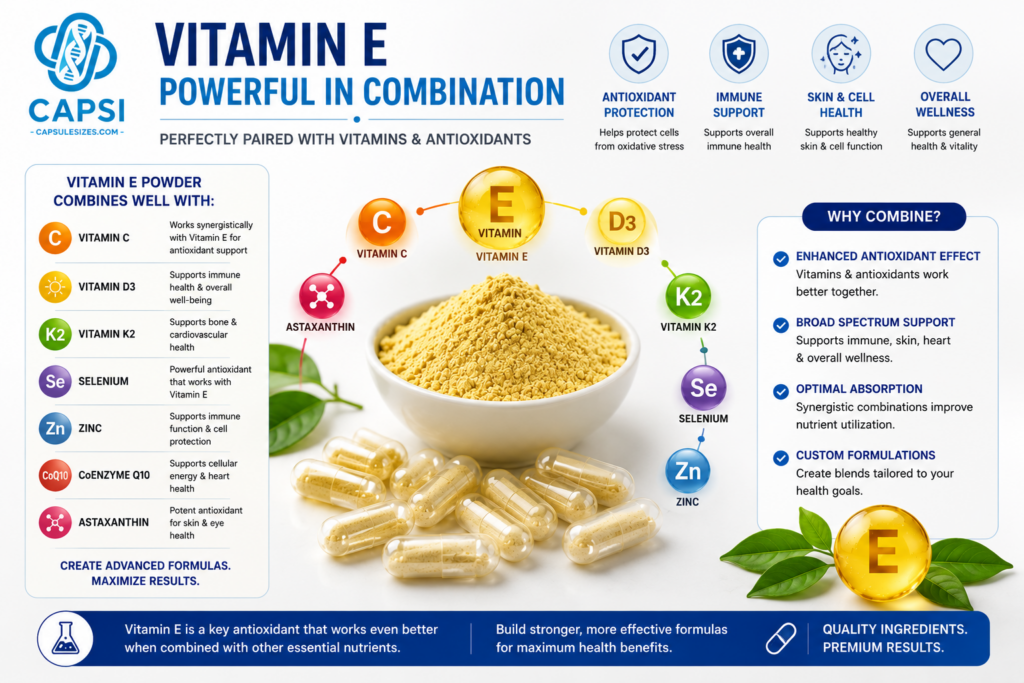
Yes. Vitamin E powder is commonly combined with:
- Vitamin C
- Vitamin D3
- Vitamin K2
- Selenium
- Zinc
- Coenzyme Q10
- Astaxanthin
- Mixed antioxidant blends
When combining ingredients, capsule size requirements increase accordingly.
How to Determine the Exact Capsule Size
Because Vitamin E powders vary between manufacturers, the most accurate method is:
- Measure powder bulk density.
- Calculate required fill volume.
- Compare volume with capsule capacity.
- Perform a practical fill test.
This ensures the chosen capsule size achieves the desired dosage consistently.
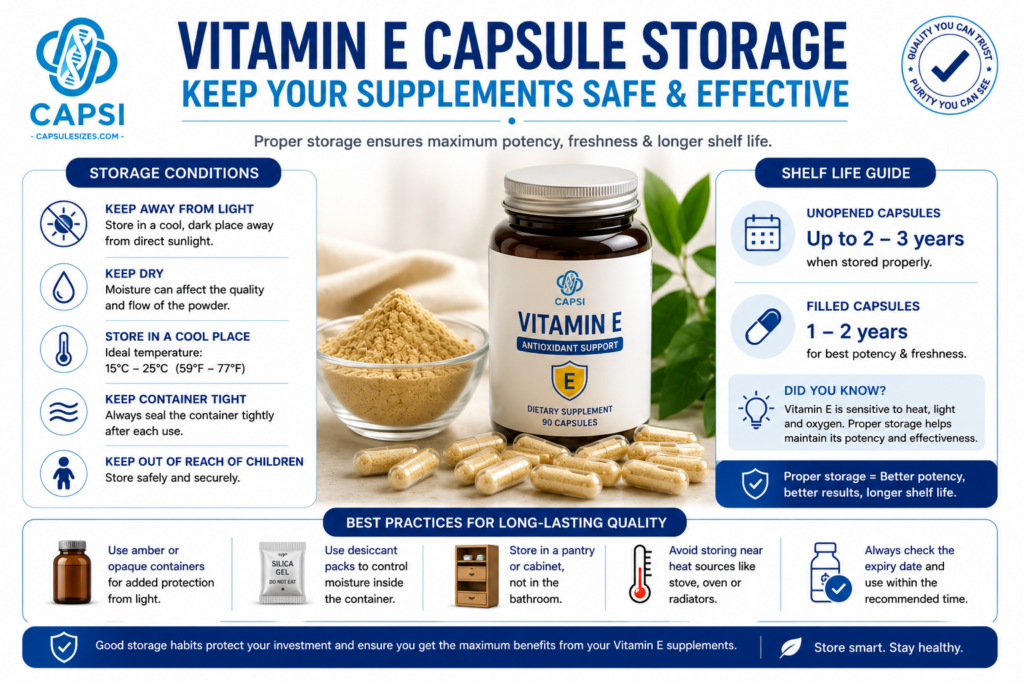
Storage Recommendations
Store Vitamin E powder capsules:
- In a cool, dry location
- Away from direct sunlight
- In sealed containers
- With appropriate desiccants when required
- Away from excessive heat and humidity
Proper storage helps maintain stability and potency.
Frequently Asked Questions
What is the best capsule size for Vitamin E powder?
For most applications, Size 0 and Size 00 capsules are the most practical choices.
Can 500 mg of Vitamin E powder fit in a size 0 capsule?
In many cases yes, depending on the powder density.
Is Vitamin E usually sold as powder or oil?
Many commercial supplements use oil-filled softgels, but powdered Vitamin E ingredients are also widely available for encapsulation.
Are vegetarian capsules suitable for Vitamin E?
Yes. HPMC capsules are commonly used for Vitamin E supplements.
Which capsule size holds the most Vitamin E powder?
Size 000 capsules typically provide the highest capacity, holding approximately 900–1,300 mg depending on density.
Conclusion
Vitamin E powder can be successfully encapsulated using standard hard capsules, with Size 0, Size 00, and Size 000 being the most commonly used options. The ideal capsule size depends on the Vitamin E concentration, powder density, and desired serving size.
For most Vitamin E powder formulations, Size 0 capsules provide an excellent balance of capacity and ease of swallowing, while Size 00 capsules are often preferred for higher-dose products. Size 000 capsules are best suited to large antioxidant blends or high-fill formulations where maximum capacity is required.