
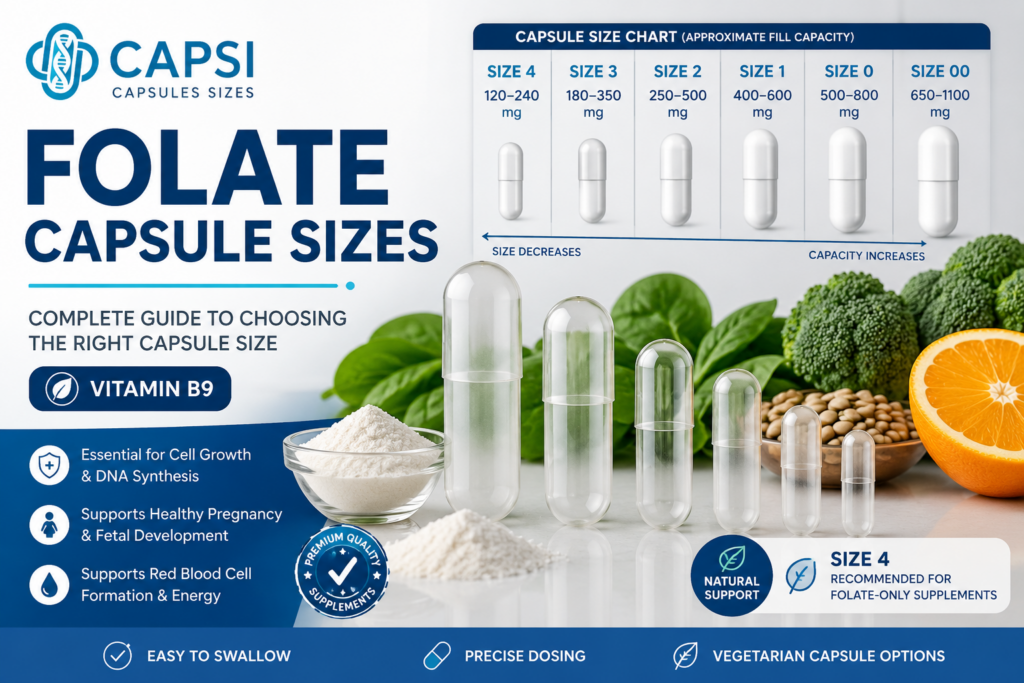
Folate Capsule Sizes: Complete Guide to Choosing the Right Capsule Size
Folate, also known as Vitamin B9, is an essential nutrient that plays a vital role in DNA synthesis, cell division, red blood cell formation, and normal nervous system function. It is especially important during pregnancy, where adequate folate intake helps support healthy fetal development.
If you are looking to encapsulate folate powder, create your own supplement formulation, or determine the best empty capsule size for a folate-based product, understanding capsule capacities is important. Since folate is required in very small amounts compared to many other supplements, it can fit into even the smallest capsule sizes with ease.
This guide explains the best capsule sizes for folate, typical dosages, capsule capacities, formulation considerations, and frequently asked questions.
What Is Folate?
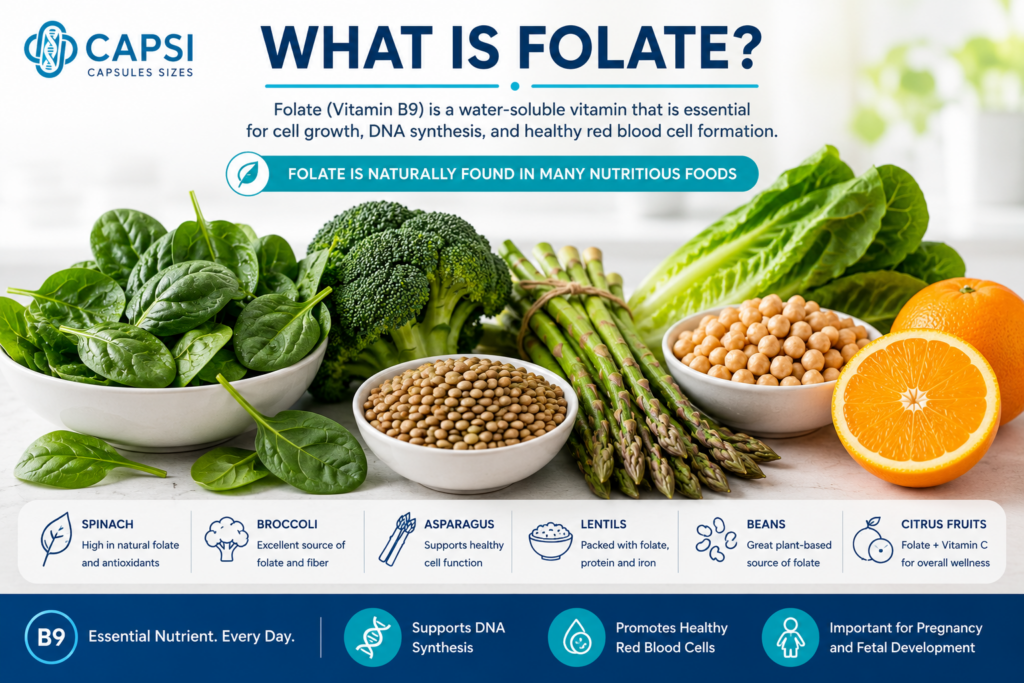
Folate is the naturally occurring form of Vitamin B9 found in foods such as:
- Leafy green vegetables
- Broccoli
- Asparagus
- Lentils
- Beans
- Citrus fruits
- Avocados
The synthetic form commonly used in supplements and fortified foods is known as folic acid.
Folate contributes to:
- Normal blood formation
- Normal immune function
- Reduction of tiredness and fatigue
- Normal psychological function
- Normal amino acid synthesis
- Maternal tissue growth during pregnancy
Because folate is highly concentrated and effective at very small doses, capsule sizing is usually determined more by fillers and supporting ingredients than by the folate itself.
Typical Folate Supplement Dosages
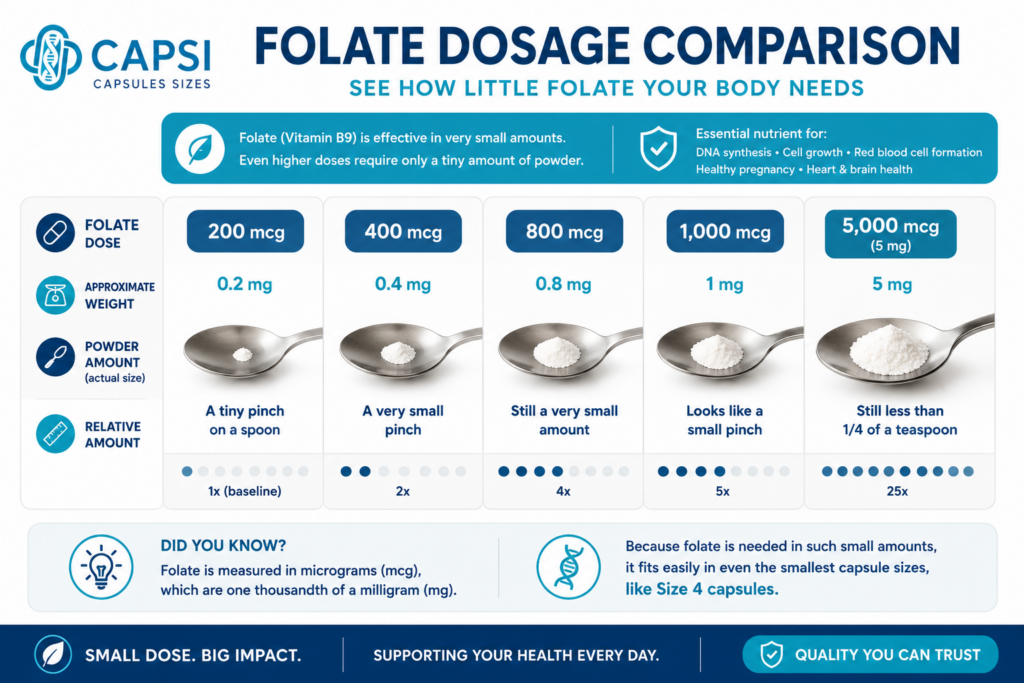
Folate is usually measured in micrograms (mcg), not milligrams (mg).
| Folate Dose | Weight |
|---|---|
| 200 mcg | 0.2 mg |
| 400 mcg | 0.4 mg |
| 800 mcg | 0.8 mg |
| 1,000 mcg | 1 mg |
| 5,000 mcg (5 mg) | 5 mg |
To put this into perspective, even a 5 mg folate dose occupies only a tiny fraction of the smallest capsule size available.
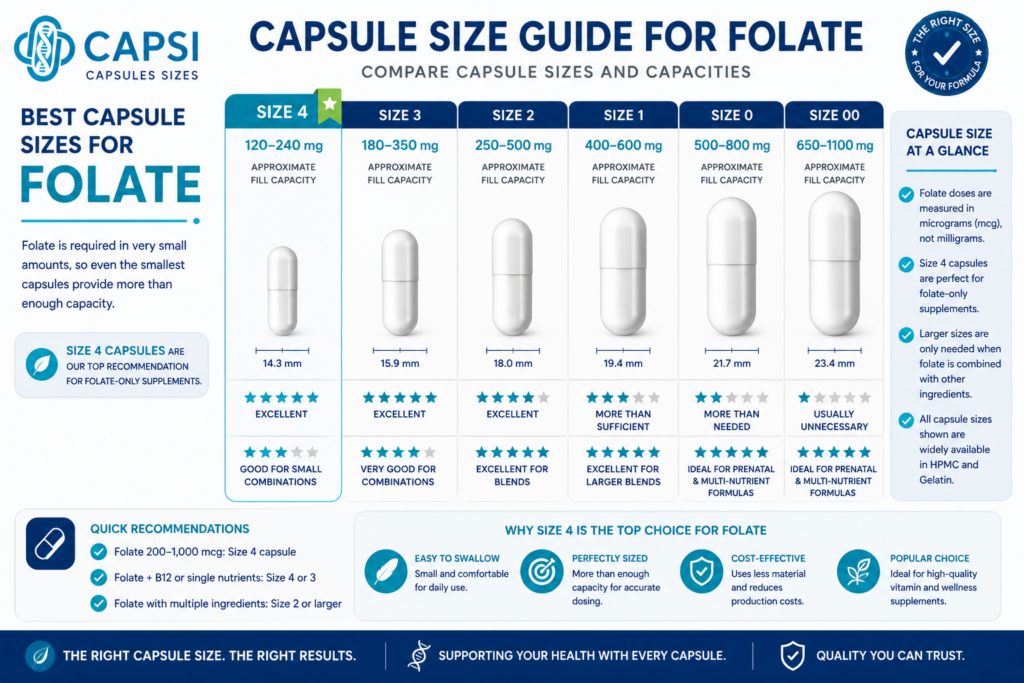
Folate Capsule Size Chart
| Capsule Size | Approximate Capacity* | Suitable for Folate |
|---|---|---|
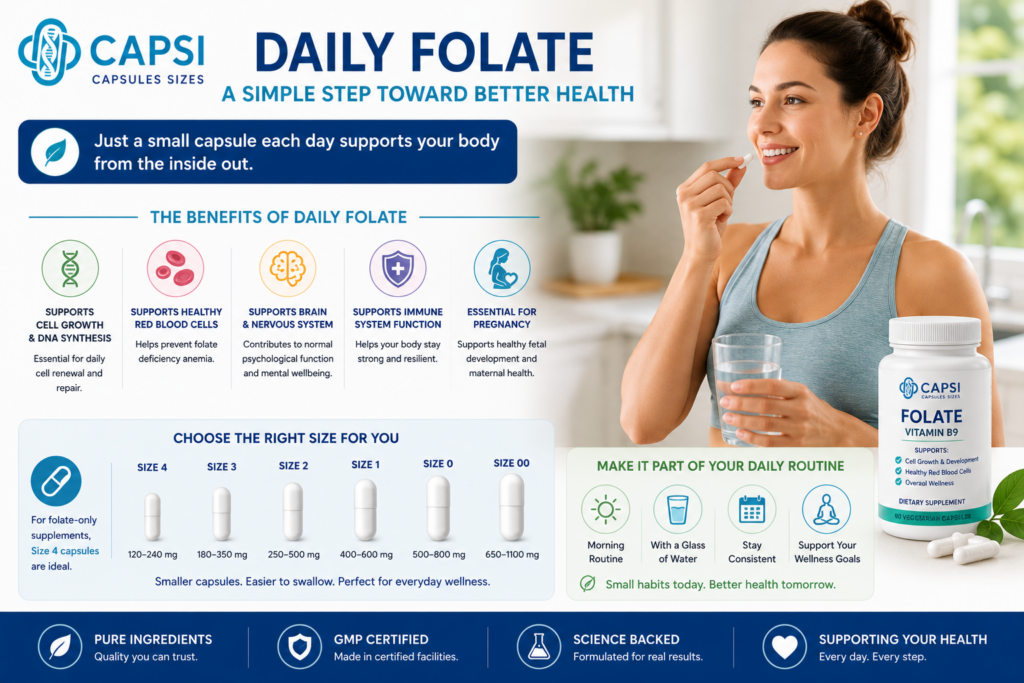
| Size 4 | 120-240 mg | Excellent |
| Size 3 | 180-350 mg | Excellent |
| Size 2 | 250-500 mg | Excellent |
| Size 1 | 400-600 mg | More than enough |
| Size 0 | 500-800 mg | Usually unnecessary |
| Size 00 | 650-1100 mg | Far larger than needed |
| Size 000 | 1000-1600 mg | Not recommended for folate alone |
*Actual capacity depends on powder density.
For folate-only formulations, Size 4 capsules are often the most practical option.
Which Capsule Size Is Best for Folate?
Size 4 Capsules
For most folate supplements, Size 4 capsules provide more than enough room.
Benefits include:
- Small and easy to swallow
- Professional supplement appearance
- Suitable for folate-only products
- Popular for daily vitamin supplements
A Size 4 capsule can typically hold hundreds of times more powder than the folate dose itself.
Size 3 Capsules
Size 3 capsules are commonly chosen when folate is combined with:
- Vitamin B12
- Vitamin B6
- Biotin
- Choline
This size offers additional room while remaining easy to swallow.
Size 2 Capsules
Size 2 capsules are ideal for more comprehensive vitamin blends such as:
- B-complex supplements
- Energy support formulas
- Multivitamin capsules
Size 0 and Size 00 Capsules
These larger capsules are generally used only when folate forms part of a larger formulation containing minerals, amino acids, or multiple active ingredients.
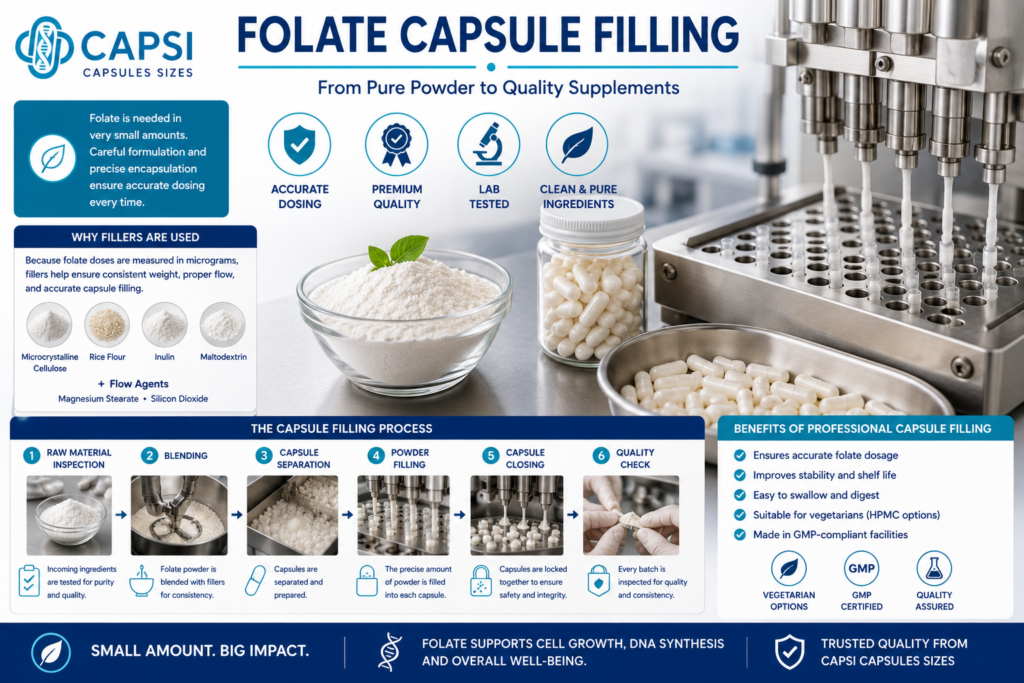
Why Do Folate Capsules Often Contain Fillers?
Since folate dosages are so small, manufacturers typically add fillers to improve manufacturing consistency.
Common fillers include:
- Microcrystalline cellulose
- Rice flour
- Inulin
- Maltodextrin
- Calcium carbonate
Flow agents may also be added:
- Magnesium stearate
- Silicon dioxide
Without these ingredients, accurately filling thousands of capsules with tiny amounts of folate would be extremely difficult.
Folate vs Folic Acid
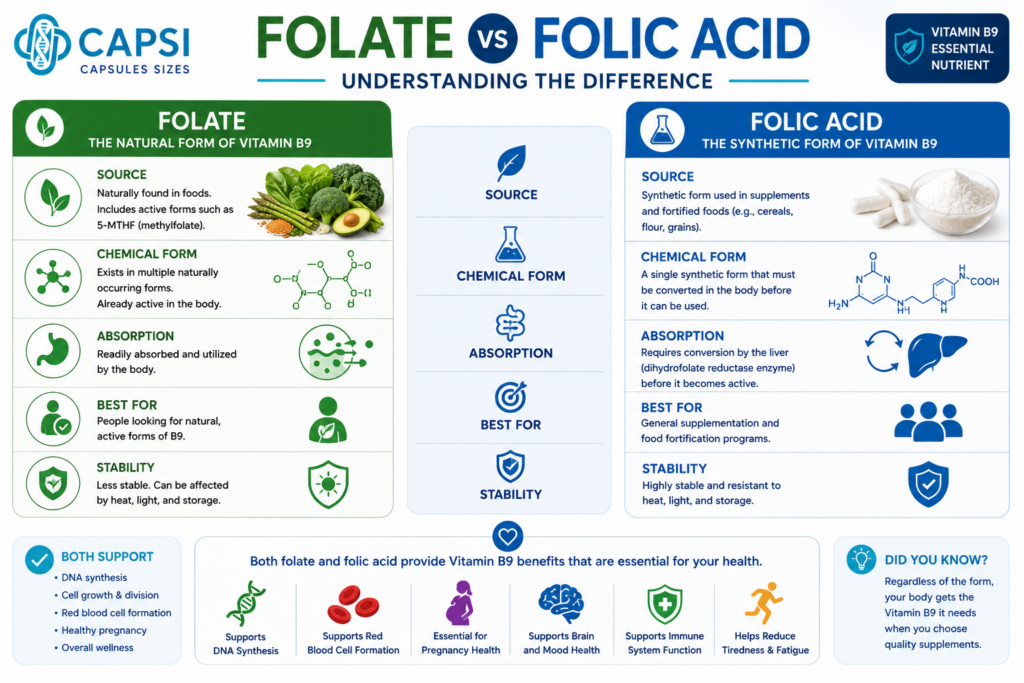
Although the terms are often used interchangeably, there are differences.
Folate
- Naturally occurring Vitamin B9
- Found in foods
- Includes active forms such as methylfolate
Folic Acid
- Synthetic form of Vitamin B9
- Commonly used in supplements
- Highly stable
- Widely used in food fortification
From a capsule sizing perspective, both folate and folic acid require virtually identical capsule sizes because the dosages are extremely small.
Folate in Prenatal Supplements
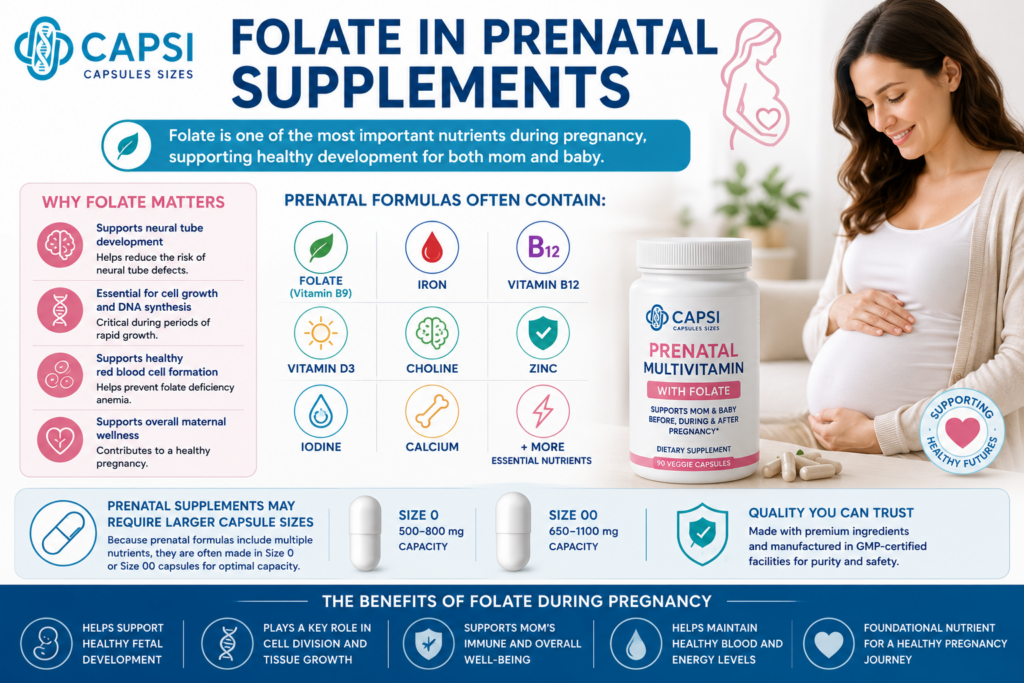
Folate is one of the most important ingredients in prenatal nutrition products.
Prenatal formulas frequently contain:
- Folate
- Iron
- Vitamin D3
- Vitamin B12
- Choline
- Iodine
- Zinc
Because of these additional ingredients, prenatal supplements often require:
- Size 0 capsules
- Size 00 capsules
- Multiple capsules per serving
The larger capsule size is usually due to the accompanying nutrients rather than the folate itself.
Can Folate Be Combined With Other Ingredients?
Yes. Folate is commonly paired with:
Folate + Vitamin B12
Popular for energy and red blood cell support.
Recommended capsule size:
- Size 4 or Size 3
Folate + Iron
Frequently used in women’s health supplements.
Recommended capsule size:
- Size 2 to Size 0
Folate + Choline
Common in prenatal formulations.
Recommended capsule size:
- Size 0 or Size 00
Folate + Complete B Complex
Contains multiple B vitamins.
Recommended capsule size:
- Size 2 or Size 1
Example Capsule Formulations
Basic Folate Capsule
- Folate: 400 mcg
- Microcrystalline cellulose: 150 mg
Recommended size:
- Size 4
Folate and B12 Formula
- Folate: 400 mcg
- Vitamin B12: 500 mcg
- Cellulose filler: 180 mg
Recommended size:
- Size 4
Prenatal Formula
- Folate: 800 mcg
- Iron: 18 mg
- Choline: 100 mg
- Vitamin D3: 25 mcg
- Additional excipients
Recommended size:
- Size 0 or Size 00
Empty Capsules for Folate Supplements
Both capsule materials work well with folate formulations.
HPMC Capsules
Advantages:
- Vegetarian
- Vegan friendly
- Plant-based
- Suitable for a wide range of consumers
Gelatin Capsules
Advantages:
- Cost-effective
- Widely available
- Easy to fill
- Excellent performance
The choice between gelatin and HPMC generally depends on dietary requirements rather than capsule capacity.
Frequently Asked Questions
What is the best capsule size for folate?
Size 4 capsules are typically the best choice for folate-only supplements.
Can folate fit into a Size 4 capsule?
Yes. Even high-strength folate doses require only a tiny amount of space and fit comfortably into a Size 4 capsule.
Why are folate capsules larger than the active ingredient requires?
Manufacturers add fillers to ensure accurate dosing and reliable capsule filling.
Can I use Size 00 capsules for folate?
Yes, but they are much larger than necessary unless folate is combined with other ingredients.
Is folate measured in milligrams?
Most folate supplements are measured in micrograms (mcg), which are one thousandth of a milligram.
Are HPMC capsules suitable for folate?
Yes. HPMC capsules are commonly used for folate supplements and are suitable for vegetarian and vegan formulations.
Conclusion
Folate is one of the easiest vitamins to encapsulate because effective doses are extremely small. A standard folate supplement containing 400 mcg to 1,000 mcg requires only a tiny fraction of a capsule’s capacity, making Size 4 capsules the preferred choice for folate-only products. When folate is combined with other nutrients such as Vitamin B12, iron, choline, or complete prenatal blends, larger capsules such as Size 3, Size 2, Size 1, or Size 0 may become more appropriate.
For most manufacturers, supplement brands, and home encapsulation projects, a small capsule size provides the best balance between capacity, consumer comfort, and ease of swallowing.