
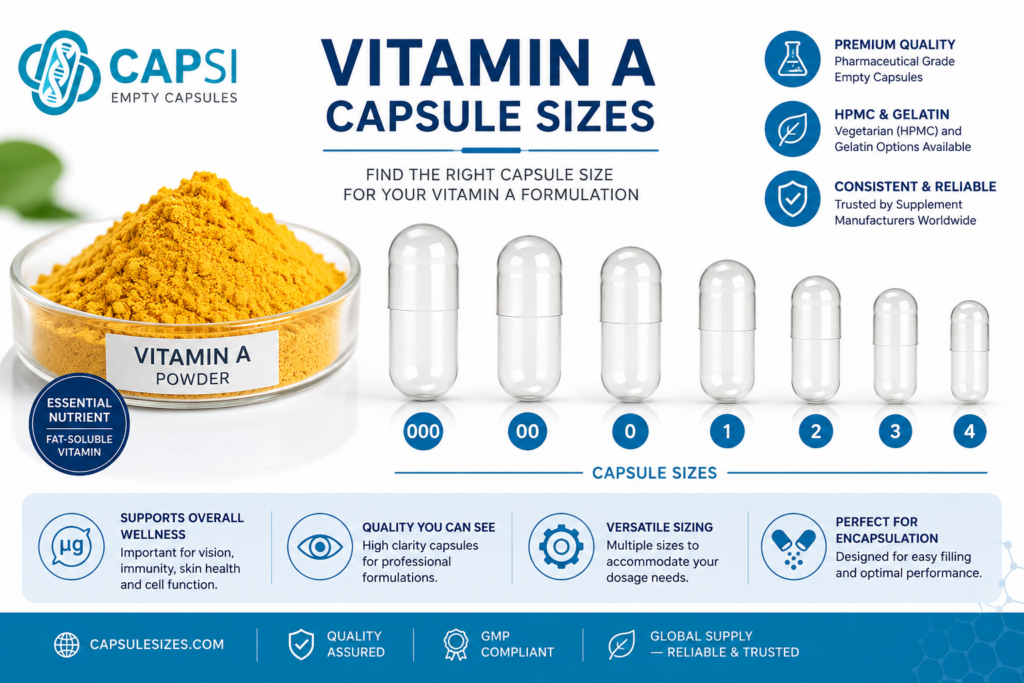
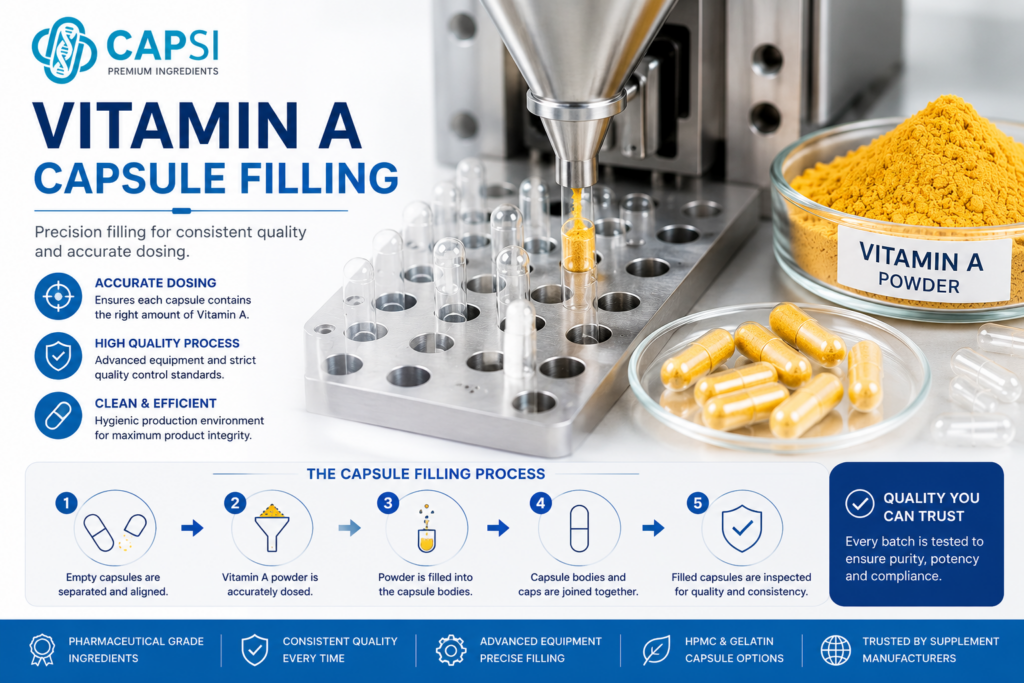
Vitamin A is an essential fat-soluble vitamin commonly used in dietary supplements, multivitamins, eye health formulations, skin health products, and immune support blends. When encapsulating Vitamin A powder, selecting the correct capsule size is important to ensure the desired dosage fits comfortably within the capsule.
This guide explains typical Vitamin A powder densities, estimated capsule capacities, recommended capsule sizes, and factors that affect how much Vitamin A can fit into an empty capsule.
What Is Vitamin A?
Vitamin A refers to a group of compounds including:
- Retinol
- Retinyl Acetate
- Retinyl Palmitate
- Beta-Carotene (Vitamin A precursor)
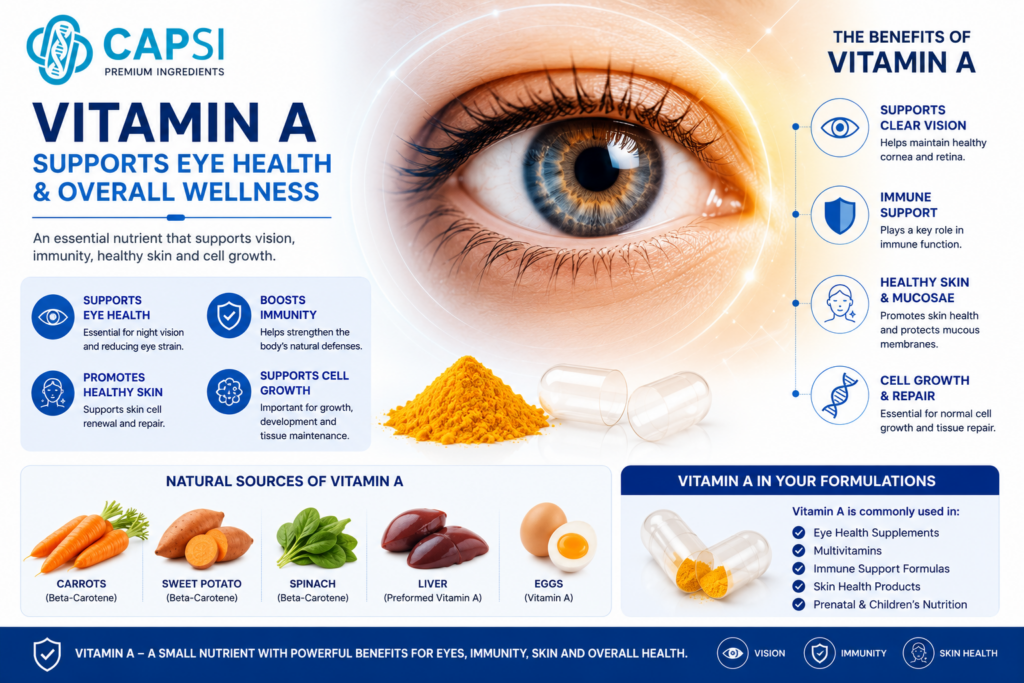
Vitamin A is widely used in supplements that support:
- Vision and eye health
- Immune system function
- Skin health
- Cell growth and development
- Antioxidant support
Most Vitamin A supplements contain relatively small dosages measured in micrograms (mcg) or International Units (IU), meaning capsule size is usually determined by the carrier material rather than the Vitamin A itself.
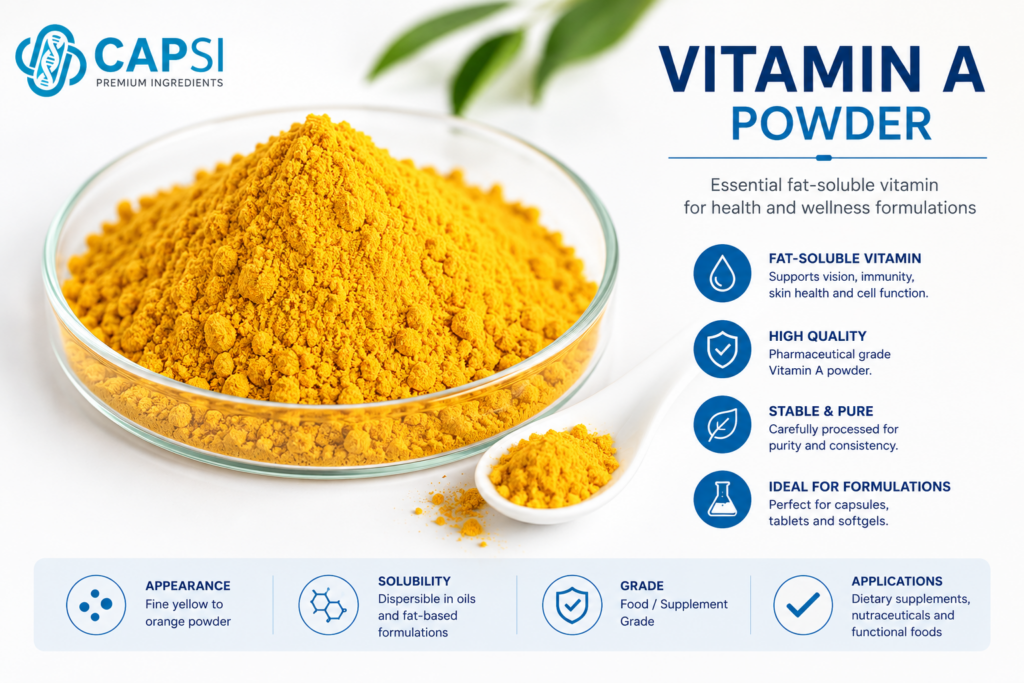
Common Vitamin A Dosages
Typical supplement strengths include:
| Vitamin A Strength | Equivalent IU |
|---|---|
| 300 mcg | 1,000 IU |
| 600 mcg | 2,000 IU |
| 900 mcg | 3,000 IU |
| 1,500 mcg | 5,000 IU |
| 3,000 mcg | 10,000 IU |
Because these quantities are extremely small, Vitamin A is often blended with carriers such as:
- Maltodextrin
- Microcrystalline Cellulose
- Rice Flour
- Silica
- Starch
Vitamin A Powder Density
The exact density depends on the form and carrier system used.
Typical bulk density:
| Powder Type | Approximate Density |
|---|---|
| Pure Vitamin A concentrate | Very low dosage |
| Vitamin A with carrier | 0.40–0.70 g/ml |
| Multivitamin blend containing Vitamin A | 0.50–0.80 g/ml |
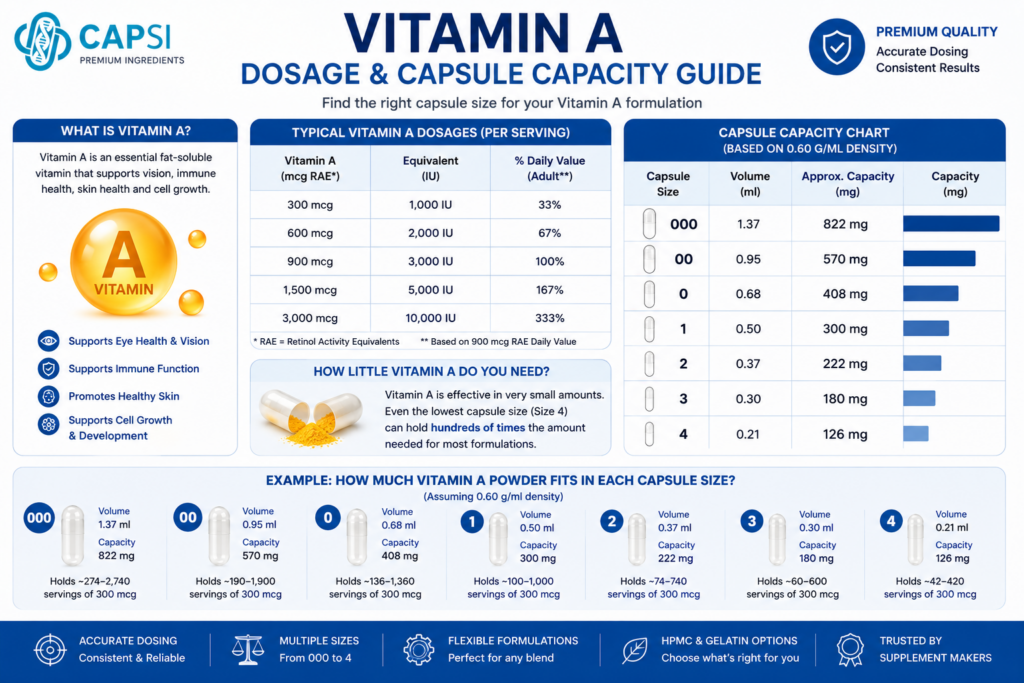
For sizing calculations, a density of 0.60 g/ml is often a reasonable estimate.
Capsule Size Capacity Chart for Vitamin A Powder
| Capsule Size | Volume (ml) | Approx Capacity at 0.60 g/ml |
|---|---|---|
| 000 | 1.37 ml | 822 mg |
| 00 | 0.95 ml | 570 mg |
| 0 | 0.68 ml | 408 mg |
| 1 | 0.50 ml | 300 mg |
| 2 | 0.37 ml | 222 mg |
| 3 | 0.30 ml | 180 mg |
| 4 | 0.21 ml | 126 mg |
Since Vitamin A dosages are usually very small, even a size 4 capsule can hold many times the required amount.
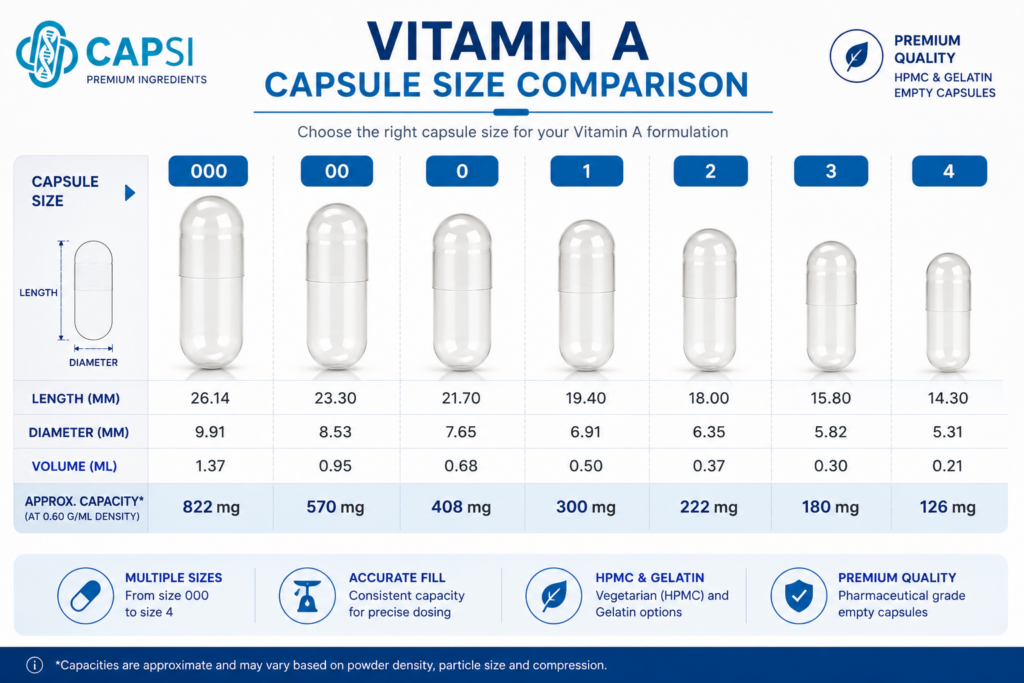
Recommended Capsule Sizes
Size 4 Capsules
Best for:
- Low-dose Vitamin A supplements
- Vitamin A and D combinations
- Compact formulations
Approximate fill capacity:
- 126 mg
Size 3 Capsules
Best for:
- Standard Vitamin A products
- Small multivitamin blends
Approximate fill capacity:
- 180 mg
Size 2 Capsules
Best for:
- Vitamin A mixed with additional nutrients
- Eye health formulations
Approximate fill capacity:
- 222 mg
Size 1 Capsules
Best for:
- Larger vitamin blends
- Combined antioxidant formulas
Approximate fill capacity:
- 300 mg
Size 0 Capsules
Best for:
- Multivitamin formulations
- High-fill nutritional blends
Approximate fill capacity:
- 408 mg
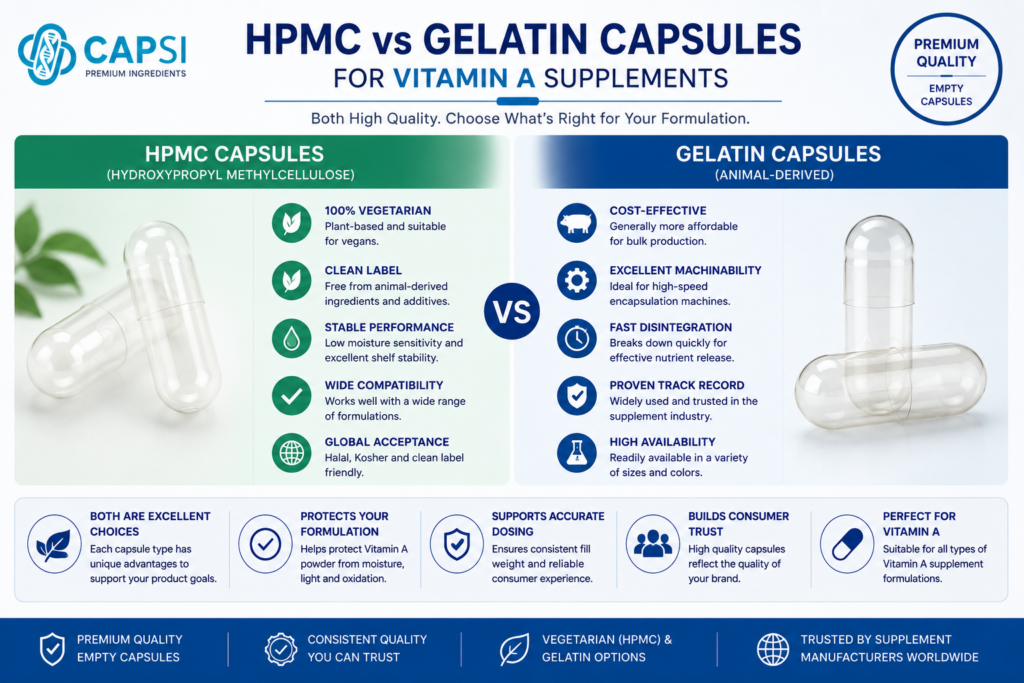
HPMC vs Gelatin Capsules for Vitamin A
HPMC Capsules
Advantages:
- Vegetarian and vegan friendly
- Suitable for halal and kosher applications
- Stable across varying humidity conditions
- Plant-based formulation
Gelatin Capsules
Advantages:
- Cost-effective
- Excellent machinability
- Fast disintegration
- Widely used in commercial manufacturing
Both capsule types are suitable for Vitamin A powders.
Factors Affecting Capsule Fill Weight
Actual fill weights depend on:
Powder Density
Dense powders fit more material into the same capsule.
Particle Size
Fine powders often pack more efficiently.
Carrier Ingredients
Many Vitamin A ingredients are diluted with carriers, significantly increasing volume requirements.
Manufacturing Method
Machine-filled capsules typically achieve higher and more consistent fill weights than hand-filled capsules.
Vitamin A in Multivitamin Formulas
Vitamin A is rarely encapsulated alone.
It is commonly combined with:
- Vitamin D3
- Vitamin E
- Vitamin K2
- Zinc
- Selenium
- Copper
- B-Complex Vitamins
In these cases, capsule size is determined by the total blend rather than the Vitamin A content itself.
Which Capsule Size Is Best for Vitamin A?
| Application | Recommended Capsule Size |
|---|---|
| Low-dose Vitamin A | Size 4 |
| Vitamin A with carriers | Size 3 |
| Eye health blends | Size 2 |
| Multivitamin formulas | Size 1 |
| Large nutrient blends | Size 0 |
For most standalone Vitamin A powder formulations, Size 3 or Size 4 capsules are usually sufficient. When Vitamin A is included within broader nutritional blends, Size 1 or Size 0 capsules are often preferred.
Frequently Asked Questions
Can Vitamin A fit into a size 4 capsule?
Yes. Typical Vitamin A dosages are very small, and a size 4 capsule usually provides more than enough capacity.
Is Vitamin A usually sold as a powder?
Yes. Supplement manufacturers commonly use spray-dried Vitamin A powders blended with carrier ingredients to improve handling and stability.
Which capsule size is most common for Vitamin A supplements?
Size 3 and Size 4 capsules are common for standalone Vitamin A products, while Size 0 and Size 1 are often used for multivitamin blends.
Do HPMC capsules work with Vitamin A powder?
Yes. HPMC capsules are widely used for Vitamin A supplements and are suitable for vegetarian and vegan formulations.
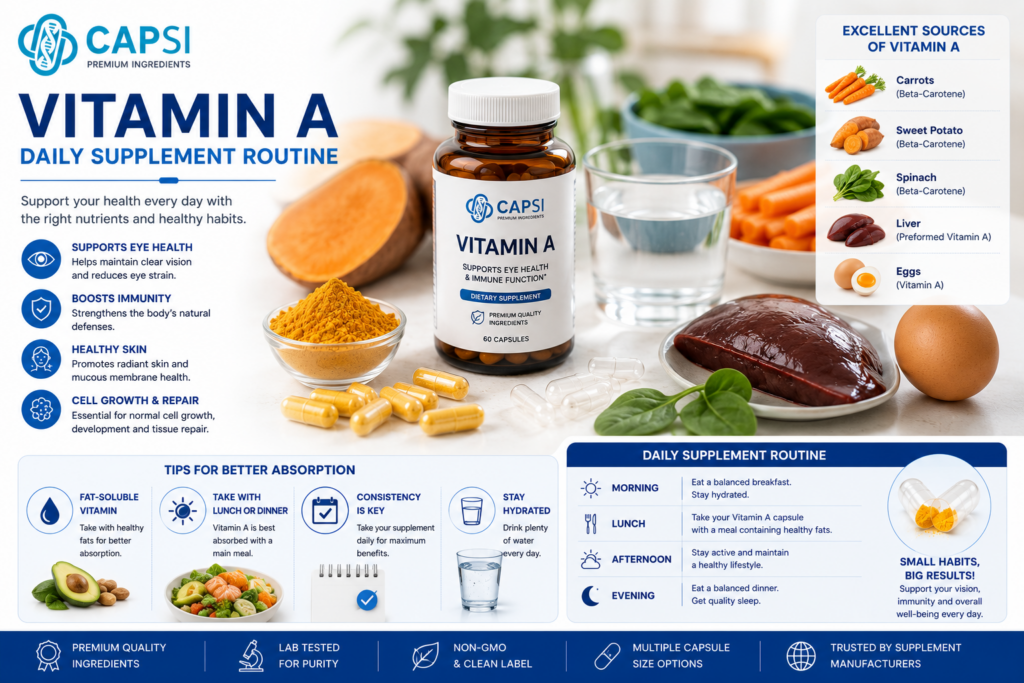
Conclusion
Vitamin A requires only a very small amount of active ingredient, meaning capsule sizing is usually driven by the carrier materials and any additional nutrients included in the formulation. For most Vitamin A supplements, Size 3 and Size 4 capsules provide ample capacity, while larger sizes such as Size 1 and Size 0 are ideal for multivitamin and eye-health blends. Choosing the correct capsule size helps optimize manufacturing efficiency, consumer experience, and supplement presentation.